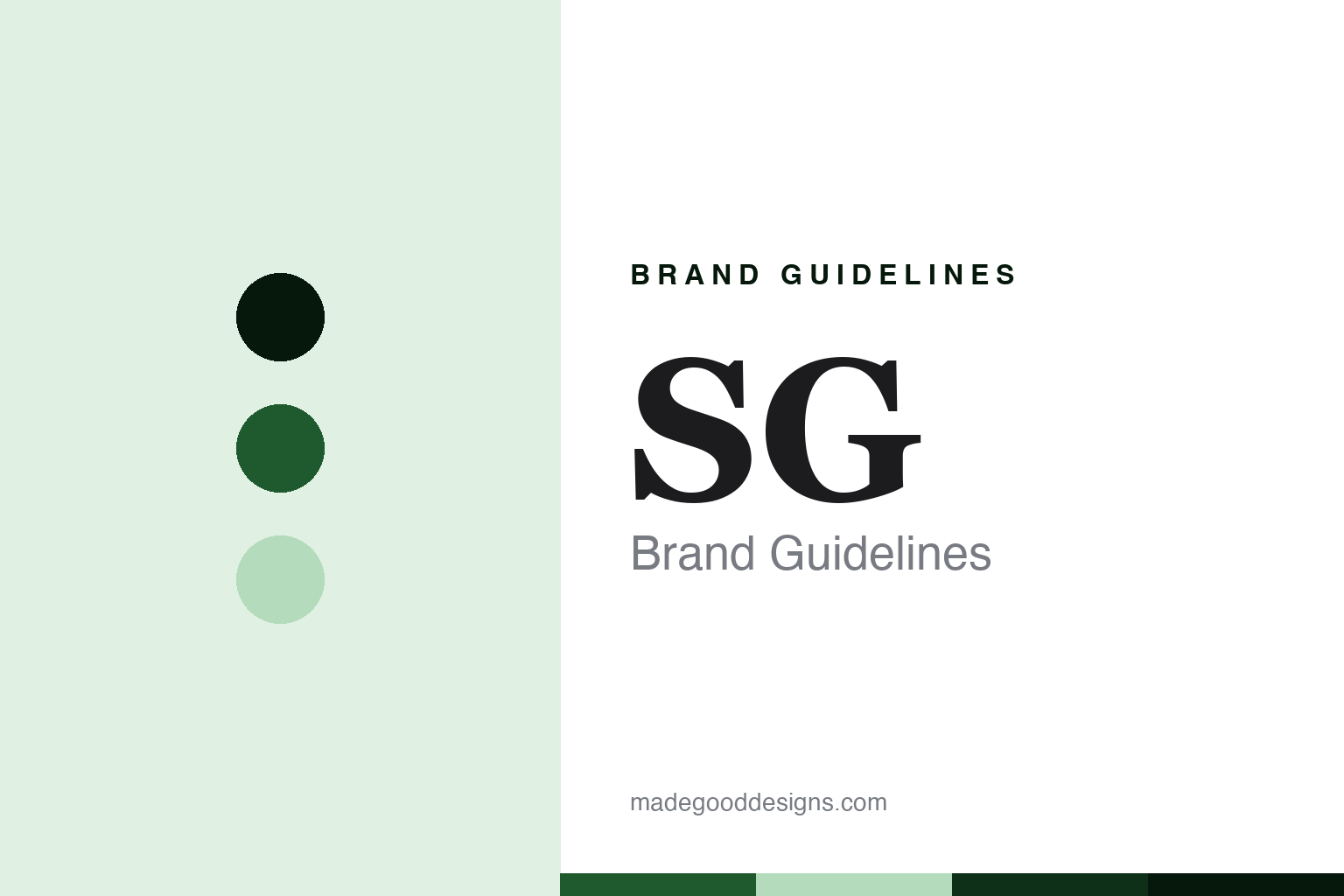
SG Brand Guidelines
From Sialkot to every Test in India.
Aa
Two constants: a Greenland-green palette and a heritage-serif register. Abstract homage — not an SG product or mark; no bat, ball or logo is reproduced.
Two stitching machines and a dozen people
SG began in a city that is now in Pakistan, and restarted from almost nothing in one that is in India.
The fullest account of SG’s origins comes from a 2012 profile in the Indian newspaper Mint. “SG began life in a small manufacturing unit in Sialkot in 1931, when brothers Dwarkanath and Kedarnath Anand decided to diversify the family leather business into manufacturing and exporting sports gear.” By the Second World War the unit employed about 250 people; a member of the family recalled exports worth fourteen or fifteen lakh rupees.
Then came Partition. In 1947, the same account says, part of the family was on holiday in Kashmir and was told to go to Amritsar rather than back to Sialkot, which became part of Pakistan. They never went back to Sialkot. After moving through Amritsar, Delhi, Mathura and Agra, they restarted in Meerut in 1950 “with two stitching machines and a dozen employees to make footballs and other leather sporting goods.” The business they left behind in Sialkot, a later profile notes, was called Sanspareils Co.
The name itself is French — sans pareil, without equal — though we found no SG source explaining it, nor any explaining “Greenlands.” The company records give the other half of the date story: the operating company, Sanspareils Greenlands Private Limited, was incorporated on 25 May 1979 and is registered at Victoria Park, Meerut. The brand is from 1931; the legal entity is from 1979.
Colour
For decades SG made sports goods for other people’s brands. Its own name came later.
This round is about the bat behind the sticker, and SG lived on the other side of that sticker for a generation. In the 1950s and 1960s, Mint reported, the family made goods for foreign brands and had no brand of its own. It launched the Featherlite protective-gear name in 1972, and only in 1982 began selling bats, pads, gloves and balls under its own name. A second unit followed in 1983.
The habit has not entirely gone. In 2015 The Cricket Monthly reported that SG made bats for international brands but would not say which. It described the company then as having about a thousand workers and two factories, and said it handcrafted more than 350,000 bats a year. In 2012, Mint found a board in the new Meerut unit reading “Today’s production 1,417 bats,” and quoted the company’s Wasi Ullah Khan: “No international player will play with a machine-made bat.”
Its own name arrived with a famous innings: in 1987 Sunil Gavaskar reached 10,000 Test runs with an SG bat. The company sells both English-willow and Kashmir-willow bats as separate ranges. English willow is grown largely in the eastern counties of England; Kashmir willow in the valley of Kashmir, whose 2000 Willow Act bars unprocessed clefts from leaving the territory.
Meerut sits at the end of that supply line, sometimes literally. In December 2023 officials seized 6,150 willow clefts at the Lakhanpur toll plaza, on the road out of Jammu and Kashmir, “bound for Meerut.” In July 2026 the region’s High Court quashed the confiscation — not because the clefts were lawful, but because the procedure for seizing them had lapsed when the old state’s forest law was repealed in 2019 — and told the government that if it was serious about the Act, “it should rise to the occasion.” Meerut itself, its district industries centre reports, now has 9,720 sports-related small businesses with a turnover of about ₹1,852 crore in 2025–26. SG is one name in a city full of bat makers.
Typography
Since 1994, every Test match in India has been played with an SG ball. In 2018 India’s captain said what he thought of it.
SG’s most important product is not its bat. In 1992, Mint reported, it became the official ball supplier to India’s cricket board for all domestic matches, and “since 1994, all Test matches in India have been played with SG balls.” In 2012 it was supplying about 2,400 Test balls and 3,000 tournament balls a year to the board.
That makes SG part of the conditions of Test cricket in India — and a target when the conditions are disliked. During the home series against the West Indies in October 2018, India’s captain Virat Kohli said he preferred the English Dukes ball: “To have a ball scuffed up in five overs is something that we haven’t seen before. The quality of the ball used to be quite high before and I don’t understand the reason why it’s gone down.” Ravichandran Ashwin added: “I’m pretty disappointed with the way the SG ball is at this point of time.” In 2021, after a Chennai Test, SG’s Paras Anand pointed to the hard surface, and said that expecting a ball forty to sixty overs old “to behave like a 10-over old ball is not going to happen.”
The exchange shows what a supplier to an entire national format carries. The bat is a choice each player makes; the ball is a choice made for everyone. SG’s name has been on both for three decades.
The bat, meanwhile, is bounded by the same Laws as everyone’s. MCC’s Law 5 says “The blade shall consist solely of wood” and caps it at 10.8 centimetres wide, 6.7 deep, with edges no thicker than four. Every bat in this round, from Meerut to Taunton, is the same regulated object; the differences are in the wood, the hands, and the name on the face.
Aa
A warm heritage serif — confident, slightly old-fashioned, the voice of a family firm. (Specimen set in Fraunces, a serif STAND-IN; NOT the SG logo or products.)
Two letters, one family
The initials carry a French phrase and a Partition story.
The brand is two letters — SG — standing for Sanspareils Greenlands. The company describes itself with a single line: “Since 1931, Sanspareils Greenlands has redefined cricket equipment.” It names Paras Anand as chief executive and Puneet Anand as a director, and the register lists four Anands among its directors. Few brands in this series are still run by the family that founded them ninety-five years earlier.
For a design reader, the lesson is restraint. A long history, a displacement and a national role are all compressed into two initials. That is a very efficient brand — and it explains why SG has never needed to explain its own name.
For this guide we use a Greenland green and a pale outfield tone with a warm heritage serif. These are an unofficial interpretation, not SG’s own colour values, and nothing of its mark is reproduced.
Explore & save
Keep SG’s identity on hand — save it to a board in the Made Good inspiration library.
SG identity set
Pin the Greenland-green palette and the heritage-serif register to your own board.