Mongoose Brand Guidelines
The short blade that shocked a season.
Aa
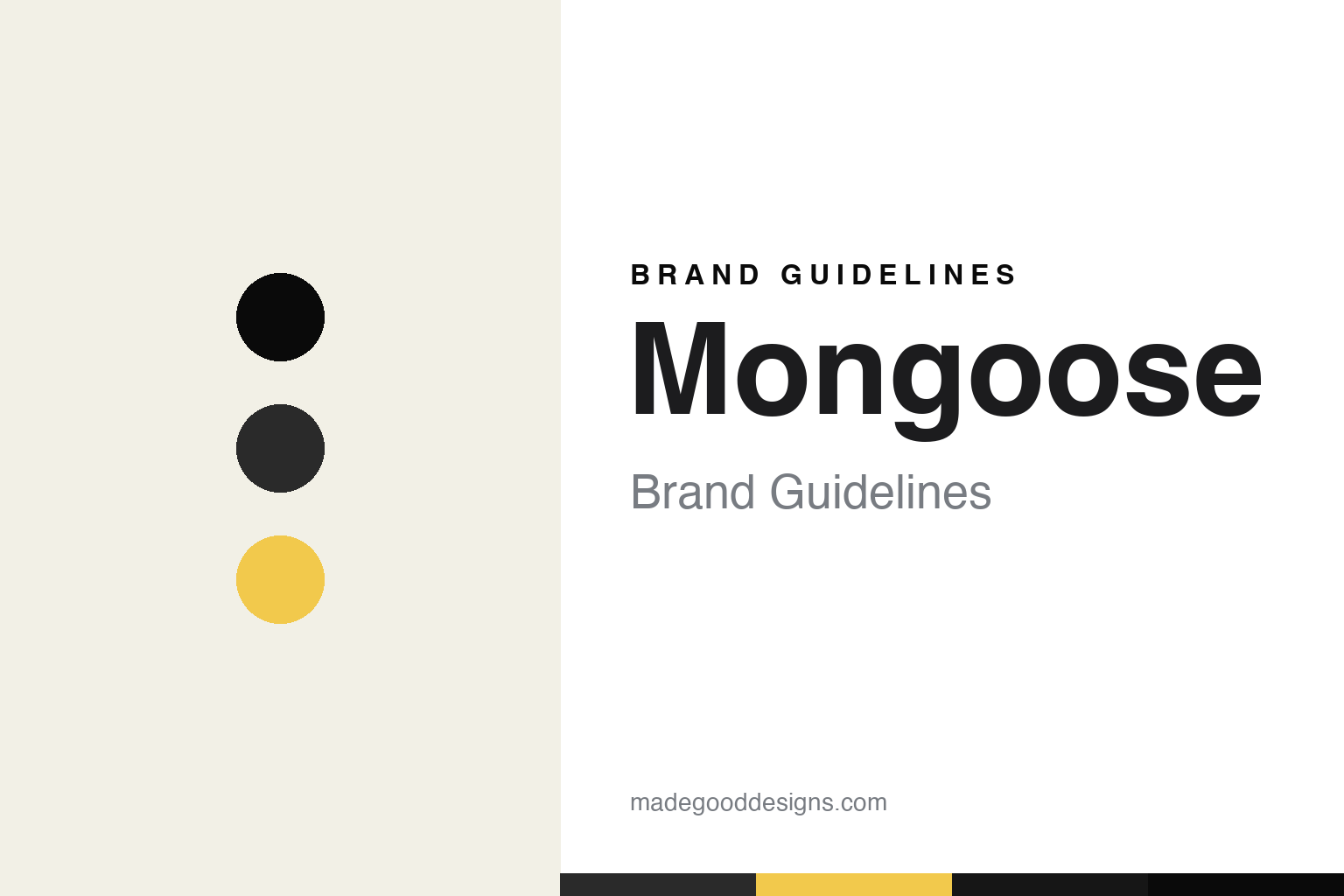
Two constants: a graphite-and-yellow palette and a technical-sans register. Abstract homage — not a Mongoose product or mark; no bat or logo is reproduced.
An idea from a hospital bed
The most radical bat of its era was invented by an advertising executive, not a bat maker.
In September 2009 the Abu Dhabi newspaper The National described how Marcus Codrington Fernandez, then a global creative director at an advertising company, had conceived a new bat while recovering from a stroke, watching old film of Geoffrey Boycott. He had worked on it for about two years. The result, sold as the Mongoose, turned the bat’s proportions upside down: a blade the company said was a third shorter than usual and a handle some forty percent longer, with the splice set up into the handle. Mongoose claimed the design gave “20 per cent more power and 15 per cent added bat speed.” Those figures were the maker’s, and we report them only as claims.
The company behind it, Mongoose Cricket Limited, was incorporated on 13 April 2009 with Fernandez as director. Its launch, according to a later account by a member of its team, was on 22 May 2009, and it sold two models, the MMi3 and the CoR3. Fernandez said that “ensuring the bat was within both the spirit and laws of the game has been amongst our top priorities.”
It had to be. A year earlier, in May 2008, MCC members had voted by 98.6 percent to limit a bat’s handle, including the splice, to 52 percent of its overall length — a rule introduced, Cricinfo reported, to stop “the extra power gained by players when the handles contain substances such as carbon.” Mongoose was designed after that rule, not because of it, and its long handle had to fit inside it; today the Law reads: “Except for bats of size 6 and less, the handle shall not exceed 52% of the overall length of the bat.” The same 2008 change, Cricinfo reported, required that “All manufacturers have to submit their designs to MCC for grading” — which is the formal route by which a new bat design is meant to enter the game. The National reported that the bat had been accepted by MCC; we found no MCC statement of our own, and give that as the newspaper’s report.
Colour
Stuart Law, Dwayne Smith — and Matthew Hayden’s 93 not out.
The bat needed to be seen, and it was. Stuart Law gave it its first outing in May 2009, calling it, according to the blog King Cricket, a “weapon of mass destruction.” In August 2009, The National reported, Dwayne Smith struck 59 off 26 balls for Sussex in the Twenty20 Cup final against Somerset with a Mongoose; the New Zealander Lou Vincent was another early user.
Then came the innings that made the brand famous. On 19 March 2010, at the Feroz Shah Kotla in Delhi, Matthew Hayden made 93 not out off 43 balls for Chennai Super Kings against the Delhi Daredevils, using a Mongoose, and was man of the match as Chennai won by five wickets — an innings Cricinfo’s match report headlined as turning a “big chase into cakewalk.” Hayden later recalled that his captain, MS Dhoni, had asked him not to use it — a recollection we report as his.
Behind the publicity, the business was small. A former member of the team, interviewed by the start-up site Failory, said Mongoose had raised about $300,000 from City investors, spent about $100,000 sponsoring a star for the Indian Premier League, and sold fewer than sixty bats in India. Those figures are his recollection, not audited accounts. They describe a small business behind a very big moment.
Typography
The bats were made by contract workshops — one of them Hunts County.
Mongoose never had its own factory. The same account says its bats were made by contracted makers in Sussex, in Meerut in India, and in Huntingdon by Hunts County — the same workshop that had built the bats for the Woodworm brand a few years before. Mongoose was a design, a name and a sticker; the willow was shaped by others, in workshops whose own names did not appear in the brand’s marketing at all.
The International Cricket Council’s rules allow exactly that. They reserve the face of a bat for the manufacturer’s marks, in the top nine inches, and a brand that markets a bat takes that space whoever made it. The Laws limit such identifications to 0.02 centimetres in thickness. Mongoose’s name, in other words, was the thinnest layer on a bat whose shape was its whole point.
The company did not last. Mongoose Cricket Limited entered administration on 22 June 2011, moved to creditors’ voluntary liquidation that November and was dissolved in August 2014. In March 2018 a press release announced that a consortium called “Mongoose Inclusive Cricket,” led by the recruitment entrepreneur Raj Tulsiani, had bought the brand, “including full intellectual property rights and ownership of existing stock,” and pledged at least 20 percent of profits to community projects. The release listed James Anderson, Matthew Hayden, Andrew Symonds, Marcus Trescothick and Dwayne Smith as having “sported the Mongoose logo” — a claim by the buyers, and one that may refer to kit rather than bats. The community-interest company registered for that venture was itself dissolved in January 2021. An Instagram account carries the name today; who runs it we could not establish.
Aa
A narrow technical sans — engineered, modern, a little aggressive. (Specimen set in Rajdhani, a sans STAND-IN; NOT the Mongoose logo or products.)
A name that bites
A mongoose kills snakes. The brand wanted to kill bowling.
The name was the pitch: a small, fast animal famous for beating a deadlier opponent. Hayden’s 93 was the brand’s proof, and most accounts of Mongoose since begin with it. It is one of the clearest examples in cricket of a brand built on a single performance rather than a heritage — the opposite of the century-old names elsewhere in this series.
The lesson cuts both ways. A radical product and one famous innings made Mongoose instantly recognisable; neither gave it a factory, and the company that owned the name went into administration about fifteen months after that innings. The name passed through two companies and is now, as far as the public record shows, an Instagram handle.
For this guide we use a graphite and a strike yellow with a narrow technical sans. These are an unofficial interpretation — we found no reliable source for Mongoose’s own colours — and nothing of its mark is reproduced.
Explore & save
Keep Mongoose’s identity on hand — save it to a board in the Made Good inspiration library.
Mongoose identity set
Pin the graphite-and-yellow palette and the technical-sans register to your own board.