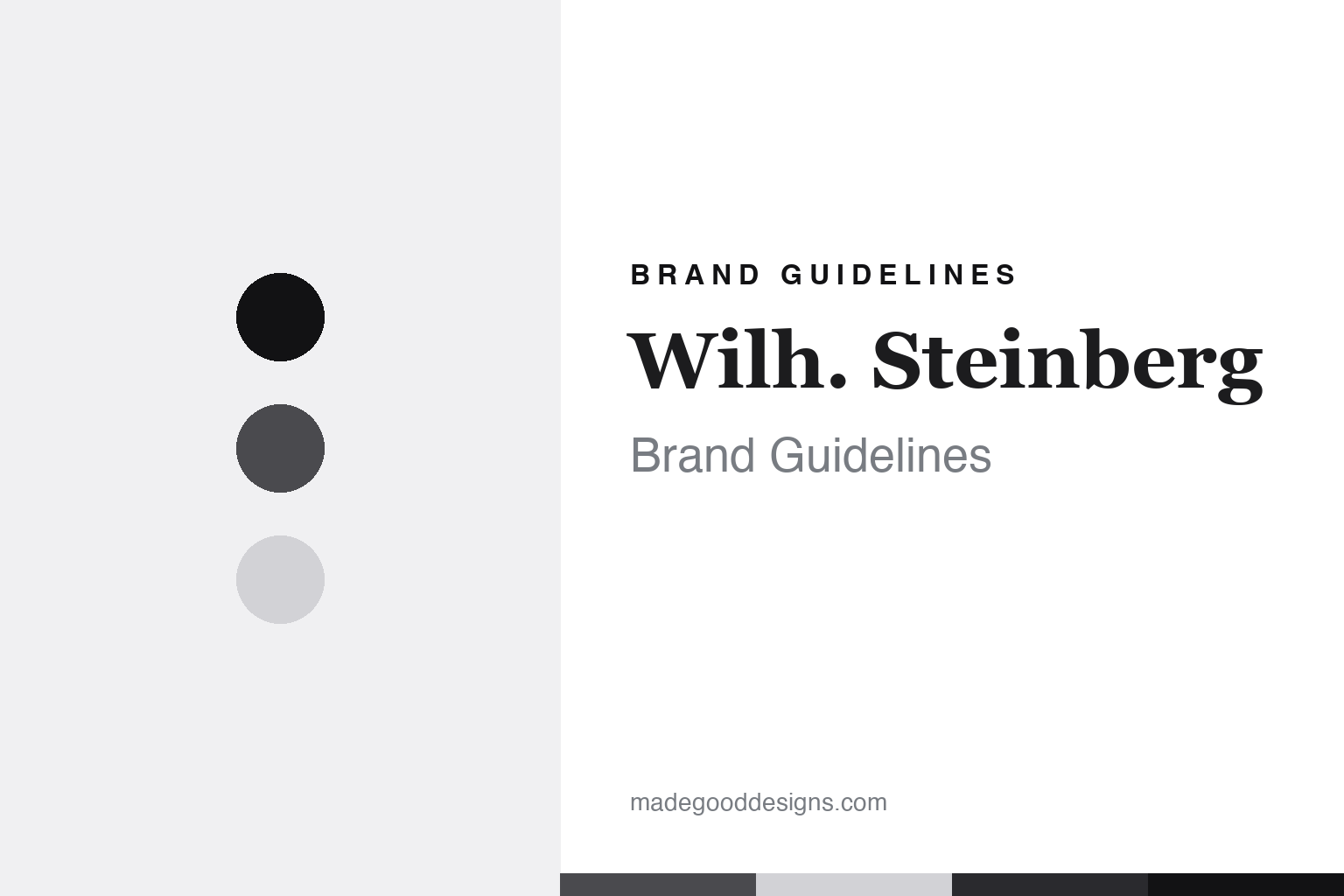
Wilh. Steinberg Brand Guidelines
Eisenberg craft, Hong Kong owner.
Aa
Two constants: a Thuringian-grey palette and a title-case serif register. Abstract homage — not a Wilh. Steinberg product or mark; no piano or wordmark is reproduced.
Adolph Geyer’s factory
There is no Wilhelm Steinberg in the company’s history.
The name on the fallboard is not the name of the founder. Wilh. Steinberg’s history begins with Adolph Geyer, born in 1846, who had learned his trade in America and who, it says, founded his piano factory in Eisenberg, Thuringia, on 2 December 1877. The town became a small centre of the trade; the history also names the Eisenberg makers Weissbrod, from 1884, and Fuchs & Möhr, from 1921, which won a state gold medal in 1925. The company’s homepage puts the continuity simply: “Bereits seit 1877 werden in Eisenberg (Thüringen) Klaviere und Flügel in Handarbeit hergestellt. Die Firma WILH. STEINBERG setzt diese lange Klavierbautradition am gleichen Standort fort.” Pianos have been handmade in Eisenberg since 1877, and Wilh. Steinberg continues that tradition on the same site.
Under East Germany, the factory became the state-owned VEB Pianofabrik Eisenberg in 1948. German Wikipedia puts its size at about 200 staff and 7,000 instruments a year, much of it for export. The “Steinberg” name appears in the company’s own history only after reunification, with a “Wilh. Steinberg AG” in January 1993. The firm’s own history and German Wikipedia give different accounts of the 1990s — the history describes an investor, Helmut Altmeyer, Wikipedia an insolvency and a new start by a Cologne dealer — and we do not try to reconcile them.
The present company, Thüringer Pianoforte GmbH, was registered at the court in Jena in 2006, and its address is Mozartstraße 3, Eisenberg. Its imprint names its representative as Terence Ng.
Colour
“WILH. STEINBERG is Part of the Parsons Music Group.”
Terence Ng is a founder, with his sister Arling, of Parsons Music, the Hong Kong group that began as a music shop in 1986 and now builds pianos in China on a large scale. Wilh. Steinberg says so plainly: “WILH. STEINBERG ist Teil der Parsons Music Group.” Piano Buyer reported in 2016 that Parsons had bought “the Wilhelm Steinberg company” about two years before it took a stake in Grotrian in 2015; German Wikipedia says Parsons first took a stake in 2008 and full control in the summer of 2013. Parsons describes itself as one of the three largest piano manufacturers in the world. In 2023 the Chinese newspaper People’s Daily reported that its upright factory at Yichang made about 70,000 pianos a year — “one out of every seven pianos in the world,” in the paper’s phrase. Piano Buyer put Wilh. Steinberg’s output at about 500 uprights and 50 grands a year — a figure dwarfed by its owner’s Chinese factories.
Ownership shapes the range. The company sells two lines. The Signature line, it says, has a Renner action, Renner hammerheads, Röslau string wire and a soundboard of Sitka spruce, and its instruments “are meticulously crafted by our experienced piano technicians in Eisenberg.” The line runs from the S-212 and S-188 grands to the S-130, S-125 and S-117 uprights, and the S-117 is described as “Our smallest made in Germany piano.” Piano Buyer reported that the Signature grands’ cabinets were supplied by Parsons.
The Performance line, “aimed at the ambitious beginner,” is described differently: it has German hammerheads by Abel or Renner and Röslau wire, and it undergoes “extensive tonal and technical treatment by our experienced piano technicians in Eisenberg.” We read all 27 pages of the company’s site. It never says where the Performance pianos are built. Piano Buyer did: it described the series as “entirely made by Parsons Music in China using Thüringer designs.”
Typography
Not on the seal list, in 2015 or in 2026.
Wilh. Steinberg appears on neither version of the German makers’ seal list that we read. The Bundesverband Klavier (BVK) certifies only brands made “zu 100 % in Deutschland”; its 2015 list and its 2026 list both omit Steinberg, and the company is not among the association’s members. The BVK’s rule is framed by brand — “Marken” — rather than by model line. We do not know whether Steinberg has ever applied, and we draw no conclusion from its absence.
The difference between the two lines lies in a phrase. “Crafted… in Eisenberg” describes the Signature pianos; “treatment… in Eisenberg” describes the Performance pianos. Both sentences are true to what the company says, and both place German craftsmen in the story; only the first places the making there. Piano Buyer’s summary of the BVK’s rules lists the steps that make a piano “German” — gluing the soundboard, fitting the iron plate, stringing, casing, regulating, tuning and voicing. “Tonal and technical treatment” suggests the finishing steps near the end of that list — regulating, tuning and voicing — rather than the building steps at its start.
Steinberg is not unusual in this. Across the German trade, old names have survived by joining larger groups: Grotrian and Steinberg under Parsons, Schimmel under Pearl River, Seiler under Samick, Rönisch under Blüthner. It is also sold by other German makers: Pfeiffer, itself a certified brand, lists Wilh. Steinberg among the makes it represents as a dealer.
Aa
A plain title-case serif — a name with an abbreviation and a full stop. (Specimen set in Fraunces, a serif STAND-IN; NOT the Wilh. Steinberg wordmark.)
Wilh. Steinberg
An abbreviation and a full stop — the look of an old firm.
The wordmark is a dark-grey serif in title case, “Wilh. Steinberg,” with no symbol. The abbreviated first name and its full stop are the typographic signature of a nineteenth-century German firm — “Wilh.” for Wilhelm, as on old company signs and letterheads. For a name that, by the company’s own history, came into use in the 1990s, it is a deliberate borrowing of an older look. The name now stretches further than pianos: a Parsons-run site sells guitars, electronic drums and headphones under the Wilh. Steinberg brand.
That is a common move in piano branding, and it works: a buyer reads “Wilh.” and hears a family workshop. The company’s honest anchor is the place, not the name. Its homepage leads with Eisenberg and 1877, and the history it publishes is the history of a town’s factory under several names. The strongest claim the brand can make is that pianos are still made on the same site — for one of its two lines.
For this guide we use a Thuringian grey and a pale grey with a title-case serif. These are an unofficial interpretation, not the company’s colour values, and nothing of its wordmark is reproduced.
Explore & save
Keep Wilh. Steinberg’s identity on hand — save it to a board in the Made Good inspiration library.
Wilh. Steinberg identity set
Pin the Thuringian-grey palette and the title-case serif register to your own board.