Rönisch Brand Guidelines
A Dresden name, made by Blüthner.
Aa
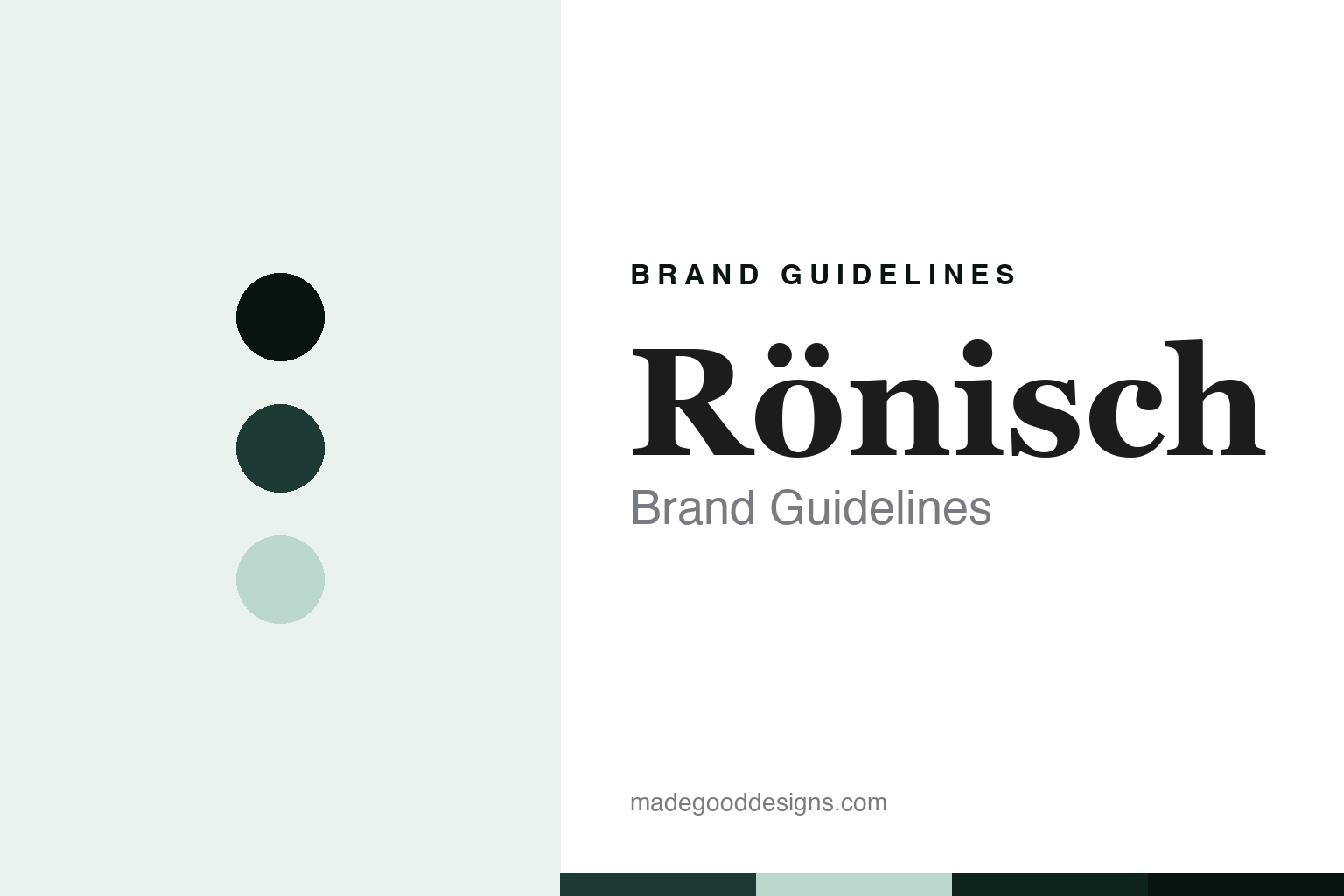
Two constants: a Saxon-green palette and a capital-serif register. Abstract homage — not a Rönisch product or mark; no piano, roundel or wordmark is reproduced.
A Dresden workshop on Palmstraße
Rönisch was a Dresden name for a century.
Carl Rönisch, born in 1814 in Goldberg, Silesia, began building pianos in 1845 in a small workshop on Palmstraße in Dresden, the company’s history says. The firm grew quickly in the Saxon capital. Rönisch says it was named purveyor to the Saxon court in 1859, and to the courts of Sweden-Norway in 1890 and Austria-Hungary in 1901 — its claims, which we report as such. It says it introduced a full iron frame, the “Voll-Panzerplatte,” in 1866. A branch factory opened in St Petersburg in 1898 and was lost in the Russian Revolution.
The company’s history is rich in famous instruments, and it tells them with relish. Rönisch says Sergei Rachmaninoff owned a Rönisch grand, number 59183, on which he composed his Third Piano Concerto in 1909, and that it stands today in the museum at Ivanovka, his family estate. It says a concert grand, number 8461, won first prize at the Melbourne exhibition of 1888 and is now in a keyboard collection at the Australian National University in Canberra. And it says it shipped 862 instruments to the British colonies in 1882 and 1883. These are the company’s accounts.
Those exports belong to a bigger story. Saxon pianos sold so well abroad in the late nineteenth century that the English writer Ernest Edwin Williams made them a target of his 1896 polemic “Made in Germany.” “Your piano may bear an English name and address,” he wrote, “and, the Merchandise Marks Act notwithstanding, be English in little besides… they are the product of — not the Old Kent Road but — the Saxon Vogtland.” By his own figures, German piano exports had risen from £740,000 in 1886 to £1,054,000 ten years later. Rönisch, by its own account, was exporting under its own name in those same years.
In 1918 the family’s Hermann Rönisch sold the firm to Ludwig Hupfeld of Leipzig, the maker of player pianos, and Rönisch became a branch of Ludwig Hupfeld AG. A Dresden name now belonged to a Leipzig company — the first of the brand’s changes of owner, and not the last.
Colour
Bombed in Dresden. “Werk 1” of the combine. Then Blüthner.
The Dresden factory was destroyed in February 1945, the company says, and production moved to Hupfeld’s undamaged works in Böhlitz-Ehrenberg, on the edge of Leipzig. The first post-war Rönisch was shown at the Leipzig Spring Fair in 1948. In 1967 the brand became part of the East German state combine VEB Deutsche Piano-Union Leipzig, in which the Rönisch plant was “Werk 1.” By 1986, Rönisch says, the union’s 13 plants made 21,000 uprights a year — the “largest piano producer in Europe,” in its words.
After reunification, in 1990, Werk 1 became the Leipziger Pianofortefabrik GmbH; Piano Buyer says the brand was “privately owned again in the 1990s.” Then, in 2009, came what Rönisch calls a “Vereinigung” — a union — with the Julius Blüthner Pianofortefabrik. Piano Buyer put it more plainly: “In 2009… Blüthner purchased the Rönisch and Hupfeld brands.” A new company, Carl Rönisch Pianofortemanufaktur GmbH, moved into Blüthner’s factory at Großpösna, outside Leipzig.
The register records the rest. The German trade-mark register lists the word mark “Rönisch” for Julius Blüthner Pianofortefabrik GmbH from 2021, and North Data’s summary of the commercial register shows a merger of the Rönisch company with Blüthner’s published in July 2023. The German piano makers’ association still lists the two at the same Großpösna address and telephone number.
Typography
“Made by Blüthner” — and on the seal list twice.
Blüthner’s own site uses a careful set of labels for the brands it owns. In its menu, Rönisch appears as “Rönisch made by Blüthner,” and its page says “Rönisch instruments are handmade under the strict quality control of the Blüthner family.” Blüthner’s more affordable house line, Haessler — named, Blüthner says, as “a tribute to Dr. Rudolf Blüthner-Haessler” — is likewise “made by Blüthner.” A third brand, Irmler, is labelled differently: “designed by Blüthner.” The difference of one word is the whole story of where each is made.
Rönisch’s place is confirmed by the trade seal. The Bundesverband Klavier (BVK), the German makers’ association, certifies only brands made “zu 100 % in Deutschland,” and its 2026 list carries two Rönisch marks: “Rönisch” and “Carl Rönisch.” Both were also on its archived list of 2015. Piano Buyer described Rönisch in 2019 as “entirely made in Germany,” with rims, beams and cabinets supplied by Blüthner, and put production at about 600 uprights and 300 grands a year — figures that are now several years old.
So a Dresden brand of 1845, made in or near Leipzig since 1945, is now built in a Leipzig family firm’s factory and certified as fully German-made. Its owners have changed several times; the region where it is made has not.
Aa
A classical capital serif — the lettering of a nameboard. (Specimen set in Fraunces, a serif STAND-IN; NOT the Rönisch logo.)
Rönisch seit 1845
Two marks: a serif wordmark and a wheel-shaped roundel.
Rönisch uses two marks, matching its two certified names. The main one is a serif capital wordmark, “RÖNISCH,” with “seit 1845” beneath, in black. The second, for the “Carl Rönisch” line, is a circular roundel: a spoked wheel, shaped like a ship’s helm, enclosing the words “CARL RÖNISCH · 1845.” The company launched a Carl Rönisch Edition in 2012, it says. Its website header also links to Hupfeld, the other old Leipzig name that Blüthner bought in 2009.
The identity is quietly historical. Like Thürmer’s “seit 1834,” the line “seit 1845” asserts continuity across a war, a state combine and several owners — a claim about a name and a craft, not about a single unbroken company. It leans on the founder’s name and the founding year rather than on Blüthner, whose name appears in the menu label rather than on the nameboard. For a design guide, Rönisch is a clean example of a second brand inside a family group: distinct enough to have its own heritage and marks, close enough to share a factory, a place on the seal list and an address.
For this guide we use a Saxon green and a pale celadon with a capital serif. These are an unofficial interpretation, not Rönisch’s colour values, and nothing of its roundel or wordmark is reproduced.
Explore & save
Keep Rönisch’s identity on hand — save it to a board in the Made Good inspiration library.
Rönisch identity set
Pin the Saxon-green palette and the capital-serif register to your own board.