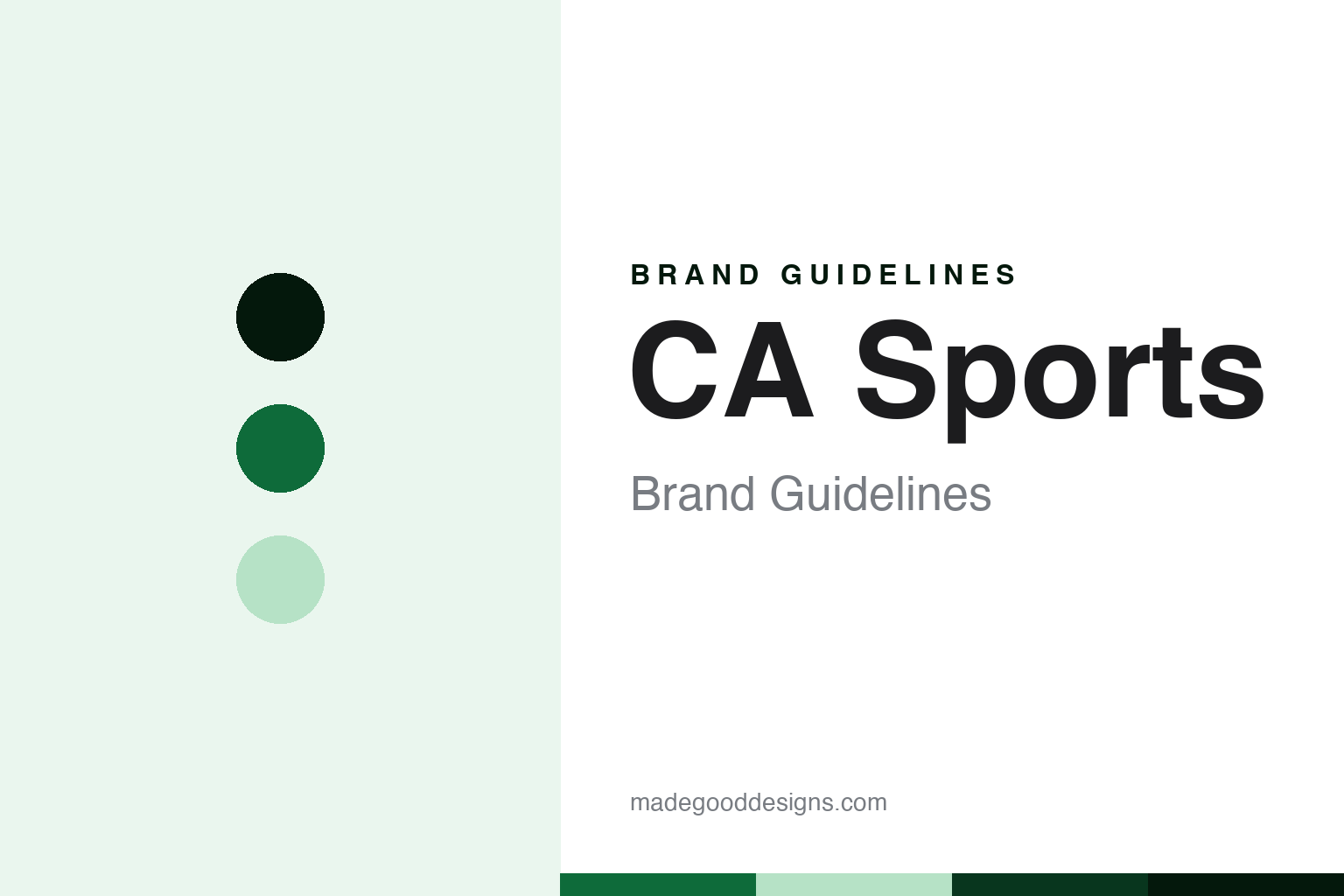
CA Sports Brand Guidelines
Two initials from a racket workshop.
Aa
Two constants: a Sialkot-green palette and a heavy-grotesque register. Abstract homage — not a CA product or mark; no bat, sticker or logo is reproduced.
Initials, not an acronym
“CA” is two people, not two words.
The letters on CA’s bats are a family record. The company was founded in 1958 in Sialkot, in Pakistan’s Punjab, by Charaghdin, and its name, the company says, is made of “the initials of Charaghdin and Abdulrasheed, symbolizing the shared legacy of the first two generations” — the founder and his son, Abdul Rasheed. The Express Tribune, profiling the company in 2015, gave the same account. It is a common origin for a South Asian sports brand, and an easily misread one: the letters are names, not an abbreviation of anything.
CA did not begin with cricket. It began, according to both the Tribune and Dawn, with wooden lawn-tennis rackets. Dawn’s 2015 account says the firm first tried bats in 1965, stopped after about four years, and returned to them when graphite rackets, from the mid-1970s, undercut the wooden-racket trade; the Tribune says it had started making cricket bats by 1978. The details differ, but the shape is clear: a racket workshop that turned to bats when its first product became obsolete.
By 2015 the company was run by the founder’s grandson, Zahid Javed, who told the papers its story. The company trades today as CA Pro (Pvt.) Ltd, from Daska Road in Sialkot, and calls its flagship range “CA Pro.” Another Sialkot bat maker, Ihsan, founded a year earlier, gives an address on the same road.
Colour
Tape-ball bats by the hundred thousand, and a curve it says it made first.
The Tribune’s 2015 visit described a factory of about 500 workers, with a three-tonne roller press for compressing blades and a station for stamping logos. It put output at “40,000 to 45,000 regular bats every year and up to 500,000 tape ball bats.” The second number is the more revealing. Tape-ball cricket — played on streets and open ground with a tennis ball wrapped in electrical tape — is the everyday game of Pakistan, and Javed told the paper: “CA is the pioneer in tape ball bats.” The wood for those bats, he said, came from Mansehra, Peshawar, Abbottabad and Rawalakot, and the bats were sold only in Pakistan and Bangladesh.
Javed made a larger claim to Dawn: “The curve-shaped bats we see in today’s cricket were first produced by CA in 1979.” He also said that the owner of the English maker Gray-Nicolls had once visited to ask, “How do you give curve to the bat?” These are his accounts, and we report them as such; the history of the bat’s shape has many claimants.
For its proper cricket bats, the Tribune noted, “The willow used by CA arrives graded and ready to go to production.” CA sells both English-willow bats and bats in what it calls “Pak Willow.” We found no statement from CA on where its English-willow clefts are grown or cut; we describe it as a maker that sells English-willow bats finished in Sialkot.
That two-willow catalogue is now the game’s central question. In October 2025 the Marylebone Cricket Club, which writes the Laws, held a conference at Lord’s on what it called the “cricket bat emergency” — “a shortage of willow and spiralling prices,” caused, it said, by “the reliance on English willow.” Its answer took effect on 1 October 2026, when a new edition of the Laws legalised laminated bats in open-age cricket, “as part of an attempt to slow the rising costs of bats around the world.” MCC had floated a face of English willow backed by cheaper Kashmir willow “or even other woods.” For a maker that already sells both an English and a local willow, that is a change in the rules about what a proper bat may be made of.
Typography
Saleem Malik first. Babar Azam in 2025.
CA’s first international player, according to Dawn, was Saleem Malik, in 1984. Javed told the paper that Ramiz Raja, Wasim Akram, Saleem Yousuf and Iqbal Qasim followed, and that CA signed Brian Lara in 1997 — his account. The company also says it supplied the Pakistan Cricket Board: Javed said CA held the kit contract for the 2011 World Cup and the 2012 World Twenty20, and the company’s own timeline lists “2014 Pakistan Cricket Team Apparel Sponsor.” That was a deal of the early 2010s; CA is not the board’s current kit supplier.
Its most valuable signing is recent. At the start of 2025, ProPakistani reported that Babar Azam, Pakistan’s leading batter, had left Gray-Nicolls, whose bats he had used since 2020, and signed with CA. Pakistani media reported a fee of about Rs70 million a year; no figure was confirmed by either side, and we treat it as a report. CA’s own site also lists England’s Jason Roy as a 2022 ambassador, with a signature “CA JR20” bat.
CA belongs to an industry town. Sialkot is one of the world’s great sports-goods centres; its footballs are famous, and its industry signed, with the International Labour Organization and UNICEF, the Atlanta Agreement of 14 February 1997, which moved football stitching out of homes and into monitored centres to end child labour. Pakistan’s sports-goods exports were worth $357.9 million in the ten months to April 2026, according to the national statistics bureau as reported by The Nation.
CA
A heavy grotesque — two initials, set large. (Specimen set in Archivo Black, a sans STAND-IN; NOT the CA logo.)
Crafting champions
Two letters and a date.
CA’s taglines lean on time: “Crafting Champions For More Than Six Decades” and “Crafting Cricket Excellence Since 1958.” The mark itself is the two initials, “CA,” extended as “CA Pro” for the top range. Two capital letters work well on a bat: they read from the far end of a ground and fit on the narrow face of a tape-ball bat as easily as on a Test player’s blade.
For a design guide, CA is a reminder that initial-marks often hide people. To a buyer in Melbourne or Manchester, “CA” is a neutral pair of letters; to its own family, it is a founder and his son. The brand keeps that story on its about page rather than on the bat, and the letters do the rest.
For this guide we use a deep green and a pale mint with a heavy grotesque. These are an unofficial interpretation — we did not verify CA’s own colours — and nothing of its logo is reproduced.
Explore & save
Keep CA Sports’s identity on hand — save it to a board in the Made Good inspiration library.
CA Sports identity set
Pin the Sialkot-green palette and the heavy-grotesque register to your own board.