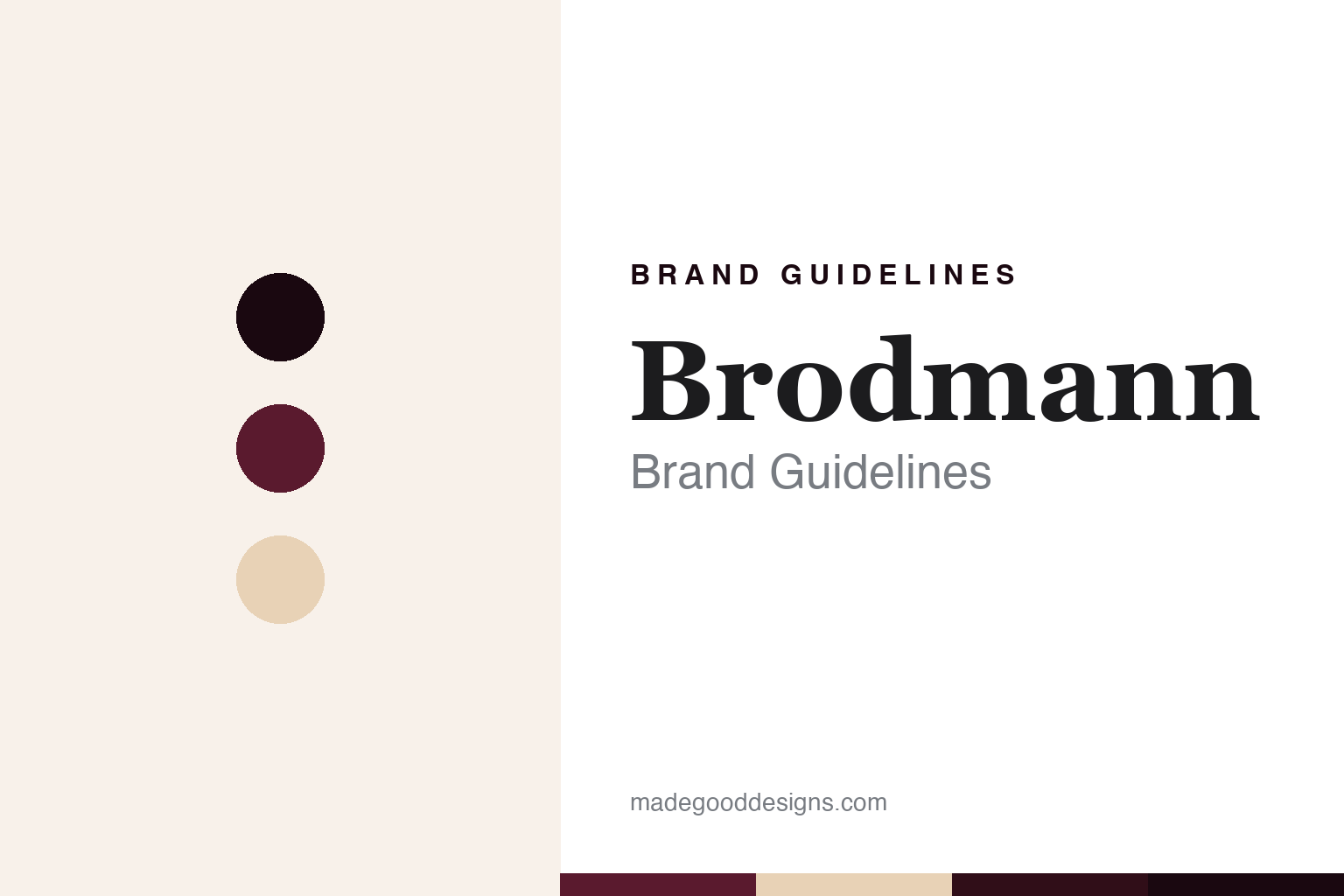
Brodmann Brand Guidelines
Beethoven’s Viennese maker, revived.
Aa
Two constants: a Viennese-burgundy palette and a Biedermeier-serif register. Abstract homage — not a Brodmann product or mark; no piano or logo is reproduced.
A Josephstadt workshop
Joseph Brodmann made pianos in Beethoven’s Vienna.
Joseph Brodmann was born around 1763 in the Eichsfeld region of what was then Prussia, the Austrian music lexicon records, and took the oath of a Vienna citizen in October 1796. By 1803 he had a workshop in the Josephstadt district, at Glacis 40, later renumbered 43. He rose in his trade’s guild — second master in 1812, first master in 1813–14 — and in 1825 patented a three-layered soundboard; the patent expired in 1832. Beethoven and Weber, both the brand and German Wikipedia record, played Brodmann instruments.
His firm’s most important legacy was a successor. “1828 übernahm Bösendorfer die Firma,” the lexicon says — in 1828 Bösendorfer took over the firm. Ignaz Bösendorfer had worked in Brodmann’s workshop, music histories record, and the house that grew from that takeover became one of the most famous piano names in the world. Brodmann himself died in Vienna in 1848. For more than a century and a half after that, his name survived only in museums, instrument collections and histories of Viennese music, and on the surviving instruments that carry his name on their fallboards.
That is the starting point for this guide. Brodmann is a revived name in the full sense: there was no continuous Brodmann company between the nineteenth century and the twenty-first. What returned was the name, the city and the association with Beethoven’s Vienna.
Colour
Bösendorfer executives, a second line, and a restructuring.
The revival came from inside the house that had absorbed the original. Piano Buyer writes: “The modern-day Brodmann company was founded in 2004 by two former Bösendorfer executives. Brodmann, they say, was originally planned as a possible second line for Bösendorfer, but when that company abandoned the idea, the two executives pursued it on their own.” The Vienna news site Vienna.at, in 2013, named one of them: “Christian Höferl, Brodmann-Geschäftsführer – und davor viele Jahre in der Bösendorfer-Chefetage” — managing director, and before that for many years in Bösendorfer’s top management — and dated the company to 2005. We say the mid-2000s.
The same report described the business at its height: about 1,200 pianos a year in 18 models across three classes, made “je nach Klasse in China, Deutschland und Österreich” — in China, Germany or Austria, depending on the class. Then it stumbled. In May 2014 the Austrian press agency reported that the Joseph Brodmann Group, based in Vienna’s Favoriten district, had applied for restructuring under self-administration, with liabilities of about €2 million and an offer of 30 per cent to creditors; the company blamed the collapse of its American market, and admitted booking commission deliveries as sales. Five staff were given notice, and creditors were offered their 30 per cent over two years.
The name survived the restructuring. Piano Buyer: “In 2014, the Vienna-based Brodmann company filed for bankruptcy protection in Austria. However, manufacture and distribution of the Brodmann line continue unchanged.” It names the maker as Parsons Music, of Hong Kong and China, and says American distribution rights are held by Piano Marketing Group. We could not establish who owns the Brodmann name today.
Typography
Why an old name can be used again.
Brodmann’s path illustrates why a heritage name can be taken up at all. Trade-mark rights depend on use. In the United States, a mark is “abandoned” when “its use has been discontinued with intent not to resume such use,” and “Nonuse for 3 consecutive years shall be prima facie evidence of abandonment.” In the European Union, a mark not put to “genuine use” for five years can be revoked — though not, the regulation adds, if “genuine use of the trade mark has been started or resumed” before anyone applies to revoke it. British law adds a further ground: a mark may be revoked if its use makes it “liable to mislead the public, particularly as to the nature, quality or geographical origin” of the goods. A name silent since the 1820s carried no trade-mark rights for anyone; what it carried was history, and history is free to invoke.
What the law polices is the suggestion of a connection. In a 2019 decision on the name of another old German maker, Schiedmayer, the US Trademark Trial and Appeal Board described sellers who buy “unbranded, ‘no-name’ pianos from China” and brand them with the marks of unrelated makers — “known in the industry as ‘stencil pianos’” — and cancelled one such registration because it would “falsely suggest a connection” with the real firm. Brodmann’s modern founders had a stronger claim to the name than most: they came from Bösendorfer, the house that took over Brodmann’s firm.
Piano Buyer’s 2022 survey listed Brodmann among the “foreign-owned companies that own factories in China or contract with Chinese manufacturers to make pianos for the U.S. market.” The phrase is broad; it does not say every Brodmann model has always been made in China, and the company’s own 2013 account described three production countries.
Aa
A Biedermeier serif — the lettering of Vienna around 1820. (Specimen set in Cormorant Garamond, a serif STAND-IN; NOT the Brodmann logo.)
Vienna-based Brodmann
A city in the brand line, and a sound in the copy.
The brand’s American site leads with a place: “Vienna-based Brodmann continues the legacy with three lines.” It describes “the distinctive and highly valued Brodmann sound, which is both dynamic and natural,” and lists European components — Strunz soundboards, Röslau wire, a “treble bell.” It does not state a country of manufacture. Its identity, in short, is Viennese; its factory, on Piano Buyer’s account, is not. The house that absorbed the original firm, Bösendorfer, has itself been owned since 2008 by Japan’s Yamaha — a reminder that in the piano trade even the most Viennese names now sit inside international groups.
For a design guide, Brodmann is the clearest example of a revived name in this round: a historical maker with a real connection to Beethoven and Bösendorfer, a modern company set up by people from the house that absorbed the original, and a product built by a large Asian group. Each layer is genuine; the brand’s task is to say which layer a buyer is paying for.
For this guide we use a burgundy and a pale gold with a Biedermeier-flavoured serif. These are an unofficial interpretation, not Brodmann’s colour values, and nothing of its logo is reproduced.
Explore & save
Keep Brodmann’s identity on hand — save it to a board in the Made Good inspiration library.
Brodmann identity set
Pin the Viennese-burgundy palette and the Biedermeier-serif register to your own board.