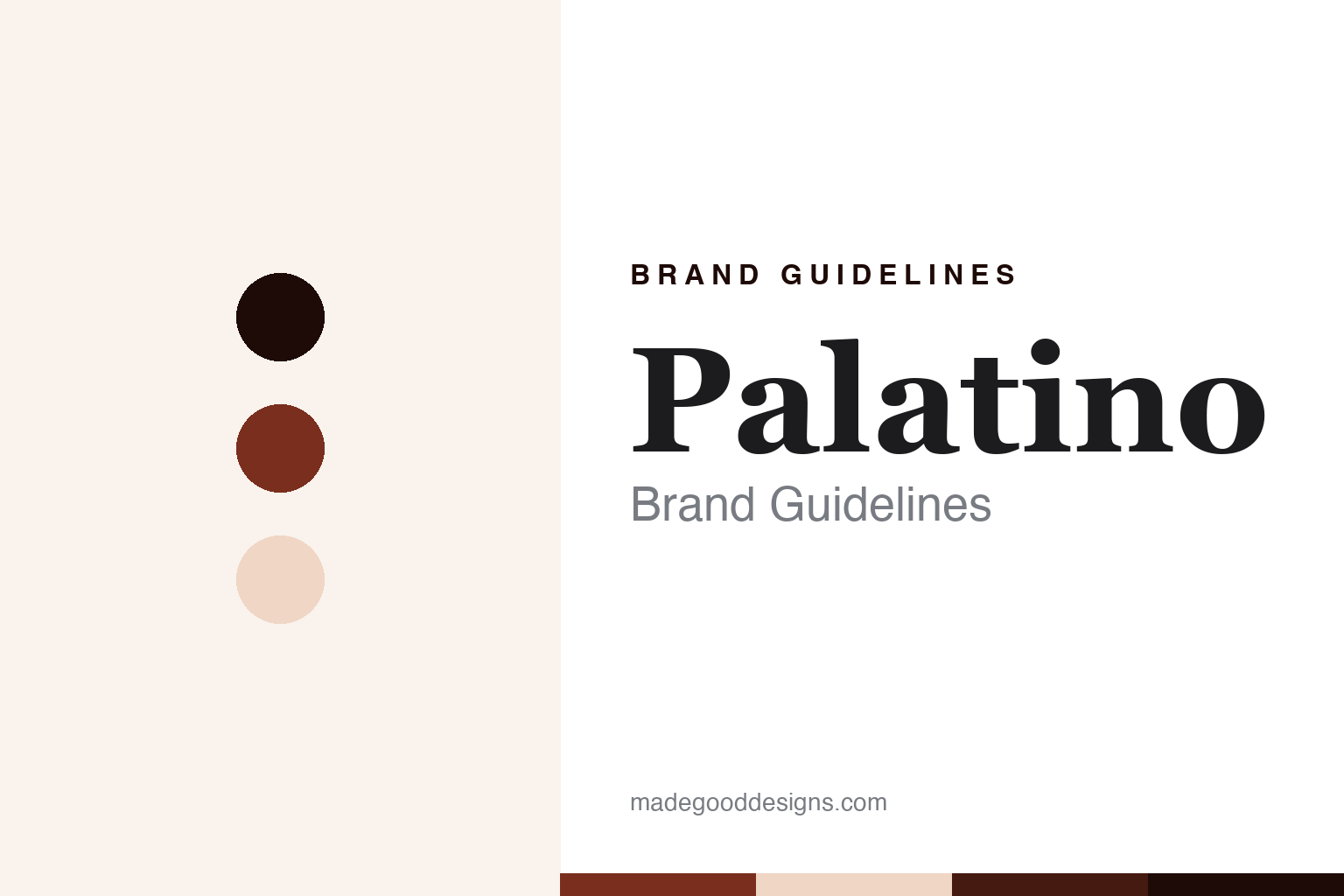
Palatino Brand Guidelines
An Italian-sounding name from a California company.
Aa
Two constants: a Palatine-red palette and a Roman-serif register. Abstract homage — not a Palatino or AXL product or mark; no piano or logo is reproduced.
AXL’s piano division
Palatino is a line of a larger instrument company.
Palatino is a brand of AXL, an American musical-instrument company based in Hayward, in the San Francisco Bay Area. AXL’s own description, in an archived copy of its website from 2025, is direct: “Sales, Marketing, and Administration offices are located in Hayward, CA, USA, with our manufacturing hub centered in China.” It says it ships to 136 countries, describes itself as “a leading OEM builder” — that is, a maker of instruments for other companies’ brands as well as its own — and lists its brands: Recording King, Loar, Palatino, Guardian, Savannah and Lucida, among others. Several are old American instrument names put back into use — Recording King was a house brand of the Montgomery Ward catalogue in the 1930s, and Loar recalls Lloyd Loar, the Gibson engineer of the 1920s — so the company is practised in giving its Chinese-made instruments names with a history. AXL says it ships from warehouses in Shanghai; older versions of its site listed further brands, among them VHT, Koloa, Aisling and Jambone. “The Palatino division encompasses vertical and grand pianos and benches, stringed instruments, brass, woodwinds, bags and cases, parts and accessories.”
Piano Buyer’s 2022 survey of the American market listed “AXL (Palatino brand)” among the “foreign-owned companies that own factories in China or contract with Chinese manufacturers to make pianos for the U.S. market.” That wording does not say which of the two AXL does, and we do not either. What the record supports is the outline: an American-based company, a Chinese manufacturing base, and a range in which pianos sit beside violins and trumpets — a catalogue built for breadth rather than a single specialist workshop.
Palatino is the thinnest record in this round, and we say so plainly at the outset. Piano Buyer has no current brand profile for it; AXL’s live website was unreachable when we checked; and Palatino’s own US website, when we read it, listed strings, brass, woodwinds and bows but no pianos. That is one reading of one site on one day, and we do not say the pianos have been discontinued.
Colour
A dealer’s account.
Most of what is published about Palatino pianos comes from dealers. One, Cordogan’s, in the Chicago area, says “The Palatino factory is located in Shanghai, China,” that it first uncrated a Palatino “back in 2002,” and that the company had begun building pianos in 2000 after “making string instruments for many decades.” It lists Röslau wire from Germany, Mapes strings, Japanese Toyo machinery and German CNC routers.
The same dealer says the keyboards and solid spruce soundboards come from “Palatino’s mother country of Italy.” We report that as the dealer’s claim. AXL describes itself as Californian with a Chinese manufacturing hub, and we found nothing from AXL or Palatino that describes Italy as the brand’s home. The Italian-sounding name, in other words, has encouraged an Italian story that the owner’s own description does not tell.
That is the central point of this guide. Palatino is a well-chosen name — Italian, classical, easy to say — attached to instruments that, on the owner’s account, come from China. Nothing in that is improper. But it shows how readily a name can carry an origin that the product does not have, and why the owner’s own description, rather than a dealer’s, is the one to rely on.
Typography
The tariff line.
A piano from a Chinese manufacturing hub sits on a particular line in the US tariff schedule. Upright and grand pianos carry a general duty of 4.7 per cent (headings 9201.10 and 9201.20). When the US Trade Representative published “List 4A” of Chinese goods on 20 August 2019 — a list for products where China supplied less than 75 per cent of American imports — all three piano subheadings were on it. The extra duty rose to 15 per cent from September 2019 and was cut to 7.5 per cent from 14 February 2020; the 2026 schedule still carries it.
For a company like AXL, which also sells guitars, the tariff map is uneven: guitars went on a later list reserved for products where China dominated American imports. Further duties imposed on Chinese goods in 2025 under emergency powers were ended by executive order in February 2026, and a 2026 trade action covering sixty economies, China among them, is in force; we do not attempt a combined rate.
The piano trade has long worked this way. UN Comtrade data show China supplying 5.9 per cent of the value of upright pianos imported into the United States in 2023 — about $3 million, or 1,169 instruments — down from 12.1 per cent, or 3,060 instruments, in 2018, while Japan supplied 58.4 per cent and Indonesia 25.7 per cent; for grand pianos, China’s share was 4.2 per cent in 2023. A 1999 US International Trade Commission study had already found that pianos from Japan, Korea, China and Indonesia made up 93 per cent of American piano imports by quantity, and that “U.S. producers are major importers, buying foreign-produced pianos to complement their product lines.”
Aa
A Roman serif — a name that sounds like a Roman hill. (Specimen set in Cormorant Garamond, a serif STAND-IN; NOT the Palatino logo, and not the Palatino typeface.)
Palatino
A name designers already know — for something else.
For designers, the name Palatino means something else first: the typeface Hermann Zapf drew around 1950, named after the Palatine Hill in Rome. The piano brand shares the name, not the typeface, and nothing here suggests any connection. The coincidence is useful all the same, because it shows why the name works: it evokes Rome, classicism and craft before a buyer knows anything about the product.
For a design guide, Palatino is a lesson in where to look for a brand’s truth. The name points to Italy; the dealer’s copy follows it there; the owner’s own description points to California and China. When the three disagree, the owner’s statement is the one to trust — and the absence of an owner’s statement about the factory itself is the gap a buyer should ask about.
For this guide we use a Palatine red and a travertine with a Roman serif. These are an unofficial interpretation, not the brand’s colour values, and nothing of its logo is reproduced.
Explore & save
Keep Palatino’s identity on hand — save it to a board in the Made Good inspiration library.
Palatino identity set
Pin the Palatine-red palette and the Roman-serif register to your own board.