Orgelbau Klais Brand Guidelines
A life for the organ.
Aa
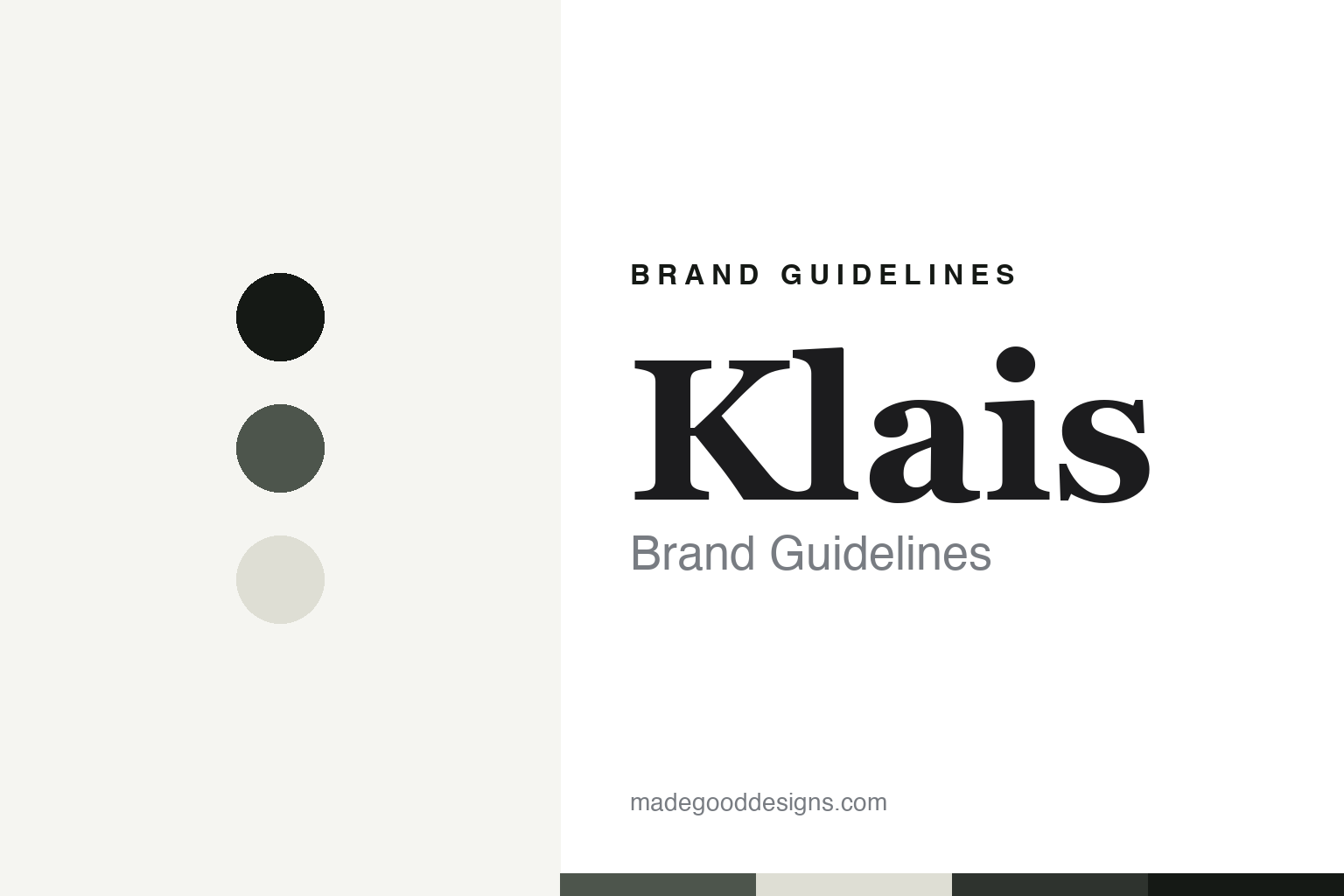
Two constants: a Klais grey-green and stone palette and a Rhineland serif register. Abstract homage — not a Klais product or mark; no instrument, logo or nameplate is reproduced.
A family under the workshop roof
Klais has been in Bonn since 1882, and on the same street since 1896.
Orgelbau Klais was founded in Bonn in 1882 by Johannes Klais (1852–1925), who had trained in Alsace, Switzerland and southern Germany. Its own account of the family is plain: four generations, each running the firm in turn. Johannes was followed by his son Hans Klais (1890–1965), who led the workshop from 1925; Hans Gerd Klais ran it from 1965 to 1995; and since 1995 it has been led by Philipp Klais, the founder’s great-grandson, born in 1967.
The address has barely moved. Klais describes its Kölnstraße building as “Werkstatt und Wohnhaus seit 1896” — workshop and home since 1896 — and says “Die Familie wohnt und arbeitet unter dem Dach der Werkstatt”: the family lives and works under the workshop’s roof. Hans Gerd Klais, who ran the firm for thirty years, died in 2026, at the age of ninety-five or ninety-six.
Early on, the firm made a technical name for itself. Klais says Johannes and his son Hans introduced electric action — electrical connections between the keys and the valves under the pipes — in 1906, when most organs still relied on mechanical or pneumatic linkages. A family firm, in other words, but not a conservative one: the household that lives above the shop was wiring its instruments by 1906.
Colour
Every part made in Bonn.
The company is Johannes Klais Orgelbau GmbH & Co. KG, registered at the Bonn court, with Philipp Klais and Johannes Zurnieden as managing directors. It is family-run; we did not check the shareholdings beyond that. The German-language Wikipedia gives it 43 employees in 2024 and puts exports at about 40 per cent of its work, and the business writer Hermann Simon counts it among Germany’s “Hidden Champions” — his term for little-known firms that lead a world market in a narrow niche.
Its biggest recent commission shows how much stays in-house. For the Elbphilharmonie in Hamburg, opened in 2017, Klais built an organ of 4,765 pipes, 380 of them wooden, for the hall on Hamburg’s harbour, and the hall’s own media notes say “Each individual part was manufactured in Bonn.” That is the firm’s answer to where its organs are made: in one building, by a few dozen people, for halls on several continents.
Its concert-hall list reads like an atlas: Kyoto Concert Hall (1995, 90 stops and 7,155 pipes), Symphony Hall in Birmingham (2001), the National Centre for the Performing Arts in Beijing (2007) and the Petronas Philharmonic Hall in Kuala Lumpur among them. For readers in Singapore, the nearest is the Esplanade Concert Hall, whose Klais organ of 61 stops and 4,740 pipes was installed in 2002, when the arts centre opened on Marina Bay. Closer to home, Klais has built several organs for Cologne Cathedral, and its website recently announced the inauguration of a new Marian organ there under the headline “Aller guten Dinge sind drei” — all good things come in threes.
Typography
A craft with a heritage listing.
Klais’s home country has given its trade rare recognition. In December 2017 UNESCO inscribed “Organ craftsmanship and music” in Germany on its Representative List of the Intangible Cultural Heritage of Humanity. UNESCO’s summary begins: “Organ craftsmanship and music has shaped Germany’s musical landscape and instrument-making for centuries.” It says there are “400 medium-sized craftspeople’s establishments in Germany, which guarantee its viability and transmission, as well as some larger family-owned workshops.” Germany’s nomination added that about 2,800 professional organ builders worked in those workshops and that “Ca. 50,000 organs in Germany are in constant use.”
Klais appears in that file by name. Among the letters of support listed in the nomination are “Signatures expressing support for the nomination by the employees of a representative organ construction workshop (Klais in Bonn).” The nomination also notes that becoming an organ builder takes a three-and-a-half-year apprenticeship, and that about 180 apprentices were learning the trade in Germany at the time. It described the workshops this way: “The majority of these are medium-sized companies with between 6 and 18 employees. There are also some larger workshops of between 30 and 60 persons, some of which are family-owned companies since several generations.” With 43 staff and a fourth-generation family at its head, Klais fits the second sentence exactly. The nomination put the trade’s annual turnover in Germany at about 120 million euros — a small industry by money, and a large one by reach.
The same autumn, on 15 November 2017, the European Union removed pipe organs from the scope of its hazardous-substances directive for electrical equipment, because organ pipes use “a specific type of lead-based alloy, for which no alternative has been found so far,” adding that most pipe organs “are kept in the same place for centuries.” Klais’s restoration work bears that out: in 1973 it shipped the Las Piñas Bamboo Organ from the church of Las Piñas, from the Philippines to Bonn, restored it, and returned it in 1975. According to Wikipedia, Klais also trained local choirboys during the work, who later set up their own workshop.
Aa
A Rhineland serif — a quiet name over a workshop door. (Specimen set in Fraunces, a serif STAND-IN; NOT the Klais logo.)
Klais
A life for the organ.
Klais’s website carries one line in its title and logo text: “Ein Leben für die Orgel” — a life for the organ. The site uses a dark grey-green and a stone grey, with a navy accent, and lets large photographs of organ façades do most of the talking. It is a quiet identity, closer to an architect’s practice than a manufacturer’s, and it suits a firm whose product is built into buildings.
For a design guide, Klais shows a family firm whose strongest brand asset is continuity of place: the same street since 1896, the same surname on the door, and the claim, repeated in its biggest commission, that every part is made in Bonn. The tagline describes a family as much as a company. For a Singapore audience, the Esplanade organ is the simplest way to hear what the brand sounds like. Compare Rieger, which had to rebuild in another country.
For this guide we use a grey-green and a stone tone with a serif, an unofficial interpretation of the website’s colours. No organ, façade design or logo is reproduced.
Explore & save
Keep Orgelbau Klais’s identity on hand — save it to a board in the Made Good inspiration library.
Klais identity set
Pin the Klais grey-green and stone palette and the Rhineland serif register to your own board.