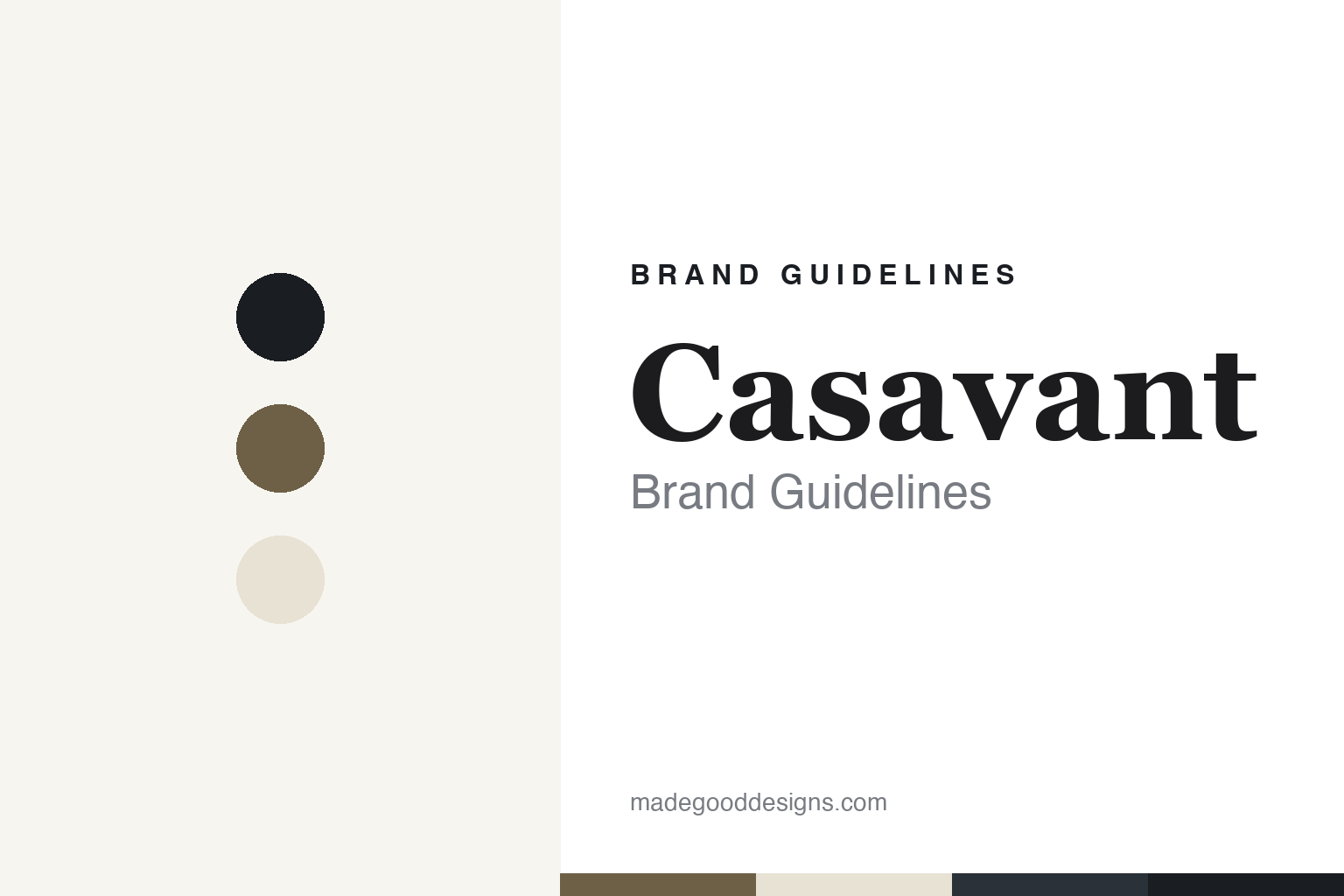
Casavant Frères Brand Guidelines
Two brothers back from France.
Aa
Two constants: a Casavant gold-brown and charcoal palette and a Québécois serif register. Abstract homage — not a Casavant product or mark; no instrument, logo or nameplate is reproduced.
Two brothers back from France
Casavant Frères has built organs in Saint-Hyacinthe since 1879.
Casavant Frères is a pipe-organ builder in Saint-Hyacinthe, Québec, east of Montréal. It was founded by two brothers, Claver Casavant (1855–1933) and Samuel Casavant (1859–1929), sons of Joseph Casavant (1807–1874), whom the company calls “the first organ builder born in Canada.” Claver trained in France, working for the organ builder John Abbey in Versailles in 1878; Samuel joined him, and Casavant says both “spent time with the organ builder Cavaillé-Coll,” the leading French builder of the day.
They came home “in October 1879” and set up Casavant Frères — Casavant Brothers — in Saint-Hyacinthe, on the site of their father’s old workshop on rue Girouard, according to Wikipedia. The company’s address is still on the same street, at 900 Girouard Est. Its Opus 1, in 1880, was for the Notre-Dame-de-Lourdes Chapel in Montréal.
Within a dozen years the brothers had built the instrument that made their name. Casavant’s Opus 26, completed in 1891 for Notre-Dame Basilica in Montréal, had four manuals and 82 stops, with a 32-foot principal in the façade. Casavant calls it “then the second largest pipe organ in North America” and says it “established the international reputation” of the firm. It was dedicated in May 1891 by the organist Frederick Archer.
Colour
Public, private, and in new hands.
The ownership story is not the one the name suggests. In 1919, while both brothers were still alive, the partnership became a stock company, Casavant Frères Limitée, “to ensure the continuity of the firm,” the company says. From 1963 to 1976 it was “transformed into a public company.” Around 1976 the Canadian businessman Bertin Nadeau acquired it and, in Casavant’s words, “once again, the firm is a private company.”
Casavant’s own timeline says that in 2019 “Quebec Entrepreneur and professional musician Simon Tétreault acquires Casavant Frères,” and its team page lists Tétreault as president today, with Alain Goneau as its tonal director — the seventh in the firm’s history, by Casavant’s count. We found no record of the owners between Nadeau and Tétreault, and did not search the Québec business register, so we leave that gap open. The brothers’ family has not run the firm since their deaths in 1929 and 1933.
What has not changed is where the organs are built. “Casavant Frères is still based in Saint-Hyacinthe, where it was founded in 1879,” the company says. Its workshops cover metalwork — “casting, pipe making… preliminary voicing” — woodwork, and “a large assembly room,” and its staff “witness all the different phases of organ building in the same location.” For six years, from 1912 to 1918, it also ran a second workshop in South Haven, Michigan, which built 52 new organs.
Typography
Opus numbers as a record of reach.
Casavant numbers its instruments, and the numbers tell the story. Opus 700, in 1917, went to Emmanuel Church in Boston, with 138 stops — the “then-largest organ in a United States church,” the company says. Opus 1367, in 1930, was a five-manual, 109-stop organ for Metropolitan United in Toronto, then the largest organ in Canada; the same year Casavant won a Grand Prix at the Antwerp International Exhibition. Opus 3750, for Broadway Baptist Church in Fort Worth, Texas, in 1996, is the one it calls its “magnum opus.”
The later numbers reach further. Opus 3900 is the organ of the Maison Symphonique in Montréal (2011), Opus 3899 the organ at the Kennedy Center in Washington (2012), and Opus 3883 the organ for the Grand Theater of Hefei, Casavant’s first in the People’s Republic of China. Wikipedia put the total at “more than 3,900 organs” as of 2014, and Casavant says it has built more than 200 mechanical-action organs since the 1960s. The highest number on its own timeline, Opus 3906, went to Saemoonan Church in Seoul and was installed in 2019; by 1990, it says, it had built 26 new organs for Japan.
The trade it belongs to has been recognised elsewhere. In December 2017 UNESCO added “Organ craftsmanship and music” in Germany to its Representative List of the Intangible Cultural Heritage of Humanity, noting that each instrument “is created specifically for the architectural space in which it will be played.” That describes Casavant’s work too: each opus number is a one-off for a particular room. Germany’s nomination file counted around 2,800 organ builders in 400 workshops there, most with between six and eighteen staff. The same autumn, the EU took pipe organs out of its hazardous-substances directive because their pipes use “a specific type of lead-based alloy, for which no alternative has been found so far,” adding that “Most pipe organs are kept in the same place for centuries.” Casavant’s Opus 26 has been in Notre-Dame Basilica since 1891.
Aa
A Québécois serif — a builder’s name in a church’s colours. (Specimen set in Fraunces, a serif STAND-IN; NOT the Casavant logo.)
Casavant
As you imagined it.
Casavant’s website title is a promise to the client: “As You Imagined it, as You Wished it to be.” Its homepage adds “Sound, Soul, Story” and “The Power to Reunite People… the Strength to Raise Souls.” The site uses a muted gold-brown and a charcoal, with Philosopher and Roboto Slab type — a mix of the decorative and the sturdy that suits a church-organ builder.
The firm has put its name on more than organs. A furniture department ran from 1938 to 1981 and fitted the main courtroom of the Supreme Court of Canada in 1948; a phonograph department sold RCA Victor players between 1919 and 1926. In 2019 it acquired the Vineer Organ Library and Archives in Ottawa. For a design guide, Casavant is a Canadian heritage name, nearly a century and a half old, whose “Frères” has outlived the brothers by nearly a century — the name now stands for a place and a craft rather than a family. Its tagline is written to the client rather than about the firm, which is unusual for a heritage maker: it promises the organ “as you imagined it,” not as Casavant has always made it. Compare Rieger, whose name also outlived its founding family.
For this guide we use a gold-brown and a charcoal with a serif, an unofficial interpretation of the website’s colours. No organ, case design or logo is reproduced.
Explore & save
Keep Casavant Frères’s identity on hand — save it to a board in the Made Good inspiration library.
Casavant identity set
Pin the Casavant gold-brown and charcoal palette and the Québécois serif register to your own board.