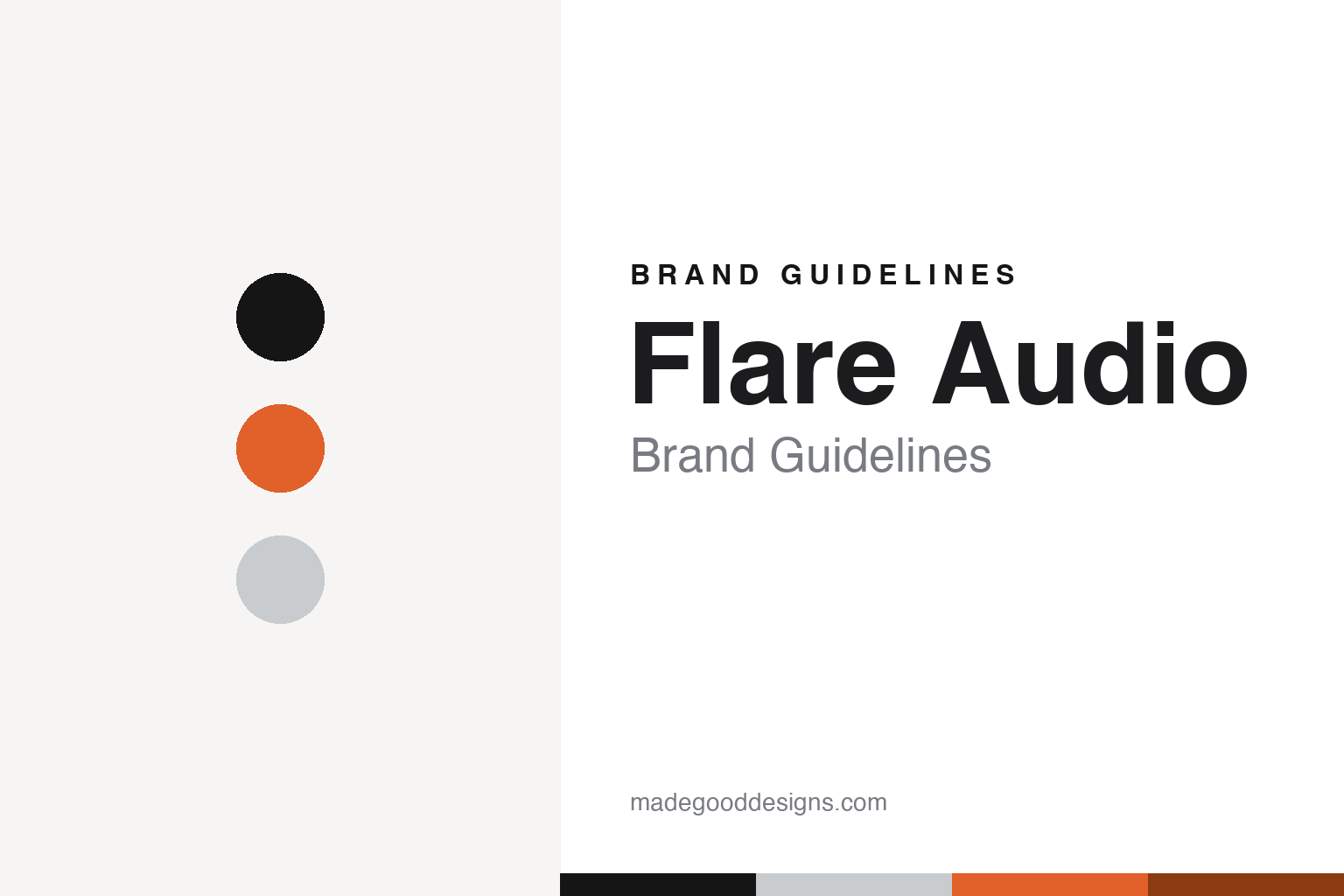
Flare Audio Brand Guidelines
The Sussex loudspeaker builders who turned their sound into metal earplugs.
Aa
Two constants: a Flare black, aluminium and orange palette and a grotesque sans register. Abstract homage — not a Flare Audio product or mark; no earplug, logo or nameplate is reproduced.
From a garden garage
A pro-audio crew that started with loudspeakers.
Flare Audio dates its story to 2010 — its site says it has been “shaping sound since 2010” — and tells it as a garage tale. The first products, it says, were made in a garage in the founders’ garden by a team of three, who designed and built loudspeakers and supplied PA for gigs and festivals, prepping kit under gazebos and testing speakers into the early hours.
The people behind it are Davies Roberts, whom the company calls its co-founder and inventor, and Naomi Roberts, also named by the company as a co-founder. Both have been directors of the operating company since it was incorporated in July 2007, Companies House shows, under the name Purple Audio Limited; it became Flare Audio Limited in 2012. Flare says its audio journey began at the Isle of Wight Festival in 2007, where Davies was front-of-house engineer for the band KOOPA.
Its early years were spent as a pro-audio manufacturer and hire company. The company says it drew praise from Jimmy Page, Jarvis Cocker, Richard Hawley and the producer Flood. One installation is on the independent record: when Olympic Studios in Barnes reopened as a cinema in October 2013, Wikipedia notes, citing a local newspaper report, that it used a Flare sound system.
Colour
Shrinking the loudspeaker.
Flare describes its technology as a fight against resonance. In its first warehouse it filed its first patents, it says, on two ideas: Space, “an anti-resonance compression technology,” and Vortex, a pressure-releasing exhaust it calls its own “infinite baffle.” Confident that these ideas could be miniaturised, it moved into consumer audio in 2015 with its first earphone, launched through a crowdfunding campaign; later models included the Flares Pro and the Jet, and the company reported in 2019 that T3 had named its Flares Pro 2HD the best in-ear earphone.
The product that made the name, though, was an earplug. Isolate is a small machined plug, which Flare says is “precision-made from aerospace-grade aluminium or titanium,” fitted with replaceable memory-foam tips. The company says Isolate raised more than £2 million across crowdfunding campaigns and that it has sold over 300,000 pairs of earplugs. The metal body, in bare aluminium, titanium or coloured anodised finishes, gives the range its look; any noise-reduction figures belong to the company’s own data sheets.
The line then widened: Earshade and Sleeep for sleep and everyday wear, earHD, and Calmer, a soft insert the company says it first designed with music in mind. Flare says Calmer and earHD came from an “epiphany in a swimming pool” about distortion in the ear itself. It also sells universal-fit in-ear monitors, among them the Reveal, Ultra and Zero, which it says are “designed and made at Flare HQ in England.”
The loudspeaker side never went away. Flare says it has since launched Flare Zero, high-end loudspeakers built from recycled materials, which it says were installed in the cinema at Selfridges; the Zero name now also appears on a reference in-ear monitor. In 2024 the co-founders demonstrated Immerse, another of its listening technologies, to the drum-and-bass DJs Fabio and Grooverider in a filmed conversation the company published, and its press archive records sponsorship of two categories at the 2017 Q Awards.
Those threads explain the brand’s voice. Flare writes like a crew rather than a corporation — “a small renegade gang of three working from a garage,” in its own words — and it names products by what they do: Isolate, Calmer, Sleeep, Earshade, Definition. The metal earplug, meanwhile, works as a logo in itself, recognisable at a glance even without the name printed on it.
Typography
Hearing protection as product design.
The seven brands in this group all sell earplugs, but they come from very different places and decades. The oldest is German and more than a century old; the newest names arrived in the 2010s, selling online and, in one case, through crowdfunding. What they share is a product people put in their ears to turn the world down, sold to concert-goers, musicians, sleepers and travellers.
Three are new names built around filtered plugs for music and nightlife. Loop is a Belgian company founded in 2016 by the childhood friends Maarten Bodewes and Dimitri O., according to Wikipedia and the company, and CNBC reported in 2023 that it was headquartered in Antwerp. Eargasm says it is based in Southern California and was founded in 2015 by Ryan Parry. Earasers belongs to Persona Medical of Florida, whose president, Don Campbell, designed the soft silicone plug, the company says.
Two date from the 1990s. Alpine Hearing Protection says it was founded in the Netherlands in 1994 as a pioneer of reusable filtered earplugs for the general public. In 2025 the Belgian investor Gimv announced it was taking a majority stake. ACS says it was established in 1994 to make custom-fit hearing protection, and describes itself as a privately owned UK company that also makes in-ear monitors.
The last two are the outliers. Flare Audio began as a three-person pro-audio maker in a garden garage on England’s south coast, it says, before crowdfunding its Isolate ear protector; Companies House lists Flare Audio Limited, of Lancing in West Sussex, as incorporated in 2007. Ohropax was founded in Berlin in 1907 by the pharmacist Maximilian Negwer, is still run by his family, and makes its wax plugs in Wehrheim, near Frankfurt.
This guide sets out what can be checked about each brand — who founded it, who owns it, and what it says about where its products are made — and marks clearly what rests only on the company’s own word.
Aa
A grotesque sans — a stand-in, not the Flare logo. (Specimen set in Space Grotesk, a Google Fonts STAND-IN; Flare’s own lettering is not documented and is not reproduced.)
Flare Audio
A King’s Award winner on the south coast.
Flare remains a small, founder-run company. It says it has grown from three people in a garden to a team of about 20 in a warehouse and offices “on the South coast,” and that it ships to more than 186 countries; its registered office is in Lancing, West Sussex. Companies House lists a holding company, Flare Audio Technologies Limited, as the controlling shareholder of the operating company.
In 2025 Flare Audio Ltd received a King’s Award for Enterprise in Innovation, the official list shows; the company says the award was for Calmer, and Davies Roberts attended a royal reception afterwards. Flare also sells Isolate and other products in a licensed collaboration with the BWT Alpine Formula One Team, and during lockdown it partnered with Tim Burgess of The Charlatans on a Tim’s Listening Party edition of its Jet earphones, giving £5 from each sale to the Music Venue Trust.
For a design guide, Flare Audio shows how a pro-audio company can carry an engineer’s voice into consumer products: a machined metal object, a plain story of garages and gigs, and product names that say what they do. Compare Etymotic and ACS. For this guide we use black anodised, aluminium and signal orange with a grotesque sans, an unofficial interpretation; no product or logo is reproduced.
Explore & save
Keep Flare Audio’s identity on hand — save it to a board in the Made Good inspiration library.
Flare Audio identity set
Pin the Flare black, aluminium and orange palette and the grotesque sans register to your own board.