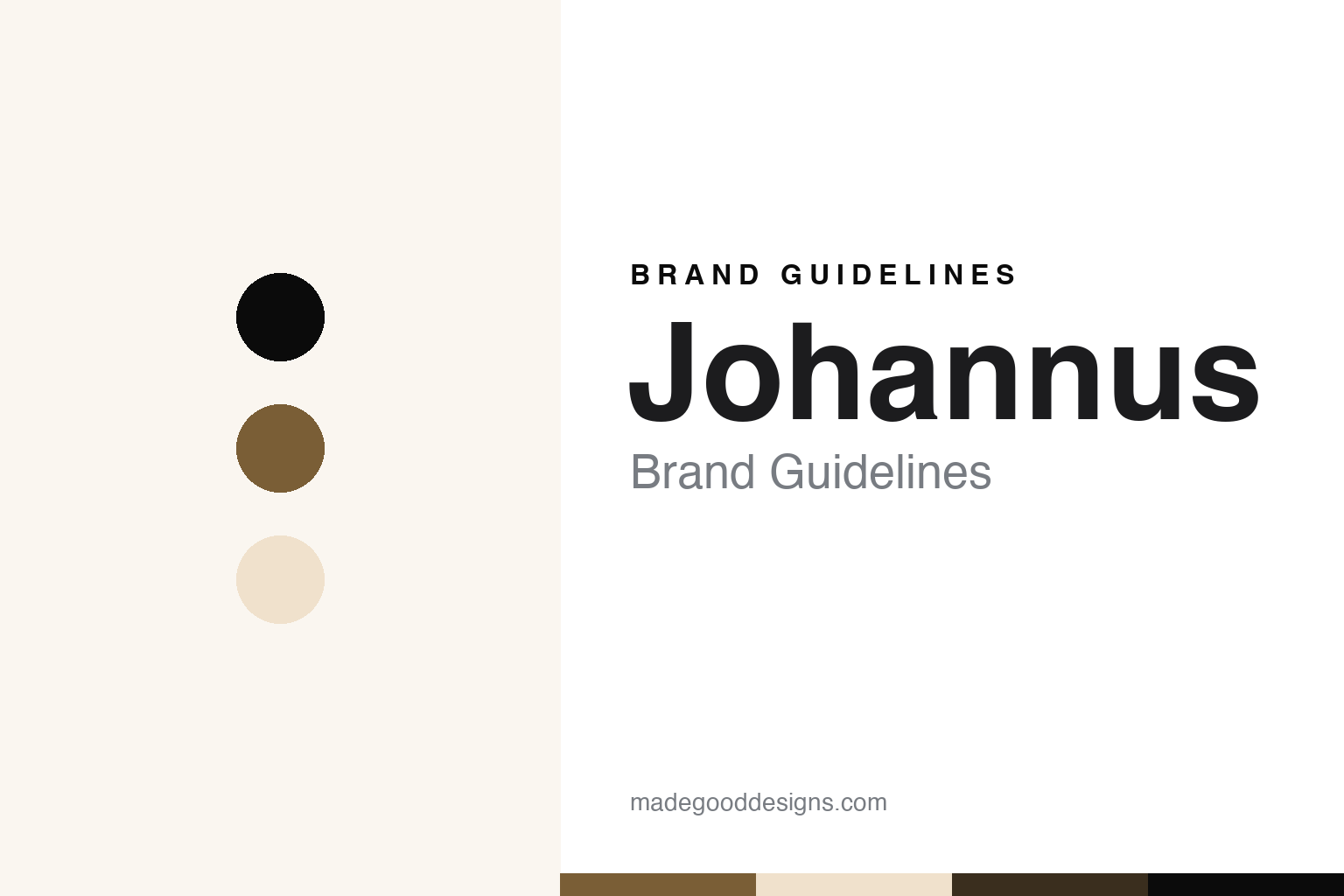
Johannus Brand Guidelines
The sound of the pipe organ, within reach.
Aa
Two constants: a Johannus black and sand palette and a Ede sans register. Abstract homage — not a Johannus product or mark; no instrument, logo or nameplate is reproduced.
The pipe organ’s sound, within reach
Johannus has built digital organs in the Netherlands since 1968.
Johannus makes digital church and home organs in Ede, in the middle of the Netherlands. It dates itself to 19 September 1968 — “This vision has been an important principle for Johannus since Sept. 19, 1968,” its About page says — and was founded by Hans Versteegt (1928–2011), who — according to Wikipedia — had earlier designed electronic organs for the Dutch firm Eminent and for Viscount in Italy. Production began in 1971 in nearby Veenendaal and moved to Ede in 1976, where it has stayed.
Versteegt retired in 1985, seventeen years after founding the company, and died in 2011. In 1987 the business was bought by Gert van de Weerd, and in 2009 it passed to his sons, Marco van de Weerd, who handles marketing and sales, and René van de Weerd, who leads research and development (Wikipedia). Johannus describes itself as “a family business… passed down from father to son.” The family it means is the van de Weerds, not the founder’s.
Its homepage headline makes the pitch plainly, in eight words: “The sound of the pipe organ, within reach.” A pipe organ is built into a building, for one room; a digital organ reproduces the sound of pipes through loudspeakers, in a fraction of the space. That is the market Johannus serves — churches without room for pipes, and organists who want to practise at home — or in a flat, where pipes could never fit. The brand’s whole vocabulary — Ecclesia, concert hall, “the sound of the pipe organ” — borrows from the instrument it stands in for.
Colour
One neoclassical building in Ede.
The company today is Johannus B.V., at Keplerlaan 2 in Ede. Its account of where its organs are made is direct: “Johannus is housed in an extraordinary neoclassical building on Keplerlaan in Ede, in the heart of the Netherlands,” where, it says, people “work here every day to develop and build Johannus organs.” Wikipedia dates the building to 2002 and says it includes a concert hall seating 330, named after the Dutch organist Feike Asma (1912–1984), who also gives his name to an annual Johannus competition.
From there, Johannus says, its organs are “shipped around the world every day,” and “The sound of Johannus rings forth in more than 100 countries.” Its current ranges are called Studio, One², LiVE, Ecclesia and Monarke, running from home instruments to large church consoles. The names do a lot of the selling: “Studio” and “LiVE” speak to players at home, and “Ecclesia” — Latin for church — to congregations.
Johannus is also the centre of a group. The Global Organ Group, headquartered at Johannus in Ede, brings together Johannus, the British builders Makin and Copeman Hart, and the American firm Rodgers, which the van de Weerd family bought from Roland with effect from 15 January 2016. A Johannus customer and a Rodgers customer on different continents may be buying from the same family. Copeman Hart was founded in 1960 and joined the group in 2011; Makin was founded in 1970. The group, in other words, is a set of heritage names under one Dutch roof, each sold in its own national voice.
Typography
From pipes to samples.
The digital organ has a precise patent history. In April 1934 Laurens Hammond was granted US patent 1,956,350 for an “Electrical musical instrument,” the basis of the Hammond organ. Storing sound digitally came later: in 1970 the engineer Ralph Deutsch, who had filed in August 1967, was granted US patent 3,515,792 for a “Digital organ,” assigned to North American Rockwell. The Smithsonian holds an Allen organ of 1971 that it describes as “one of the first to use digital sampling.”
Johannus began as an electronic-organ maker and moved into sampling with the rest of the industry; Wikipedia, without a citation, dates its first real-time sampling to 1987. The company’s promise has stayed the same as its headline — the sound of pipes, without the pipes. The Smithsonian notes that in 1971 a digital organ was “one of only two consumer products in the world to utilize digital technology,” alongside the calculator. Johannus was founded three years before that organ was introduced, and grew up with the technology.
Pipes themselves are a different object in law. When the European Union removed “pipe organs” from the scope of its hazardous-substances directive on 15 November 2017, it explained that “Pipes in organs are built using a specific type of lead-based alloy, for which no alternative has been found so far.” The exclusion is written for pipe organs only. And in December 2017 UNESCO added “Organ craftsmanship and music” in Germany to its list of intangible cultural heritage — recognition for the hand-built instrument whose sound Johannus reproduces. Germany’s nomination counted around 2,800 organ builders in 400 workshops, and “Ca. 50,000 organs in Germany are in constant use.” UNESCO itself added: “Transcultural by its very nature, organ music is a universal language that fosters interreligious understanding.”
Aa
An Ede sans — a plain name on a dark console. (Specimen set in Inter Tight, a sans STAND-IN; NOT the Johannus logo.)
Johannus
Black, sand and a concert hall.
Johannus’s website is black at top and bottom, with a sand-gold accent and a light grey — the colours of an organ console in a dim church. The name is set plainly; the photographs of consoles and of the Ede building carry the identity.
For a design guide, Johannus is a lesson in how a digital product borrows the authority of a physical one. It names its ranges Ecclesia and Monarke, builds a neoclassical headquarters with a concert hall, and promises the sound of pipes. Everything about the brand points back to the instrument it replaces, down to a concert hall named after an organist. The family that owns it has used the same strategy twice — first with Johannus, then with Rodgers — buying a name with a history and keeping it. Compare Klais and Rieger, whose pipes are made by hand in a single workshop.
For this guide we use black and a sand-gold with a sans serif — the plainer letterform of a technology company rather than a workshop — an unofficial interpretation of the website’s colours. No organ, console or logo is reproduced.
Explore & save
Keep Johannus’s identity on hand — save it to a board in the Made Good inspiration library.
Johannus identity set
Pin the Johannus black and sand palette and the Ede sans register to your own board.