Paolo Soprani Brand Guidelines
The founding myth of Castelfidardo.
Aa
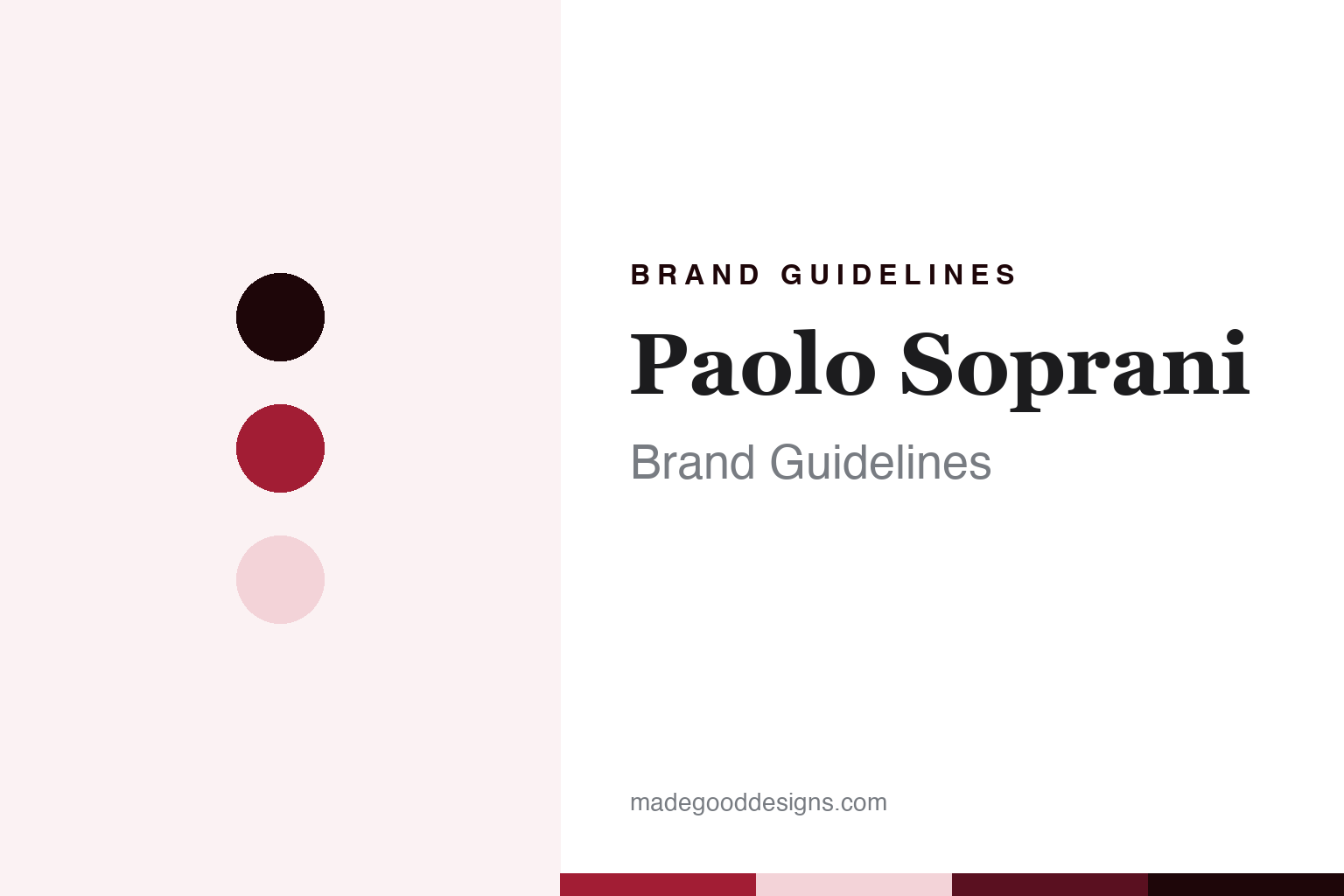
Two constants: a Soprani red and blush palette and a Marche serif register. Abstract homage — not a Paolo Soprani product or mark; no instrument, logo or nameplate is reproduced.
The founding myth of Castelfidardo
An Austrian pilgrim, a box with bellows, and a town’s industry.
Castelfidardo, a hill town near Ancona in the Marche, calls itself the home of the Italian accordion. Its municipality opened the Museo Internazionale della Fisarmonica on 9 May 1981, and its own description is plain: the town is known around the world for the instrument “grazie all’ingegno di Paolo Soprani che realizzò nel 1863 la prima industria italiana della fisarmonica” — thanks to the ingenuity of Paolo Soprani, who created the first Italian accordion industry in 1863.
The story behind that date is a legend, and the brand says so. Its website begins: “Ciò che è avvenuto nel lontano 1863 ha il sapore di una leggenda” — what happened back in 1863 has the flavour of a legend. An Austrian pilgrim returning from the shrine at Loreto stayed the night at the Soprani family’s farmhouse carrying a “rudimentale scatola,” a rudimentary box; in the best-known version he gave it to the young Paolo, in others Paolo bought it, or took it apart overnight to see how it worked. Italy’s national biographical dictionary, Treccani’s Dizionario Biografico degli Italiani, calls the meeting a “mito di fondazione” — a founding myth — of the accordion industry.
What is documented is the man. Paolo Soprani was born in Recanati on 20 October 1844 and died in Castelfidardo on 20 February 1918. The brand says that in 1864 “Paolo, con l’aiuto dei suoi fratelli, aprì una piccola bottega sotto casa” — opened a small workshop below the house with his brothers’ help. Treccani says he began large-scale production in 1872, and that “La Soprani fu la prima ditta del ramo a darsi una proiezione estera”: the first firm in the trade to look abroad, sending instruments to Greece in 1874.
Colour
A name owned by others since 1988.
The company Paolo built grew large. The brand says he ran a factory with his sons Luigi and Achille that employed about 400 workers, that it won recognition at the Paris exhibition of 1900, and that he belonged to the “Accademia degli Inventori di Bruxelles e Parigi.” His brother Settimio ran a separate accordion firm — a point worth keeping straight, because it was Settimio Soprani’s business, not Paolo’s, that merged with Scandalli and Frontalini to form Farfisa in 1946.
The name has changed hands since. The trade magazine Strumenti&Musica sets out the sequence: “Nel 1988 il marchio ‘Paolo Soprani’ è stato acquistato dalla ditta Bontempi, nel 1993 dalla Menghini & Co.; ed attualmente è rappresentato dalla Pasco Italia.” In 1988 Bontempi bought the mark, in 1993 Menghini, and today it is presented by Pasco Italia srl, of Via Aldo Moro in Castelfidardo, which also sells a second brand, Moreschi.
Pasco frames itself as the heir to a tradition rather than a family, and it says so in its motto. Its site says the Soprani tradition “viene portata avanti da PASCO ITALIA SRL: innovazione attraverso la tradizione è il nostro motto” — is carried forward by Pasco Italia, whose motto is innovation through tradition. Treccani notes that early in the twenty-first century the “Paolo Soprani Accordions, erede dell’impresa” — heir to the business — was still making and distributing accordions.
Typography
Made in Castelfidardo, and on the national register.
The English version of the brand’s site title is “Paolo soprani – Accordions made in Castelfidardo – Italy,” and Pasco’s homepage adds a specific promise: “PAOLO SOPRANI USA SOLO VOCI ITALIANE” — Paolo Soprani uses only Italian reeds. The reeds, or “voci” — literally “voices” — are the vibrating tongues that make an accordion’s sound, so the claim goes to the heart of the instrument.
Italy now keeps a register of historic trademarks — the “Marchi storici” list maintained by the Ministry of Enterprises and Made in Italy (MIMIT) — for marks with a long record of use. On 14 November 2025 “PAOLO SOPRANI” was entered on it as number 947, in the name of Pasco Italia S.r.l. of Castelfidardo. A founding myth, in other words, now has an official government listing.
The scale of that industry has changed. An exhibition by the Ancona chamber of commerce says Castelfidardo, with about 9,000 inhabitants, once “provided employment for about 10,000 workers,” and that “51,000 instruments were produced in 1938 compared to just over 500 in 1944.” In 2012 Il Sole 24 Ore reported that the district had once turned out 240,000 accordions a year, and that by then Castelfidardo and Recanati made “non più di 30mila” — no more than 30,000 — with about twenty firms still passing the trade “di padre in figlio,” from father to son. Il Sole 24 Ore also recalled that, fifty years earlier, accordions from the Marche had been “una delle prime voci dell’export nazionale” — one of Italy’s leading exports. Italian law polices origin claims closely. Since 2003 it has been a “falsa indicazione” — a false indication — to stamp “made in Italy” on goods that do not originate in Italy under EU rules, and since 2009 “100% made in Italy” has required design, planning, processing and packaging all to take place in Italy.
Aa
A Marche serif — a founder’s full name as a brand. (Specimen set in Fraunces, a serif STAND-IN; NOT the Paolo Soprani logo.)
Paolo Soprani
A founder’s full name as a brand.
The Paolo Soprani logo comes in red, white and grey versions, and the site’s main colour is a deep red. Its model names mix the traditional and the grand: Saltarello (a dance of central Italy), Jubilee, Elite, Folk 37, Professionale, Super Paolo, Internazionale.
For a design guide, Paolo Soprani is a rare case of a brand whose founding story is officially a myth and still does its job. The full name of a nineteenth-century farmer’s son carries the weight of a town’s identity; the pilgrim and the box do the rest. The instrument itself is younger than the town’s industry might suggest. Cyrill Demian and his sons Guido and Karl were granted a Viennese patent for the “Accordion” on 23 May 1829, for a small box with bellows whose five keys each sounded a chord. Compare Scandalli, a name that also changed hands and stayed in the district.
For this guide we use a deep red and a blush with a serif, an unofficial interpretation of the website’s colours. No accordion, logo or nameplate is reproduced.
Explore & save
Keep Paolo Soprani’s identity on hand — save it to a board in the Made Good inspiration library.
Paolo Soprani identity set
Pin the Soprani red and blush palette and the Marche serif register to your own board.