Scandalli Brand Guidelines
A cursive name on the national register.
Aa
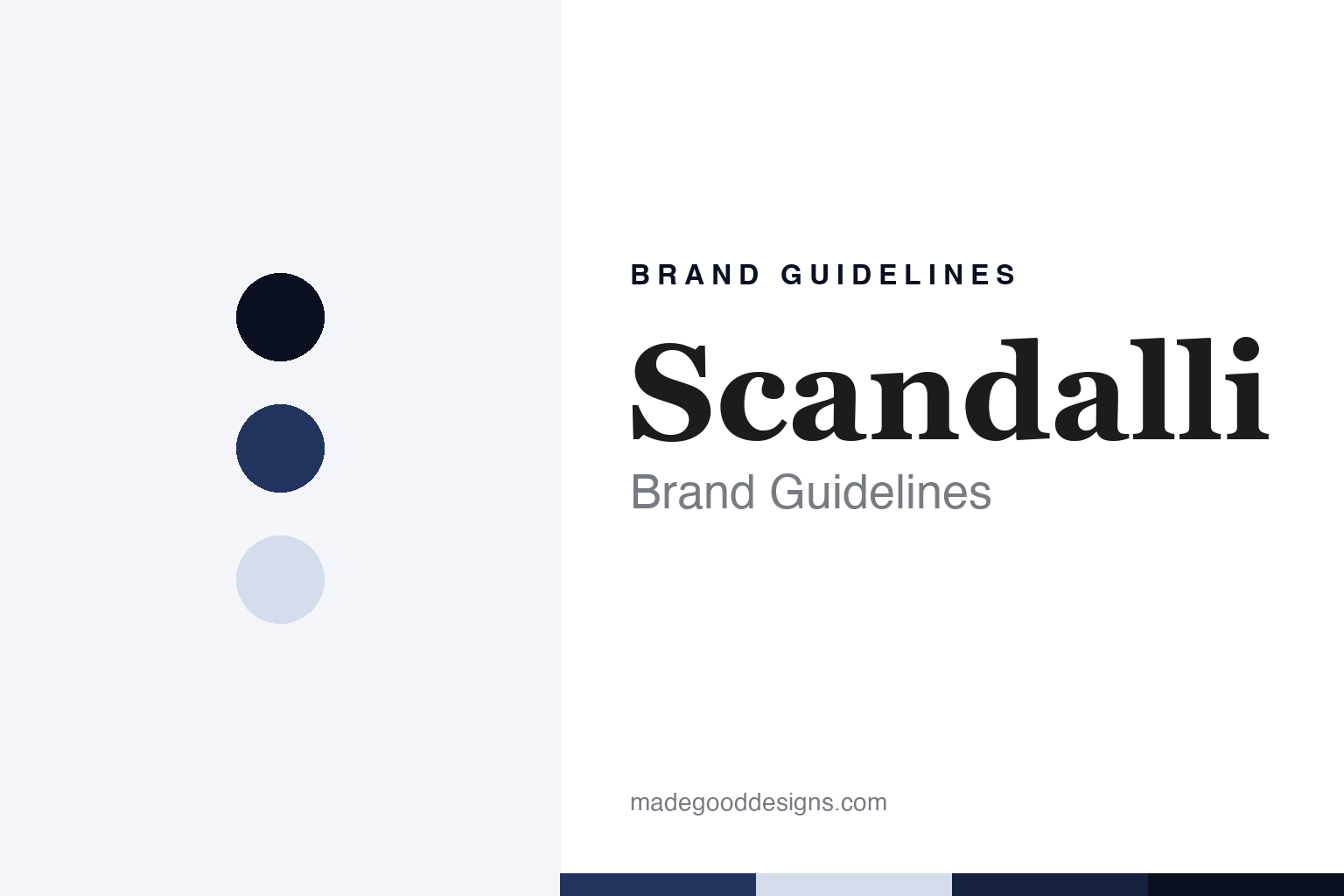
Two constants: a Scandalli navy and pale blue palette and a Cursive script register. Abstract homage — not a Scandalli product or mark; no instrument, logo or nameplate is reproduced.
A cursive name on the national register
Scandalli began in Camerano, near Ancona.
Scandalli is one of the oldest names in Italian accordions, and its founding date depends on whom you ask. The brand says “Nel 1900 Silvio Scandalli inizia a produrre fisarmoniche in una piccola bottega a Camerano” — in 1900 Silvio Scandalli began making accordions in a small workshop in Camerano, a town near Ancona — and claims “una storia di oltre 120 anni,” a history of more than 120 years. The Italian Wikipedia gives 1916, and says Silvio (1889–1977) founded the firm with his brothers Enrico and Albino. Silvio would have been about eleven in 1900, so we give both dates.
The brand says the workshop grew past 700 employees, and that its SUPER VI model of the early 1950s remains “tuttora insuperato” — still unsurpassed. Those are its words. What is documented is the region it grew up in, which by the Ancona chamber of commerce’s account produced 51,000 accordions in 1938.
Castelfidardo, a hill town near Ancona in the Marche, calls itself the home of the Italian accordion. Its municipality opened the Museo Internazionale della Fisarmonica on 9 May 1981, and its own description is plain: the town is known around the world for the instrument “grazie all’ingegno di Paolo Soprani che realizzò nel 1863 la prima industria italiana della fisarmonica” — thanks to the ingenuity of Paolo Soprani, who created the first Italian accordion industry in 1863. Scandalli was not founded in Castelfidardo, but it ended up there.
Colour
Farfisa, Lear Siegler, Bontempi — and back to accordions.
In July 1946 three Marche accordion firms — F.lli Scandalli of Camerano, Settimio Soprani of Castelfidardo and Frontalini of Numana — merged to form Farfisa, whose name Treccani records as an acronym of “FAbbriche Riunite FISArmoniche italiane,” united Italian accordion factories. The brand’s own history confirms the three-way merger. Treccani’s entry on Paolo Settimio Soprani (1913–1989), of the Settimio family, says he brought his family’s war-damaged works into the new company.
Farfisa then changed hands. The American conglomerate Lear Siegler took control — Wikipedia dates this to 1968 in English and to 1965–84 in Italian — and in October 1984 Farfisa was bought by Paolo Bontempi, Treccani says. The Italian Wikipedia dates the end of Farfisa as an accordion maker to 1988. Scandalli’s own account says it then worked “in collaborazione con la Comus-Bontempi” for some years, before, “sotto la guida di Mirco Patarini, Leonardo e Luciano Menghini, torna ad occuparsi esclusivamente di fisarmoniche” — under new leadership, it returned to making accordions only.
Today the company is Scandalli Accordions s.r.l., at Via Olivetti in Castelfidardo, not Camerano — the move put the name in the town that markets itself as the accordion’s home. Its site title reads “Accordions MADE IN CASTELFIDARDO – ITALY,” and it has a page headed “Made in Scandalli.” Its current lines are called Tradizione, Groove, Intense, Tierra, Air and Conservatorio.
Typography
Entry number six.
Italy now keeps a register of historic trademarks — the “Marchi storici” list maintained by the Ministry of Enterprises and Made in Italy (MIMIT) — for marks with a long record of use. Scandalli was one of the first names on it: entry number 6, dated 7 July 2020, in the name of Scandalli Accordions S.r.l. The register describes the mark precisely — “Marchio consistente nella parola ‘SCANDALLI’ redatta in caratteri corsivi”: a mark consisting of the word SCANDALLI written in cursive letters. Its rival name Paolo Soprani joined the list in 2025, as number 947.
The scale of that industry has changed. An exhibition by the Ancona chamber of commerce says Castelfidardo, with about 9,000 inhabitants, once “provided employment for about 10,000 workers,” and that “51,000 instruments were produced in 1938 compared to just over 500 in 1944.” In 2012 Il Sole 24 Ore reported that the district had once turned out 240,000 accordions a year, and that by then Castelfidardo and Recanati made “non più di 30mila” — no more than 30,000 — with about twenty firms still passing the trade “di padre in figlio,” from father to son.
Italian law polices origin claims closely. Since 2003 it has been a “falsa indicazione” — a false indication — to stamp “made in Italy” on goods that do not originate in Italy under EU rules, and since 2009 “100% made in Italy” has required design, planning, processing and packaging all to take place in Italy. We found no registered geographical indication or collective mark for Castelfidardo accordions, though we did not search the trademark databases; the EU opened geographical indications to craft goods only on 1 December 2025. For now, a name on the historic register and the words “made in Castelfidardo” do that work. The 2009 decree also added a fine of €10,000 to €250,000 for using a trademark in a way that misleads buyers about a product’s origin.
Aa
A cursive script — the register’s own description of the mark. (Specimen set in Fraunces, a serif STAND-IN; NOT the Scandalli logo.)
Scandalli
A signature, registered.
Scandalli’s identity is its cursive wordmark — the name written as a signature. The register’s description is the best brand guideline it has: one word, in cursive. Its website’s blue is the default colour of the WordPress theme it uses, so we do not treat it as a brand colour.
For a design guide, Scandalli shows how a script name survives corporate history. It went into Farfisa, through an American conglomerate and an Italian keyboard group, and came out the other side as the same signature on the same instrument. A cursive mark is hard to modernise and easy to recognise; Scandalli kept it, and the register now protects it in exactly that form. The instrument itself is younger than the town’s industry might suggest. Cyrill Demian and his sons Guido and Karl were granted a Viennese patent for the “Accordion” on 23 May 1829, for a small box with bellows whose five keys each sounded a chord.
The patent described the instrument simply: “Dieses Instrument hat die Gestalt eines kleinen Kästchens mit einem Blasebalge” — this instrument has the shape of a small box with a bellows. Two centuries on, Scandalli’s instruments are far more complex, but the brand still needs only one word.
For this guide we use a navy and a pale blue with a serif standing in for the script, an unofficial interpretation. No accordion, logo or wordmark is reproduced.
Explore & save
Keep Scandalli’s identity on hand — save it to a board in the Made Good inspiration library.
Scandalli identity set
Pin the Scandalli navy and pale blue palette and the Cursive script register to your own board.