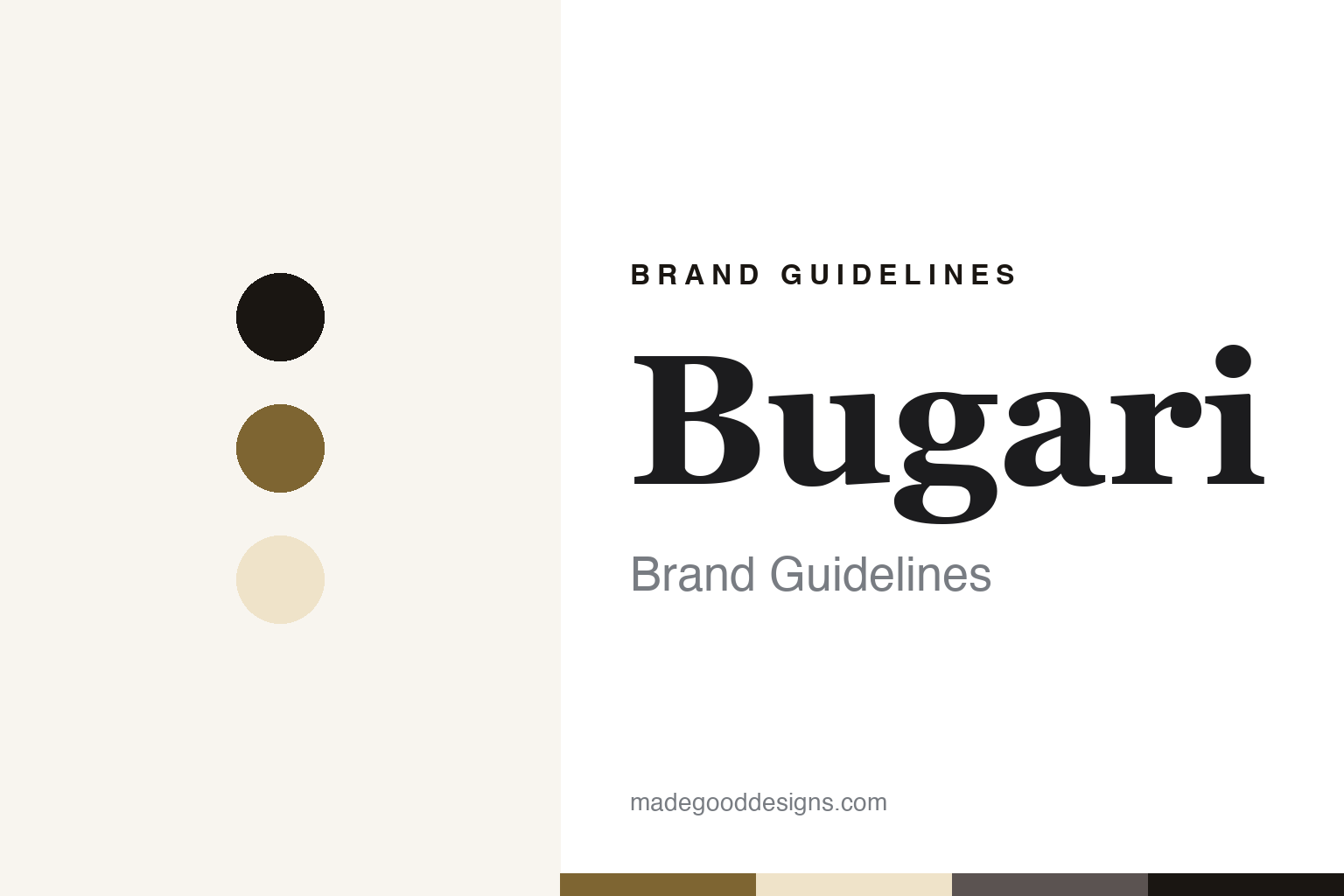
Bugari Armando Brand Guidelines
A mark created in 1961.
Aa
Two constants: a Bugari bronze and warm grey palette and a Nameplate serif register. Abstract homage — not a Bugari product or mark; no instrument, logo or nameplate is reproduced.
A mark created in 1961
Before Armando, Bugari accordions carried other people’s names.
Bugari Armando makes accordions in Castelfidardo, and its brand began with a decision about a name. The company dates itself to 1961, when, its timeline says, Nello Bugari “decide di lasciare la sua piccola attività al figlio Armando. In quel momento nasce l’azienda Armando Bugari srl” — decided to leave his small business to his son Armando, and at that moment the company was born.
The family had been building accordions for longer. In a 2013 interview with the trade magazine Strumenti&Musica, Armando Bugari said his grandfather Enrico had started making them at home, and that before 1961 the workshop’s instruments went out under the names its customers ordered — “per la maggior parte, erano clienti stranieri,” mostly foreign clients. In 1961 he created the mark “Bugari Armando,” putting the family name on the instruments for the first time. He said he had started at fourteen, as a tuner.
For decades, in other words, the family’s skill was sold under other labels. Il Sole 24 Ore also recalled that, fifty years earlier, accordions from the Marche had been “una delle prime voci dell’export nazionale” — one of Italy’s leading exports. Armando Bugari was born in 1936 and died on 23 October 2017. His obituary in Strumenti&Musica remembered him as a performer and ensemble director as well as a maker, who won first prize at an ensemble championship in Pesaro in 1958.
Colour
A partnership with Tianjin.
The company is Bugari Armando s.r.l., on the Adriatic state road, the SS16, in Castelfidardo. Its timeline marks steady growth: worldwide commercial expansion in the 1980s and 1990s; in 2007, it “acquista l’azienda ZERO SETTE e il marchio GIULIETTI” — bought the Zero Sette company and the Giulietti brand, bringing both workforces into one plant; solar panels in 2012; and “più di 30 dipendenti e collaboratori” — more than 30 employees and collaborators — by its sixtieth anniversary in 2021.
Its most notable recent step was in China. In April 2018 the Italian press reported that Bugari Armando Srl and Tianjin Huayun Music Instrument Co. Ltd. “hanno concluso un accordo di partnership” — had concluded a partnership agreement — to expand production of high-end accordions in Italy and distribute them in China, with plans for a digital accordion. The company’s own timeline places the agreement under 2019, describing an accord with “un importante gruppo di investitori della ‘Tianjin Huayun Ltd’” and framing it as support for “Made in Italy… soprattutto del ‘Made in Castelfidardo’.”
Neither source says the Chinese partner holds a stake, and we did not see the company register, so we describe it as a partnership. The production promise is explicit: the homepage says its accordions are “costruite in maniera totalmente artigianale e realizzate esclusivamente nella nostra sede di Castelfidardo” — built entirely by hand and made exclusively at its Castelfidardo premises.
Typography
Carbon, and a district that shrank.
In July 2022 Bugari announced the Carboneon, which it calls “THE WORLD’S FIRST FULL CARBON ACCORDEON,” made with an unnamed Swiss company; the first run, it said, was seven samples weighing 8.7 kg. The first-ever claim is the company’s; the weight is the point, for a player who carries the instrument on the shoulders for hours. Carbon fibre is better known from racing bicycles than from accordions.
Castelfidardo, a hill town near Ancona in the Marche, calls itself the home of the Italian accordion. Its municipality opened the Museo Internazionale della Fisarmonica on 9 May 1981, and its own description is plain: the town is known around the world for the instrument “grazie all’ingegno di Paolo Soprani che realizzò nel 1863 la prima industria italiana della fisarmonica” — thanks to the ingenuity of Paolo Soprani, who created the first Italian accordion industry in 1863. The scale of that industry has changed. An exhibition by the Ancona chamber of commerce says Castelfidardo, with about 9,000 inhabitants, once “provided employment for about 10,000 workers,” and that “51,000 instruments were produced in 1938 compared to just over 500 in 1944.” In 2012 Il Sole 24 Ore reported that the district had once turned out 240,000 accordions a year, and that by then Castelfidardo and Recanati made “non più di 30mila” — no more than 30,000 — with about twenty firms still passing the trade “di padre in figlio,” from father to son.
Italian law polices origin claims closely. Since 2003 it has been a “falsa indicazione” — a false indication — to stamp “made in Italy” on goods that do not originate in Italy under EU rules, and since 2009 “100% made in Italy” has required design, planning, processing and packaging all to take place in Italy. The 2009 decree also added a fine of €10,000 to €250,000 for using a trademark in a way that misleads buyers about a product’s origin. Against that background, a Chinese partnership framed as support for “Made in Castelfidardo” is a careful piece of positioning: new money and a new market, with the making kept in Italy.
Aa
A nameplate serif — the town’s name under the maker’s. (Specimen set in Fraunces, a serif STAND-IN; NOT the Bugari logo.)
Bugari
The town’s name under the maker’s.
Bugari’s logo is a long black nameplate with white lettering: “ORIGINAL,” then “BUGARI®” set large, then “CASTELFIDARDO” over “ARMANDO.” The town is part of the mark. The website uses a muted bronze and a warm grey, and lists three values as if numbering a specification — “.01 PRECISIONE / .02 TRADIZIONE / .03 QUALITÀ” — under the line “PRECISIONE e PROFESSIONALITÁ.”
Its homepage also quotes a proverb: “Un uomo che lavora con le sue mani è un operaio; … con le sue mani, il suo cervello e il suo cuore è un artista” — a man who works with his hands is a labourer; with his hands, his head and his heart, he is an artist. For a design guide, Bugari shows the value of finally signing your own work: the word “ORIGINAL” on the nameplate answers the decades when the family’s accordions carried other names. Compare Beltuna, a younger Castelfidardo family firm that has also turned to carbon.
For this guide we use a bronze and a warm grey with a serif, an unofficial interpretation of the website’s colours. No accordion, nameplate or logo is reproduced.
Explore & save
Keep Bugari Armando’s identity on hand — save it to a board in the Made Good inspiration library.
Bugari identity set
Pin the Bugari bronze and warm grey palette and the Nameplate serif register to your own board.