Lyon & Healy Brand Guidelines
Harpmakers since 1889.
Aa
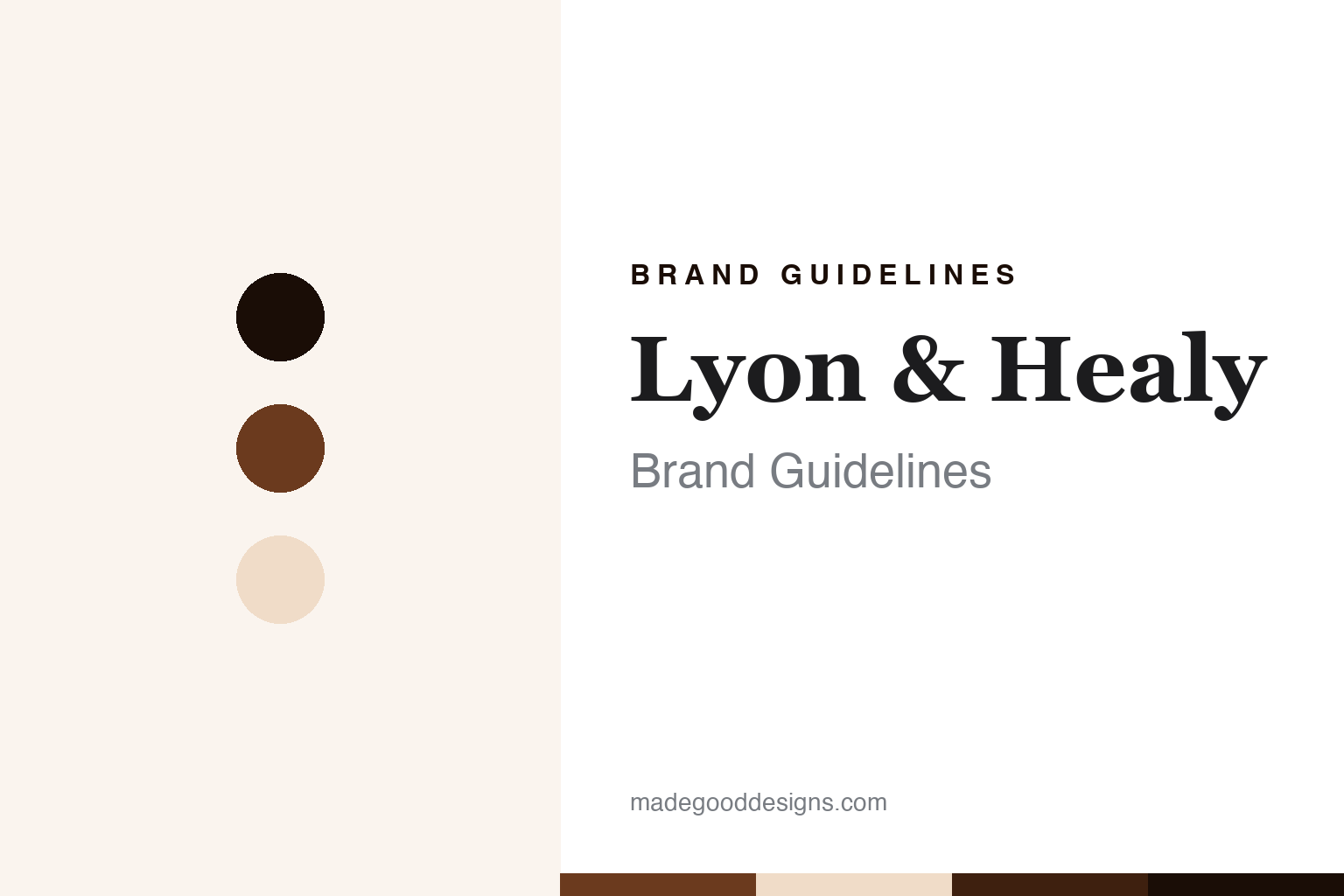
Two constants: a Lyon & Healy walnut and gilt palette and a Chicago serif register. Abstract homage — not a Lyon & Healy product or mark; no instrument, logo or nameplate is reproduced.
Harpmakers since 1889
A Chicago music shop that learned to build harps.
Lyon & Healy, the oldest name in this round, began as a shop, not a workshop. Its founders, George Washburn Lyon and Patrick Joseph Healy, were sent to Chicago from Boston by the music publisher Oliver Ditson, according to Wikipedia. The company’s own history gives the date: “On October 14, 1864, the partners opened their doors in a little shop with a stock of music at the corner of Washington and Clark Streets.” For a quarter of a century, from that corner, it sold sheet music and instruments made by others, and its music department still sells harp music today.
Then, in 1889, it built a harp. Lyon & Healy calls its first instrument “Model 21 #501,” and says it “was played daily at Morgan Park High School in Chicago until it was returned to Lyon & Healy in 1979” — ninety years after it was built. Wikipedia says Lyon retired that same year, 1889, and that Healy led the harp project; Lyon died in 1894 and Healy in 1905.
A year later, in 1890, came the instrument the company is best known for. The Style 23, introduced in 1890, has 47 strings stands about 74 inches tall and weighs about 82 pounds, with floral carving and fleur-de-lis on its column, according to Wikipedia. Lyon & Healy says it “is today the most recognizable harp in the world” — a claim we attribute to the company.
Colour
Bought by its only major competitor.
Lyon & Healy’s ownership has changed several times. Wikipedia says that in the late 1970s it was bought by Steinway & Sons — itself then owned by CBS — which soon closed the retail stores and kept the harp business. Then, in 1987, it was bought by the harpist and harp maker Victor Salvi. Salvi’s own company, its owner ever since, puts it plainly: “In 1987, Victor acquired his main competitor Lyon & Healy Harps.”
The New York Times, in its 2015 obituary of Salvi, described Lyon & Healy as his “only major competitor,” and said the purchase let him “preside over a genial global monopoly.” That is the newspaper’s phrase. Lyon & Healy’s own history says only that Salvi “added Lyon & Healy Harps to his business group.” The legal company in its footer is Lyon & Healy Harps, Inc., of 168 N Ogden Avenue, Chicago, and its website links to its sister brands: Salvi Harps, Delta Harp and Harp.com.
The making stayed in Chicago. “Today, Lyon & Healy Harps still handcrafts harps in its factory just west of the Loop,” Chicago’s downtown, the company says, in a “plus-80-year-old brick building” in the West Loop, and the Times confirmed in 2015 that “Lyon & Healy harps continue to be made under that name in Chicago.” The factory has had its own concert hall, Lyon & Healy Hall, since April 2005.
Typography
Ten years to make a master.
Lyon & Healy describes a long apprenticeship: three years, it says, to master one area of harp making, and ten to become a master craftsperson. Its music department carries more than 2,000 harp publications — a reminder that the company never entirely stopped being a music shop. Its training also produced rivals: Walter Krasicki Sr., hired in 1957 and made harp-shop foreman in 1967, left in 1969 to found Venus Harps across town, according to Venus’s own history.
The modern concert pedal harp, Lyon & Healy’s Style 23 among them, works on a mechanism patented more than two centuries ago. Sébastien Erard applied for an English patent, number 3332, in 1810, and received it that October; the Erard brothers took French patents in August 1811. Each string was fitted with two forks worked by a pedal, so that it could sound flat, natural or sharp. A Royal College of Music doctoral thesis by Fanny Guillaume-Castel calls it the mechanism “which remains the standard pedal harp mechanism today.” Erard received the English patent in October 1810, sold the first double-action harps in late 1811 and, the thesis says, about a hundred in 1812, “the first complete year of sale.” His advertisement promised strings “producing three distinct tones instead of two.”
Patrick Healy was born in Mallow, Ireland, and the harp has a special place there. Ireland’s government says it has “the distinction of being the only nation to have a musical instrument as a national emblem,” a gold harp with silver strings on blue, modelled on a fourteenth-century harp at Trinity College Dublin, and notified to the World Intellectual Property Organization in January 1985. Guinness says it registered its own harp as a trademark in 1876, and that this is why the state harp faces the other way — Guinness’s with its straight edge to the left, the government’s to the right. That account is Guinness’s. Its archive says the harp “has been synonymous with Guinness since 1862 when it was used as a symbol on the first bottle label.” The Irish Times reported in 2013 that state archives show officials in the 1980s “feared Guinness could challenge” the state’s registration.
Aa
A Chicago serif — a partnership name over a pedal harp. (Specimen set in Fraunces, a serif STAND-IN; NOT the Lyon & Healy logo.)
Lyon & Healy
A partnership name, a year and a harp.
Lyon & Healy’s tagline is simply a date: “Harpmakers since 1889.” Its copy speaks of “130 years of harpmaking experience” and of “hand-crafted pedal and lever harp[s].” The brand rests on three things: the two founders’ names joined by an ampersand, the year of the first harp, and the Style 23, whose gilded column is, in our view, the image most people picture when they think of a concert harp.
For a design guide, Lyon & Healy is an unusual case: a brand that has kept its American name and its Chicago factory for nearly four decades under the ownership of its Italian rival. The owner could have merged the two names; instead each keeps its own identity, its own factory and its own story. Compare Steinway, a former owner, and Camac, the independent French maker.
For this guide we use a walnut brown and a gilt cream with a serif, an unofficial interpretation; we did not verify the logo’s colours. No harp, column carving or logo is reproduced.
Explore & save
Keep Lyon & Healy’s identity on hand — save it to a board in the Made Good inspiration library.
Lyon & Healy identity set
Pin the Lyon & Healy walnut and gilt palette and the Chicago serif register to your own board.