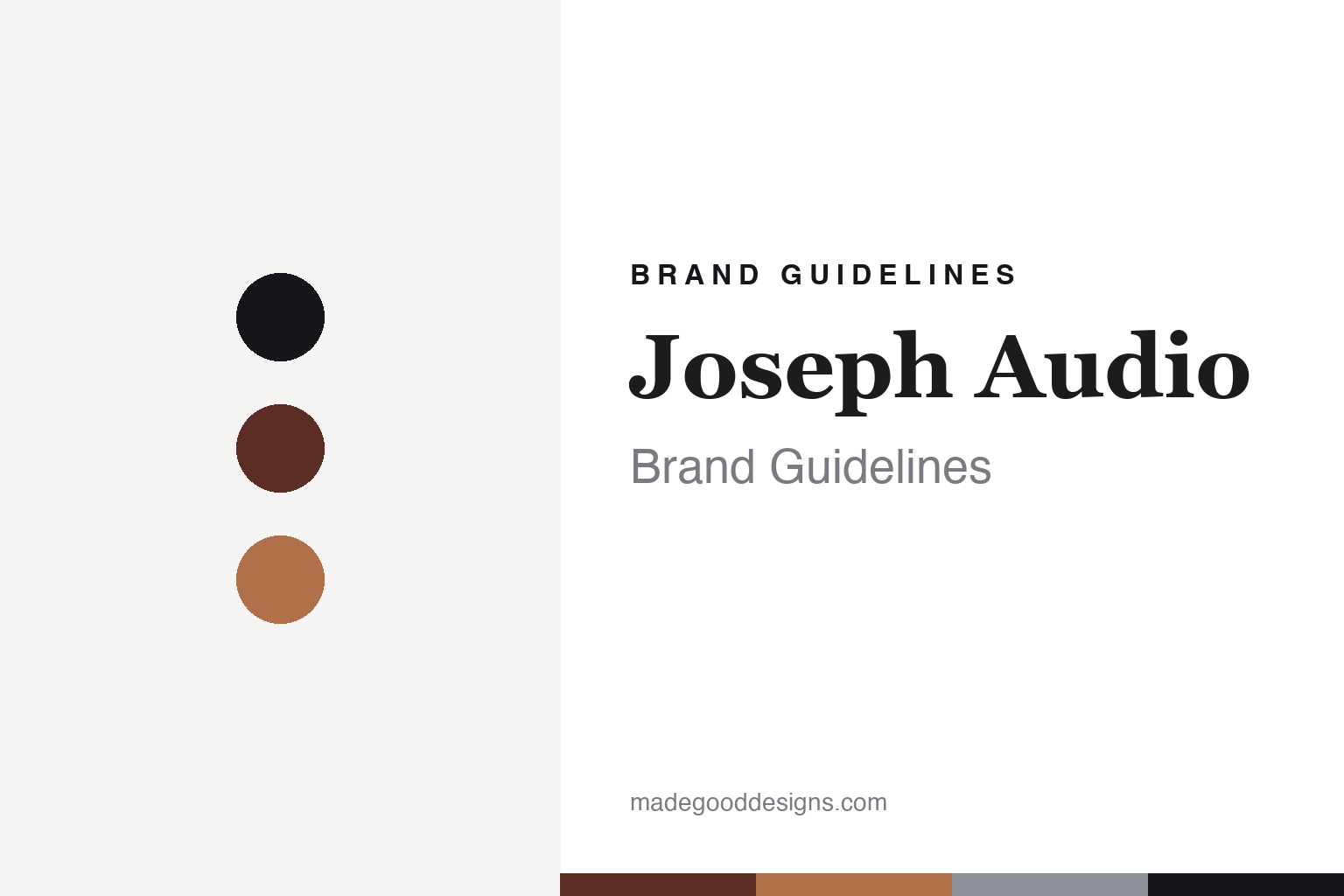
Joseph Audio Brand Guidelines
A steep crossover, a small box and a big sound.
Aa
Two constants: a Joseph rosewood, copper and piano-black palette and a Gloss-finish serif register. Abstract homage — not a Joseph Audio product or mark; no loudspeaker, logo or nameplate is reproduced.
A crossover with a cliff edge
A New York speaker company built around one patent.
Joseph Audio is a small American loudspeaker company run by Jeff Joseph, whom Stereophile described in 2018 as “loudspeaker designer Jeff Joseph, owner of Joseph Audio.” The company has not published a founding year, and we did not find one in the sources we checked. The earliest independent account we found is Stereophile’s review of the RM7si by editor John Atkinson, dated February 1996, which called Joseph Audio “a relatively new New York based company making loudspeakers designed by Richard Modafferi, who for a long time was one of the engineering lights at McIntosh.” Atkinson had first heard the speaker at Stereophile’s HI-FI ’95 show in Los Angeles in April 1995, where visitors voted the Joseph room onto the Best Sound at the Show list. Over the years the company has given addresses in White Plains, in Westchester County, and a postal box in Melville on Long Island. Writing in 2014, Atkinson credited Jeff Joseph’s skill at setting up speakers in awkward hotel rooms, a talent “going back to his days in audio retail.”
The technology came from Modafferi. A 1974 US patent for an FM stereo noise-reduction circuit names him as inventor and McIntosh Laboratory as assignee, which bears out Stereophile’s description. A later patent, filed in October 1987 and granted in September 1988 to Modafferi Acoustical Systems, describes a loudspeaker crossover whose filters have “brick-wall” responses, with band-edge slopes “on the order of 100 dB/octave.” Joseph Audio marketed this as the patented Infinite Slope crossover. Its 1999 website explained that ordinary crossovers roll off at 6 to 24 dB per octave, so woofer and tweeter play together across a wide band and interfere with each other; its own network fell at 120 dB per octave, yet was a passive circuit inside the cabinet — “some would say ‘passive-aggressive,’” the company joked. One warning for collectors: the company says the JSE Infinite Slope speakers of the 1980s came from an earlier licensee, JS Engineering, with which it is not affiliated.
Colour
From the RM series to Pulsar, Perspective and Pearl.
The early range was the RM series. The RM7si minimonitor cost $1,299 a pair in 1996 and used a Danish Vifa silk-dome tweeter; the floorstanding RM22si, RM25si, RM30si, RM33si and RM50si followed, along with the Cinergy home-cinema models. The company argued that its steep slopes let it use aluminium and magnesium woofer cones, whose high-frequency ringing could simply be cut off rather than damped. In a January 2003 follow-up, Stereophile’s Chip Stern reported that Modafferi and Joseph had spent spring 2002 reworking the RM33si, and in October 2002 he relayed Joseph’s account that an Asymmetrical Infinite Slope crossover had first been explored in the Pearl and RM33si.
Today’s line, as listed on the company website, runs from the Pearl Graphene flagship through the Perspective2 Graphene floorstander and the Pulsar2 Graphene stand-mount to the smaller Profile and Prism and the Insider2 in-wall speaker. The Pearl splits its tweeter and midrange into a separate enclosure that sits on brass points above two woofers. Part-Time Audiophile listed it at $43,999 a pair in 2023.
The drivers come from Norway. The company says they are built to its specifications “in Norway by one of the world’s leading manufacturers,” and Stereophile, reviewing the Perspective in 2014, identified them as SEAS Excel units: a 1-inch Sonatex fabric-dome tweeter and 5.5-inch woofers with cones of a 93 percent magnesium alloy and copper phase plugs. Atkinson reported that Jeff Joseph had worked with SEAS for 20 years, described an “American-made cabinet,” and wrote that each speaker’s crossover is adjusted to match the original prototype. In 2019 the Perspective2 moved to SEAS’s graphene-coated magnesium woofers. The company’s 2009 website said its speakers were “very well made in the USA”; its current site makes no claim about where cabinets are built or assembled.
Typography
Design and documentation.
The seven loudspeaker makers in this guide are small American companies, most of them built around a single designer. The oldest is Legacy Audio, which Bill Dudleston started in 1983 in Springfield, Illinois, where it remains. It sells through authorized dealers and online, and in 2025 it introduced Jay McArdle as its new owner and chief executive.
Two are in Utah. Tekton Design, run by Eric Alexander, gives its address as Orem and calls its business model “strictly direct-to-consumer.” Spatial Audio Lab, founded by Clayton Shaw, also sells direct, saying dealers “often want a double digit mark-up rate”; the company says Shaw sold its assets to Sam and David Whitt in 2023.
In the Midwest, Salk Sound, Jim Salk’s company, built speakers to order in Pontiac, Michigan, by its own account, and sold them direct. On 15 September 2023 it said it had stopped taking orders and sold its woodworking equipment.
On the coasts, Stereophile places Jeff Joseph’s Joseph Audio on Long Island, New York, and the company’s website sends buyers to dealers. Daedalus Audio, which Lou Hinkley founded in 1992, works from Ferndale, Washington; it says its speakers are sold only direct in the US, with dealers in Australia and Singapore.
The South has Volti Audio. Greg Roberts, who started out rebuilding Klipschorns in Maine, now builds horn loudspeakers in Baxter, Tennessee, selling almost entirely direct.
This guide sets out what can be checked about each brand — who founded it, who owns it, and what it says about where its products are made — and marks clearly what rests only on the company’s own word.
Aa
A gloss-finish serif — polished, compact and quietly confident. (Specimen set in Playfair Display, a serif STAND-IN; NOT the Joseph Audio logo.)
Joseph Audio
Reviews, show rooms and a long list of partners.
The Pulsar is the model reviewers return to most. Michael Fremer reviewed it for Stereophile in June 2012 at $7,000 a pair, swapping it in for his far larger Wilson MAXX 3s, and wrote that he kept listening “well past 2am” because the sound was “so musically revelatory.” Herb Reichert revisited it in July 2018, at $7,700, when it held a Class A (Restricted Extreme LF) listing in the magazine’s Recommended Components. John Atkinson reviewed the Perspective, introduced in 2013 at $12,999 a pair, in July 2014, and the Perspective2, at $14,999, in July 2019. The company’s blog reported in January 2015 that the Perspective was on the cover of Stereophile’s Recommended Components issue, and on its website it quotes The Absolute Sound naming the Pulsar its Mid-Priced Loudspeaker of the Year.
Shows matter to this brand. The company said in 2014 that The Absolute Sound’s Steven Stone had named a room built around Pulsars the best sound at AXPONA that year. Joseph Audio has exhibited for years with Doshi Audio electronics and Cardas cables — its 1998 website said every speaker was wired with “Cardas Inside” — and Part-Time Audiophile’s Marc Phillips has praised the rooms as much for Jeff Joseph’s unusual playlists as for the sound. In June 2026 he reported the Pulsar2 Graphene at High End in Vienna, and noted that his magazine’s buyers’ guide had coined the phrase “a small speaker that sounds really big” for the Pulsar.
For a design guide, Joseph Audio shows how a brand can be built on one engineering idea — the near-vertical crossover slope — and carried by compact gloss-finished cabinets, copper phase plugs and patient show demonstrations rather than a loud identity. Compare Thiel and Vandersteen, two American makers that took the opposite, gentle-slope route to coherence. For this guide we use rosewood, piano black and phase-plug copper with a serif, an unofficial interpretation; no product or logo is reproduced.
Explore & save
Keep Joseph Audio’s identity on hand — save it to a board in the Made Good inspiration library.
Joseph Audio identity set
Pin the Joseph rosewood, copper and piano-black palette and the Gloss-finish serif register to your own board.