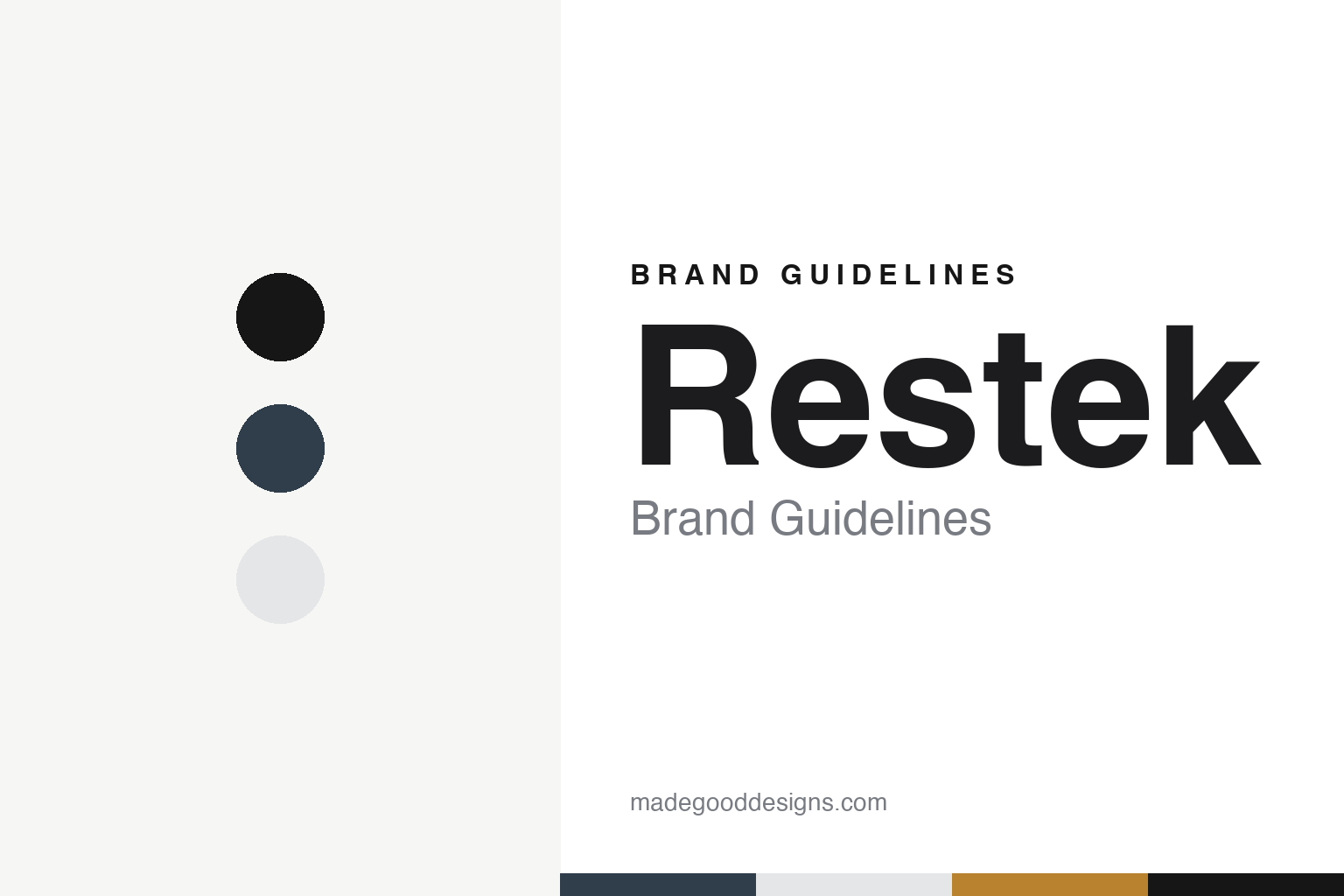
Restek Brand Guidelines
The Fuldabrück tuner and amplifier maker with a lifelong upgrade promise.
Aa
Two constants: a Restek black, slate and silver palette and an Engineering sans register. Abstract homage — not a Restek product or mark; no instrument, logo or nameplate is reproduced.
Hugo + Elschot
Two engineers from Kassel.
Restek was founded in September 1975 by two engineers, Adrianus Elschot and Bernd Hugo, graduates of what was then the Gesamthochschule Kassel, now the University of Kassel. The company’s own history gives its first name as RESTEK Elektronik Hugo + Elschot oHG, a general partnership, and says that in its first years it developed not only hi-fi equipment but also electric vehicles and industrial electronics.
Since 1977, the company says, it has been based in Fuldabrück, a small municipality just south of Kassel in northern Hesse. In its early years it also built high-end loudspeakers, and it still offers upgrades for some of those models. The name Restek on its own is easy to confuse: Restek Corporation, of Bellefonte, Pennsylvania, is an unrelated American maker of chromatography supplies for laboratories, and it owns the restek.com address. The hi-fi company is at restek.de.
Restek’s history is tied to a much bigger name. The company says it was for many years an exclusive partner of Thorens, the Swiss turntable maker, and that products such as the D1, D2, V1, V2, V3, E3 and ES3, the MMA series, the FM3003 and the GK2 were made in Fuldabrück. The Hifi-Wiki, a German reference site, also describes Restek as a Thorens partner for some years, and a Thorens enthusiasts’ archive hosts brochures for “Thorens Restek” electronics, including the D 2a, V 3, E 3 and ES 3, a set of mini modules and active loudspeakers.
The family is still in charge. Adrianus Elschot, the company says, still runs the business as owner and managing director, and since 1995 his son Dirk Elschot, who also studied electrical engineering in Kassel, has led its software development. The company’s imprint names the business as RESTEK AG, with Adrianus Elschot as chairman of the management board and Dirk Elschot as chairman of the supervisory board, and the company calls itself family-owned and “a typical German medium-sized engineering business.”
Colour
Tuners first.
Restek is best known for radio. The company says it became known around the world through some of the most respected tuners ever built, and names two: the FM-3003 and the Scalar, which it says founded its reputation for technical quality. It has kept making tuners as broadcasting changed. Its current range includes FM and DAB+ tuners alongside satellite and cable tuners.
That has meant redesigns forced from outside. A Restek service centre in Kornwestheim, near Stuttgart, reported around 2011 that the MCAB digital cable tuner could not be built from June 2010, after a chip supplier stopped making its decoder part without notice; Restek redesigned the decoder, and the tuner returned in May 2011 as the MCAB+, now with internet radio. The company’s news page has since followed the switch from DVB-S to DVB-S2 satellite reception.
Today the range is split into two families. The compact M-Serie includes the MINT integrated amplifier, the MPRE+ preamplifier, the MAMP power amplifier, the MPLA+ CD player, the MRIA+ and MINIRIA phono stages, the MDAC+ digital preamplifier and the MAMS+ audio renderer and digital-to-analogue converter. The full-width E-Serie includes the EPAL integrated amplifier, the EDITOR preamplifier, the EXTRACT and EXTENT power amplifiers, the EAMP three-channel amplifier, the EPOS+ and RADIANT IV CD players and the ERGO tuner. The company says the E-Serie goes back to a product design in production since 1987.
Restek’s own list of reviews runs from Hifi Vision, which tested the EXTENT in September 1991 and the EXTRACT in April 1992, through the German magazine HIFI STARS, which reviewed Restek products repeatedly between 2009 and 2019, to a Chinese-language test of the EXTRACT monoblocks in 2016.
Typography
Design and documentation.
The seven brands here are smaller, long-running German hi-fi makers; six still trade, most run by a founder or a founder’s family.
ASR is in Herborn, Hesse; its owner, Friedrich Schäfer, says he founded it in 1980 with Michael Rompf, who left in 1994. Restek AG of Fuldabrück, near Kassel, says Adrianus Elschot and Bernd Hugo founded it in 1975; Elschot still heads it. Gauder Akustik of Renningen, near Stuttgart, says Roland Gauder and Achim Knapp founded it in 1997.
Phonar of Tarp, in Schleswig-Holstein, says it built speakers for other brands as Scan Akustik before Klaus Henningsen founded Phonar Akustik in 1983; his son Kai took over in 1998. Abacus Electronics of Nordenham began in 1983 as Audio Pro Deutschland, part of Sweden’s Audio Pro, founder Karl-Heinz Sonder told fairaudio; the current company was registered in 2022 with Hanno Sonder as managing director. Symphonic Line of Duisburg belongs to Rolf Gemein, who founded it after an earlier firm, Vernissage, HiFi Test reported.
Isophon is the exception: German Wikipedia says the Berlin company, founded in 1929, was sold to the Bosch/Blaupunkt group in the 1980s while its name stayed with the owning family. Gauder’s firm used the name until building the last Isophon on 31 December 2012.
Five of the six active makers say they build in Germany; trade-press reports place workshops in Nordenham, Duisburg and Renningen. Phonar, a self-described manufactory, said in 2001 that many of its cabinets were made in Scandinavia.
This guide sets out what can be checked about each brand — who founded it, who owns it, and what it says about where its products are made — and marks clearly what rests only on the company’s own word.
Aa
An engineering sans — for a maker that keeps one design for decades. (Specimen set in Archivo, a sans STAND-IN; NOT the Restek logo.)
Restek
“Audio-Genuss für’s Leben.”
Restek’s slogan, “Audio-Genuss für’s Leben” — audio enjoyment for life — doubles as a business model. The company says it offers a lifelong upgrade guarantee for every component it has ever made, made possible by modular construction, a stock of sensitive spare parts kept under nitrogen, and a design that changes little from decade to decade. Its upgrade programme turns old units — “Alte Schätzchen,” or old treasures, as it calls them — into current models, and it launches a new product only every few years, modernising existing modules instead.
Its manufacturing claim is equally firm. All Restek products, the company says, are developed in-house and built entirely at its works in Fuldabrück, by hand, with most parts from its own or “friendly” workshops in Germany and suppliers in the region; every unit, it says, is checked with Rohde & Schwarz measuring equipment and by ear before it leaves. We give these as the company’s claims. It sells through specialist dealers in Germany and importers abroad, and its website carries the line “High End Made in Germany.”
The company also says that a Restek system was the official gift of the Federal Republic of Germany to the Soviet leader Mikhail Gorbachev on his visit to Bonn in 1989; we found no independent source for that and give it as Restek’s account. The company is still active: in May 2026 it announced a new remote control, the MASTER, to replace the discontinued MAESTRO.
For a design guide, Restek shows how a plain, unchanging fascia can become a brand promise in itself: the same design kept in production so that old equipment can still be upgraded. Compare T+A, another German electronics maker founded by engineers, and AVM. For this guide we use black, slate, silver and an amber accent with a sans, an unofficial interpretation; no product or logo is reproduced.
Explore & save
Keep Restek’s identity on hand — save it to a board in the Made Good inspiration library.
Restek identity set
Pin the Restek black, slate and silver palette and the Engineering sans register to your own board.