Abacus Electronics Brand Guidelines
The Nordenham amplifier maker that turned transistors around.
Aa
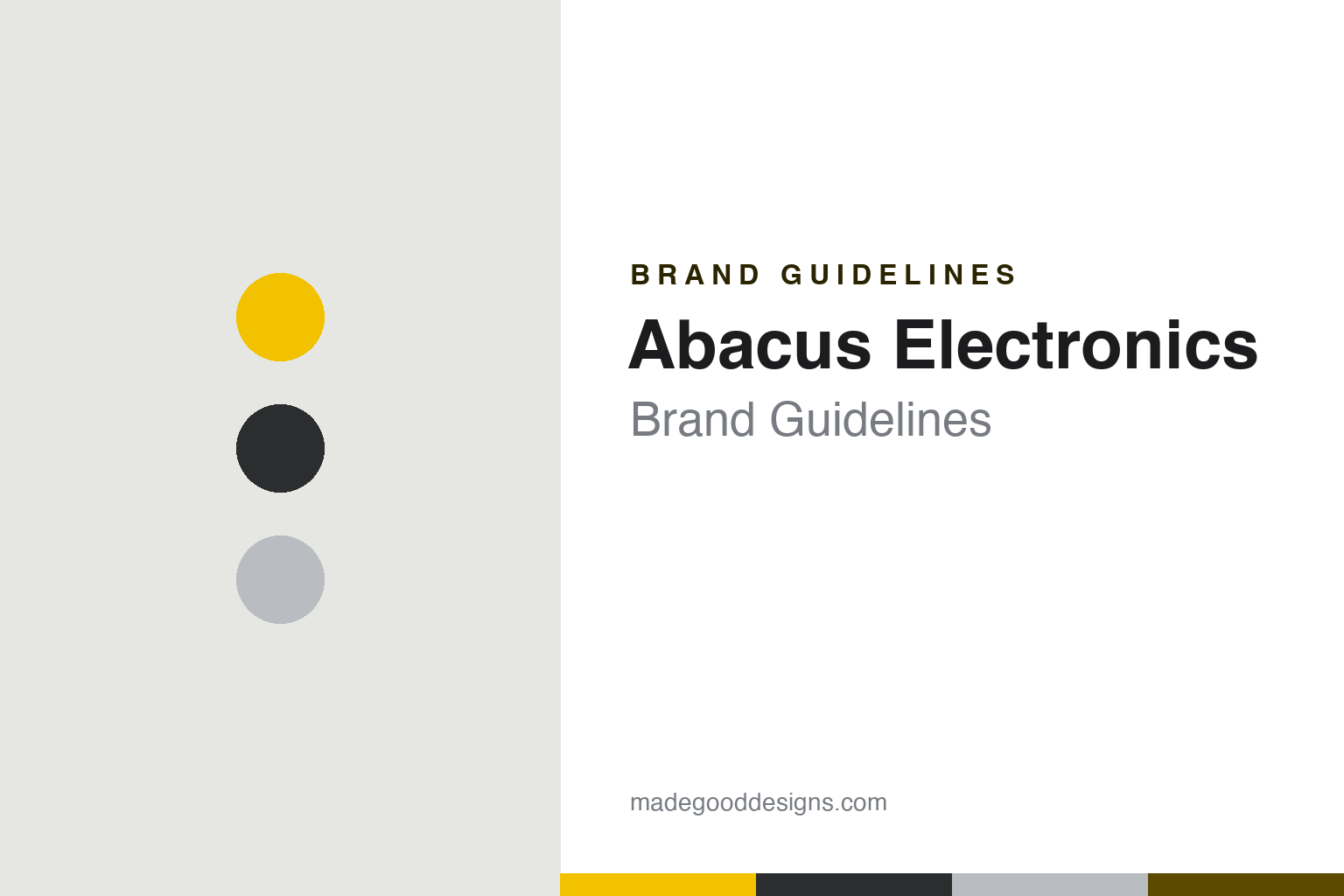
Two constants: an Abacus yellow, graphite and aluminium palette and an Engineering sans register. Abstract homage — not an Abacus product or mark; no amplifier, logo or nameplate is reproduced.
Audio Pro Deutschland
A Swedish subsidiary and a phone call.
Abacus Electronics — styled ABACUS electronics — makes amplifiers and active loudspeakers in Nordenham, a port town on the lower Weser in northern Lower Saxony. The company still works on the street where it began, fairaudio reported: it moved several times and then returned, to a larger building. Its founder is Karl-Heinz Sonder, a communications engineer and master radio and television technician, as fairaudio described him after visiting the company in January 2014.
The company did not start as a manufacturer. “It started in 1983,” Sonder told fairaudio, “as AUDIO PRO Deutschland GmbH, an autonomous German subsidiary of AUDIO PRO AB in Sweden,” the maker of active speakers and subwoofers; building its own products was, he said, “not a thought.” The Abacus website says the company “emerged from” that firm and has developed industrial electronics since 1983. Its exact founding year is reported both ways: fairaudio wrote in August 2013 that Abacus would turn 30 that September, but in October 2024 marked its 40th anniversary; German Wikipedia gives 1983 in its infobox and 1984 in its categories.
The turning point, in Sonder’s telling, came in the winter of 1983 with a late phone call from an inventor, Jochen Rieder, who described an amplifier circuit Sonder had tried and failed to make work as a student. Rieder arrived the next day with his amplifier in a wooden box; two weeks later the two had built five prototypes and sent them to hi-fi magazines — and one to Der Spiegel. Sonder calls that “the birth of Abacus.”
Colour
Collectors, not emitters.
The independent record confirms the story. In August 1985 Der Spiegel reported that a power amplifier costing about 1,000 marks, sold under the brand name “Abacus Rieder,” outperformed many high-end amplifiers costing up to 10,000 marks. It credited the circuit to Joachim Rieder, an electromechanic from Freiburg — Jochen is a common short form of Joachim — and quoted Stereo calling it a “Klangwunder,” a sound miracle, and Audio calling it “a hit.” The magazine gave the distributor as audio pro in Nordenham. German Wikipedia’s article on the company does not mention Rieder; we name him because the 1985 report does.
The idea, Der Spiegel explained, was to turn the usual circuit upside down: the output transistors feed the loudspeaker from their collectors rather than their emitters, so that the amplifier keeps tight control of the speaker cone. Sonder describes it as load-independent, with full negative feedback, and says it resembles a valve amplifier more than a conventional transistor design — without the output transformer.
The company later carried the principle over to field-effect transistors as Dolifet, short for “drain output load independent field effect transistor.” fairaudio reported in November 2014 that the 60-120D Dolifet integrated amplifier, at 990 euros, was the fourth refinement of the long-running 60-120. The range now includes the small Ampino and the larger Ampollo amplifiers, the C-Box active speakers — fairaudio described its C-Box 3 pair as bright yellow — the Mirra studio monitors, the Cortex, Trifon and Pivota speakers, and Aroio, a free Linux-based streaming system for the Raspberry Pi. In 2013 it showed the Concerto Grosso, a speaker weighing almost 80 kilograms each. Its amplifiers also power active speakers from Linnemann, fairaudio reported in 2023.
Typography
Design and documentation.
The seven brands here are smaller, long-running German hi-fi makers; six still trade, most run by a founder or a founder’s family.
ASR is in Herborn, Hesse; its owner, Friedrich Schäfer, says he founded it in 1980 with Michael Rompf, who left in 1994. Restek AG of Fuldabrück, near Kassel, says Adrianus Elschot and Bernd Hugo founded it in 1975; Elschot still heads it. Gauder Akustik of Renningen, near Stuttgart, says Roland Gauder and Achim Knapp founded it in 1997.
Phonar of Tarp, in Schleswig-Holstein, says it built speakers for other brands as Scan Akustik before Klaus Henningsen founded Phonar Akustik in 1983; his son Kai took over in 1998. Abacus Electronics of Nordenham began in 1983 as Audio Pro Deutschland, part of Sweden’s Audio Pro, founder Karl-Heinz Sonder told fairaudio; the current company was registered in 2022 with Hanno Sonder as managing director. Symphonic Line of Duisburg belongs to Rolf Gemein, who founded it after an earlier firm, Vernissage, HiFi Test reported.
Isophon is the exception: German Wikipedia says the Berlin company, founded in 1929, was sold to the Bosch/Blaupunkt group in the 1980s while its name stayed with the owning family. Gauder’s firm used the name until building the last Isophon on 31 December 2012.
Five of the six active makers say they build in Germany; trade-press reports place workshops in Nordenham, Duisburg and Renningen. Phonar, a self-described manufactory, said in 2001 that many of its cabinets were made in Scandinavia.
This guide sets out what can be checked about each brand — who founded it, who owns it, and what it says about where its products are made — and marks clearly what rests only on the company’s own word.
Aa
An engineering sans — ABACUS in capitals. (Specimen set in Archivo, a sans STAND-IN; NOT the Abacus logo.)
Abacus
“Handmade in Germany.”
Abacus makes a strong manufacturing claim — “everything developed and manufactured in Germany” — and the 2014 fairaudio visit described what that meant then: a core team of nine plus students from Oldenburg, circuit boards populated and soldered by hand rather than bought in, an in-house CNC machine, and final assembly and packing of every product in Nordenham. Sonder named an outside carpenter and metalworker and admitted that many small components are no longer made in Germany; the website says parts it cannot make itself come mostly from German and other EU suppliers. More than 90 per cent of sales were then in German-speaking countries, much of it direct, with home-trial packages.
It remains a family firm. fairaudio reported in 2014 that newer designs such as the C-Box and Ampollo came mainly from the founder’s son, Hanno Sonder, then a physics student in Oldenburg. The current company, ABACUS electronics UG, was entered in the commercial register in December 2022 with Hanno Sonder as managing director, according to North Data, and he is named as managing director on the website. Its yearly open house, ABACon, is usually held on the last weekend of October; the company cancelled the 2026 edition because of production work. Its website, relaunched in July 2026 after about ten years, now separates home and professional audio; the company says products such as the Mirra 14 took its speakers beyond being an insiders’ tip in studios. Its tone is plain: it says it works “far from esotericism and voodoo,” and its name is set in capitals, ABACUS.
For a design guide, Abacus shows how one circuit idea can carry a brand for four decades. Compare Manger, whose Zerobox speakers Abacus has converted to active operation, and Backes & Müller, a German maker of regulated active speakers. For this guide we use a yellow, a graphite and an aluminium grey with a sans, an unofficial interpretation; no product or logo is reproduced.
Explore & save
Keep Abacus Electronics’s identity on hand — save it to a board in the Made Good inspiration library.
Abacus identity set
Pin the Abacus yellow, graphite and aluminium palette and the Engineering sans register to your own board.