Gauder Akustik Brand Guidelines
The Renningen loudspeaker maker that began under the Isophon name.
Aa
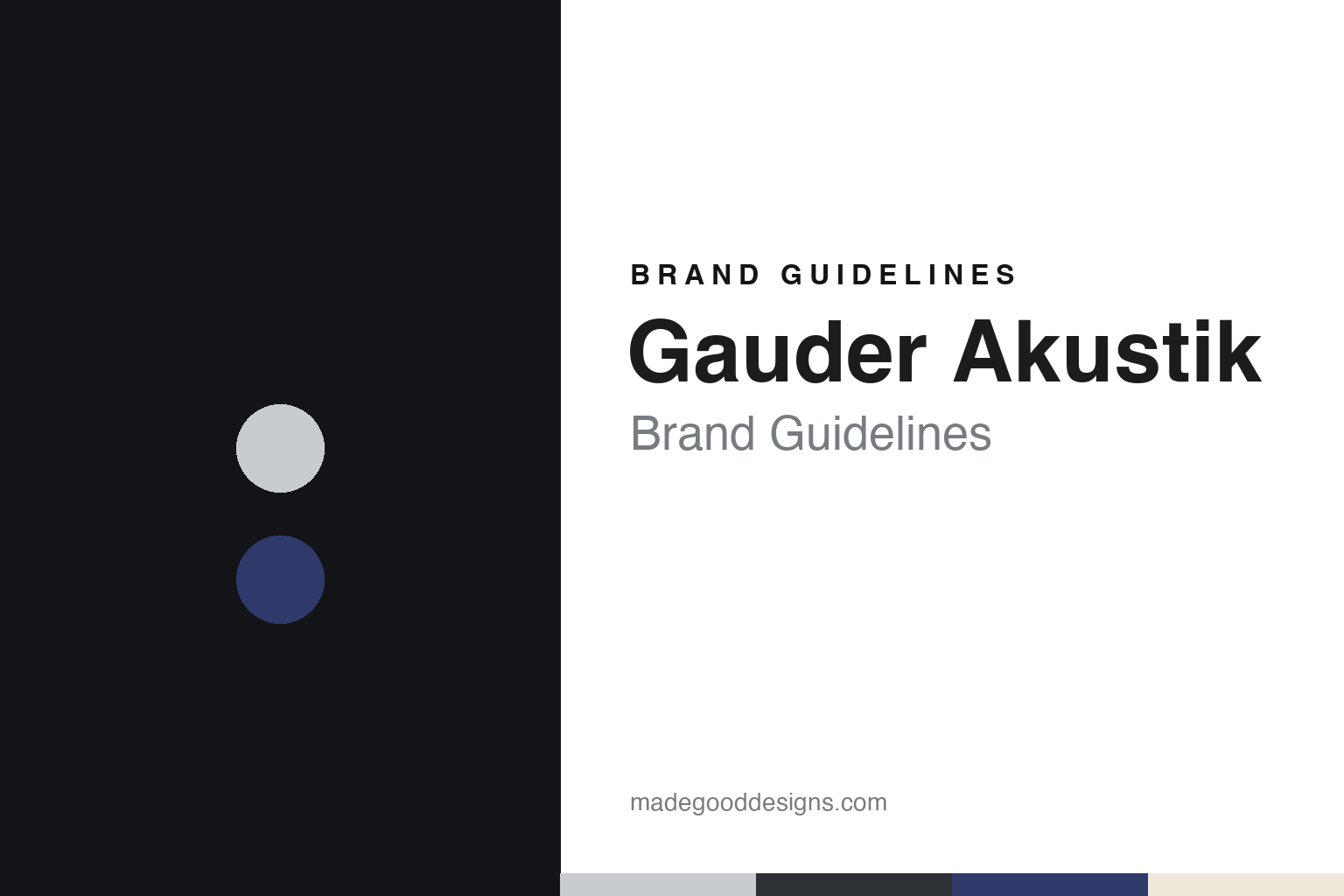
Two constants: an aluminium, graphite and indigo palette and an engineered sans register. Abstract homage — not a Gauder Akustik product or mark; no loudspeaker, logo or nameplate is reproduced.
From Isophon to Gauder
A physicist’s loudspeaker workshop near Stuttgart.
Gauder Akustik is a loudspeaker maker in Renningen, a town west of Stuttgart in Baden-Württemberg. Its legal notice names the business as Gauder & Knapp GbR, a partnership whose managing partners are Dr. Roland Gauder and Achim Knapp, and the company says the two founded the workshop in 1997. Gauder, its chief developer, is a physicist: LowBeats calls him a “promovierter Physiker,” a physicist with a doctorate, and lite magazine a doctor of physics.
For its first fifteen years or so, the firm’s loudspeakers did not carry Gauder’s name. They were sold as Isophon. That name belonged to one of Germany’s oldest loudspeaker makers, founded in Berlin in 1929; German Wikipedia says the Berlin company was sold to the Bosch/Blaupunkt group in the 1980s, while the rights to the Isophon name stayed with the owning Dräger family. From 1997, it says, a loudspeaker line under the Isophon brand was made by Acoustic Consulting GbR, until its owner, Roland Gauder, decided to sell the speakers under the name Gauder Akustik.
That matters for a common shorthand. Calling Gauder “ex-Isophon” does not mean he worked for the historic Berlin manufacturer; the sources we checked describe his own business making speakers under the revived brand name, decades after that maker had changed hands. They do not say on what terms the name was used, so we do not call it a licence. The date of the switch differs slightly: German Wikipedia gives the Isophon line as running from 1997 to 2012, while lite wrote in May 2026 that Gauder continued under his own name from 2013. By February 2014, fairaudio was listing Gauder Akustik models — Cassiano Diamond, Vescova, Arcona 80 and Berlina RC9 — at a dealer show alongside AVM.
Colour
Steep filters and teardrop cabinets.
Gauder’s loudspeakers have an engineering signature that the press describes in similar terms. The crossovers use unusually steep filters — LowBeats put them at around 60 decibels per octave on the DARC 200 — which, the magazine said, protect the ceramic midrange and treble drivers from Accuton, the German specialist whose drivers Gauder has used in most of its upper models, with a diamond tweeter as an option. The crossovers are complex enough that Gauder has used the University of Stuttgart’s mainframe computers to calculate them, LowBeats reported in 2021. A plug-in “Bass Extension” adds energy to the deepest bass.
The cabinets are the visual constant. Gauder models share a teardrop plan, which the company says computer simulations showed to be the most favourable shape. The current range is organised in series — Arcona, Capello, Elargo, Berlina and DARC — and the older Keramik series, with the Vescova and Cassiano, was discontinued in 2023, the company says. The DARC models are built from heavy aluminium ribs; Gauder told LowBeats he had experimented with wood before deciding that aluminium was far superior to MDF. The DARC 200 cost €56,000 in its basic version when deliveries began in 2019, while the Arcona 60 MK II, at €4,000 in 2020, was the smallest and least expensive floorstander in the range.
The range is still changing. lite’s May 2026 test of the Capello 80 DV found a new in-house aluminium-cone driver, called XPulse, in place of ceramic, and a tweeter co-developed with a driver specialist in the Saarland and made there. The company says it was selected for research funding in 2020 and 2021, and that its DARC 250 received a “Golden Ear Award 2025” and a “Product of the Year 2025” award in the United States; we report those as its statements.
Typography
Design and documentation.
The seven brands here are smaller, long-running German hi-fi makers; six still trade, most run by a founder or a founder’s family.
ASR is in Herborn, Hesse; its owner, Friedrich Schäfer, says he founded it in 1980 with Michael Rompf, who left in 1994. Restek AG of Fuldabrück, near Kassel, says Adrianus Elschot and Bernd Hugo founded it in 1975; Elschot still heads it. Gauder Akustik of Renningen, near Stuttgart, says Roland Gauder and Achim Knapp founded it in 1997.
Phonar of Tarp, in Schleswig-Holstein, says it built speakers for other brands as Scan Akustik before Klaus Henningsen founded Phonar Akustik in 1983; his son Kai took over in 1998. Abacus Electronics of Nordenham began in 1983 as Audio Pro Deutschland, part of Sweden’s Audio Pro, founder Karl-Heinz Sonder told fairaudio; the current company was registered in 2022 with Hanno Sonder as managing director. Symphonic Line of Duisburg belongs to Rolf Gemein, who founded it after an earlier firm, Vernissage, HiFi Test reported.
Isophon is the exception: German Wikipedia says the Berlin company, founded in 1929, was sold to the Bosch/Blaupunkt group in the 1980s while its name stayed with the owning family. Gauder’s firm used the name until building the last Isophon on 31 December 2012.
Five of the six active makers say they build in Germany; trade-press reports place workshops in Nordenham, Duisburg and Renningen. Phonar, a self-described manufactory, said in 2001 that many of its cabinets were made in Scandinavia.
This guide sets out what can be checked about each brand — who founded it, who owns it, and what it says about where its products are made — and marks clearly what rests only on the company’s own word.
Aa
An engineered sans — clean, technical, unadorned. (Specimen set in Manrope, a sans STAND-IN; NOT the Gauder Akustik logo.)
Gauder Akustik
A shape derived from physics.
Gauder Akustik’s slogan is “Loudspeakers for life. Made in Germany. That’s all,” and its claim that all cabinets are built, lacquered and finished by hand is supported in part by the press. LowBeats reported in 2021 that the firm had 16 employees and that the aluminium cabinets were assembled entirely in Renningen. lite wrote in 2026 that Gauder has its own joinery and paint shop there and has other work done by selected specialists — for the Capello’s high-gloss finish, a piano maker, because the gloss lacquer does not mix with the matt lacquer used in-house.
Finishes are part of the identity. The DARC models are offered in natural aluminium, which LowBeats called the “Silberpfeil,” or silver arrow, version, as well as in colours; the magazine recalled one version with indigo-blue ribs and gold interlayers. Accuton’s ceramic membranes, originally pale, now also come in matt black, which LowBeats said keeps them from standing out on the front. The company thanks readers of Audio and stereoplay, whose annual reader polls, it says, have ranked its models among the top products for many years. Gauder also writes a customer newsletter, Inside Gauder Akustik, which mixes news about the loudspeakers, technology and room acoustics with his personal music tips, the company says.
For a design guide, Gauder Akustik shows how a shape derived from physics — the teardrop — can become a brand mark in its own right. Compare Audio Physic, another German loudspeaker maker, Manger, and the Isophon name it once used. For this guide we use natural aluminium, graphite and an indigo with a sans, an unofficial interpretation; no product or logo is reproduced.
Explore & save
Keep Gauder Akustik’s identity on hand — save it to a board in the Made Good inspiration library.
Gauder Akustik identity set
Pin the Gauder Akustik aluminium, graphite and indigo palette and the engineered sans register to your own board.