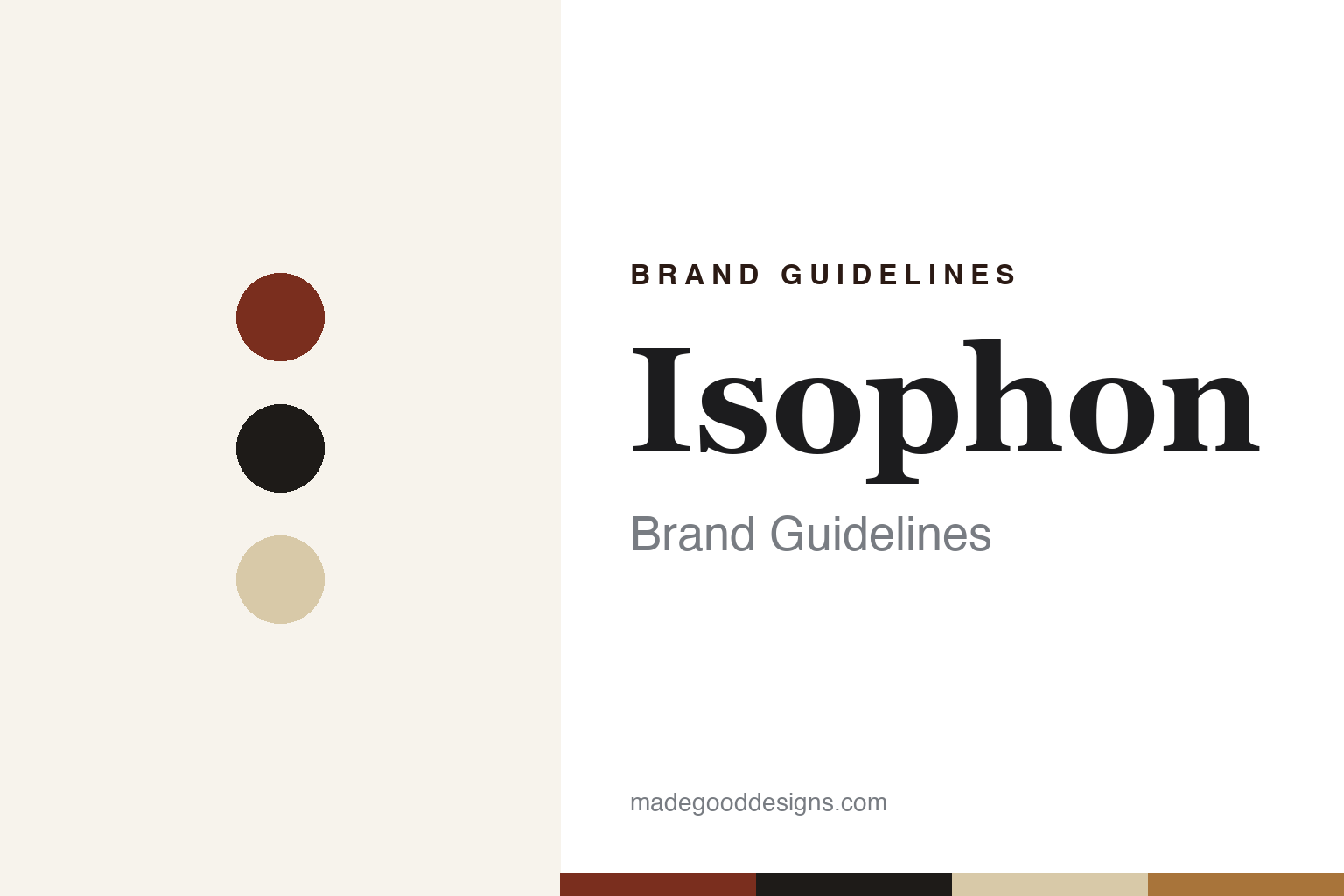
Isophon Brand Guidelines
The 1929 Berlin speaker name that ended, on a set date, as Gauder Akustik.
Aa
Two constants: a brick, black and speaker-cloth palette and a broadcast-era serif register. Abstract homage — not an Isophon product or mark; no loudspeaker, logo or nameplate is reproduced.
From capacitors to loudspeakers
A Berlin parts maker for the radio boom.
Isophon is often described as a 1930s Berlin loudspeaker name, but the sources we checked date it a little earlier. German Wikipedia says the company was founded in 1929 in Berlin as Isophon E. Fritz & Co. GmbH by Hermann Rummel, Ewald Fritz and Willi Schongs, and that it began not with loudspeakers but with variable capacitors (Drehkondensatoren) for the fast-growing radio industry; the first product it lists is a capacitor called “Universal” from 1929. The date is backed by a company-era document: a jubilee brochure titled “50 Jahre Isophon – Als der Rundfunk sprechen lernte” (“50 years of Isophon – when radio learned to speak”), covering 1929 to 1979, which the Berlin speaker-repair firm Lange und Partner published as scans in its online Isophon archive.
According to German Wikipedia, the original works were destroyed in the Second World War and Isophon carried on from 1945 in a factory in the south of Berlin. That building, a factory of 1923–24 by the architect Otto Schröder that was first built for the calculating-machine maker Ludwig Spitz & Co., is now a protected monument; Berlin’s monument list records it as the “Isophon-Fabrik” and places it in Schöneberg, while the Wikipedia article on the company says Tempelhof — both now lie in the borough of Tempelhof-Schöneberg.
The range grew well beyond radio parts. German Wikipedia lists loudspeakers for the home and for public address in railway stations, football stadiums, cinemas, department stores and trams, and names milestones such as the two-way “Orchester” combination (1949), the five-way “Cabinet” system (1951) and the “Stereonetta” stereo speakers (1956). It says Isophon had made more than 70 million loudspeaker drivers by 1979. The article also calls Isophon Europe’s largest and most technically innovative speaker maker in 1955, but its only source for that is a 1999 special reprint from the magazine Hifi & Records, published when the name had already been revived, so we treat it as a claim rather than a measured fact.
Colour
Inside other people’s designs, then a second life.
Much of Isophon’s work sat inside products that carried other names. German Wikipedia’s article on Braun’s SK 4 says the Braun L 1 loudspeaker of 1957 — a white-topped cabinet with elm sides, sold for the Atelier 1 and as a partner for the SK 4 — held a 34 × 18 cm oval driver and a 10 cm tweeter, “both from Isophon.” Its article on Echolette, the German amplifier brand, says Echolette’s speaker cabinets were made not by Echolette but “by the Berlin firm Isophon,” and several Berlin cinema histories on the same site list Isophon speakers in their projection rooms.
The independent company did not last. German Wikipedia says that in the 1980s the owners sold Isophon to the Bosch/Blaupunkt group, while the rights to the Isophon name stayed with the owning family, whom it names as the Dräger family; it gives no exact date, and we found none. The article now files Isophon under former Berlin companies.
The name returned in hi-fi far from Berlin. Gauder Akustik says its speaker workshop was founded in 1997 by Roland Gauder and Achim Knapp in Renningen, near Stuttgart, and German Wikipedia says that from 1997 to 2012 their firm, Acoustic Consulting, built a line of loudspeakers under the Isophon brand. The archived isophon.de of 2001 called them “isophon High-End-Lautsprecherboxen by Acoustic Consulting” and also named a Berlin company, isophon elektroakustische Produktions GmbH; none of the sources we checked explains how the name passed to the Renningen firm, so we do not say it was licensed or bought.
The revived Isophon was a high-end brand. The company’s 2006 site says its Cassiano, with ceramic drivers from Thiel in Bexbach, was shown with Thorens at the High End show of 2005 and quotes Stereoplay naming that room the best sound of the show. Reviewing the flagship Berlina RC7 in December 2010, the Polish magazine High Fidelity, republished by 6moons, described a cabinet of thin stacked MDF ribs clamped by six metal rods, Accuton drivers and very steep crossovers, and called Isophon a company “founded in 1929.” Acoustic Consulting’s own 2012 slogan, “Isophon – Loudspeakers Handmade in Germany since 1929,” made the same link; the Renningen business itself dates from 1997.
Typography
Germany’s smaller, long-running hi-fi makers.
The seven brands here are smaller, long-running German hi-fi makers; six still trade, most run by a founder or a founder’s family.
ASR is in Herborn, Hesse; its owner, Friedrich Schäfer, says he founded it in 1980 with Michael Rompf, who left in 1994. Restek AG of Fuldabrück, near Kassel, says Adrianus Elschot and Bernd Hugo founded it in 1975; Elschot still heads it. Gauder Akustik of Renningen, near Stuttgart, says Roland Gauder and Achim Knapp founded it in 1997.
Phonar of Tarp, in Schleswig-Holstein, says it built speakers for other brands as Scan Akustik before Klaus Henningsen founded Phonar Akustik in 1983; his son Kai took over in 1998. Abacus Electronics of Nordenham began in 1983 as Audio Pro Deutschland, part of Sweden’s Audio Pro, founder Karl-Heinz Sonder told fairaudio; the current company was registered in 2022 with Hanno Sonder as managing director. Symphonic Line of Duisburg belongs to Rolf Gemein, who founded it after an earlier firm, Vernissage, HiFi Test reported.
Isophon is the exception: German Wikipedia says the Berlin company, founded in 1929, was sold to the Bosch/Blaupunkt group in the 1980s while its name stayed with the owning family. Gauder’s firm used the name until building the last Isophon on 31 December 2012.
Five of the six active makers say they build in Germany; trade-press reports place workshops in Nordenham, Duisburg and Renningen. Phonar, a self-described manufactory, said in 2001 that many of its cabinets were made in Scandinavia.
This guide sets out what can be checked about each brand — who founded it, who owns it, and what it says about where its products are made — and marks clearly what rests only on the company’s own word.
Aa
A broadcast-era serif for a name that began in the radio industry of 1929. (Specimen set in Libre Baskerville, a serif STAND-IN; NOT the Isophon logo.)
Isophon
An ending dated to the day.
Few brand endings are recorded so precisely. In a post dated 4 January 2013 on the new Gauder Akustik site, Roland Gauder wrote: “An era comes to an end. On 31 December 2012 we built the last Isophon loudspeaker.” That last one, he said, was a Berlina for the company’s dealer in Singapore; the business would continue “under a new name, but with the same products” as Gauder Akustik. Archived copies show isophon.de forwarding to the Gauder site from April 2013. By 2020 the domain showed only a hosting company’s “reserved” page, and since early 2021 it has displayed the website of a Stuttgart security-electronics business, Dräger Electronic & Audio GmbH. The user-edited Hifi-Wiki links that firm beside its note on the Dräger family’s name rights, but we found no document showing who holds the Isophon mark today, and in the sources we checked no company sells new speakers under the name. The isophon.com address is a parked domain.
Where the speakers were made rests mostly on company statements. In 2011 Acoustic Consulting said it developed and assembled its Isophon speakers in Germany and built and lacquered the cabinets itself, while its product pages named Accuton as the source of its ceramic drivers. Gauder Akustik says today that every speaker is made by hand in Renningen and listened to before delivery. The Berlina line survives as the Berlina MK III; Gauder lists the ceramic Keramik series, which included the Isophon-era Vescova and Cassiano, as discontinued in 2023.
For a design guide, Isophon shows how a name can outlive its factory — from radio parts and drivers hidden inside other brands’ cabinets to a revived high-end label that was retired on a set date. Compare Gauder Akustik, the Renningen maker that carries the revival’s products today, and Heco, another post-war German speaker maker that supplied Braun. For this guide we use brick red, piano black and speaker-cloth beige with a serif, an unofficial interpretation; no product or logo is reproduced.
Explore & save
Keep Isophon’s identity on hand — save it to a board in the Made Good inspiration library.
Isophon identity set
Pin the Isophon brick, black and speaker-cloth palette and the broadcast-era serif register to your own board.