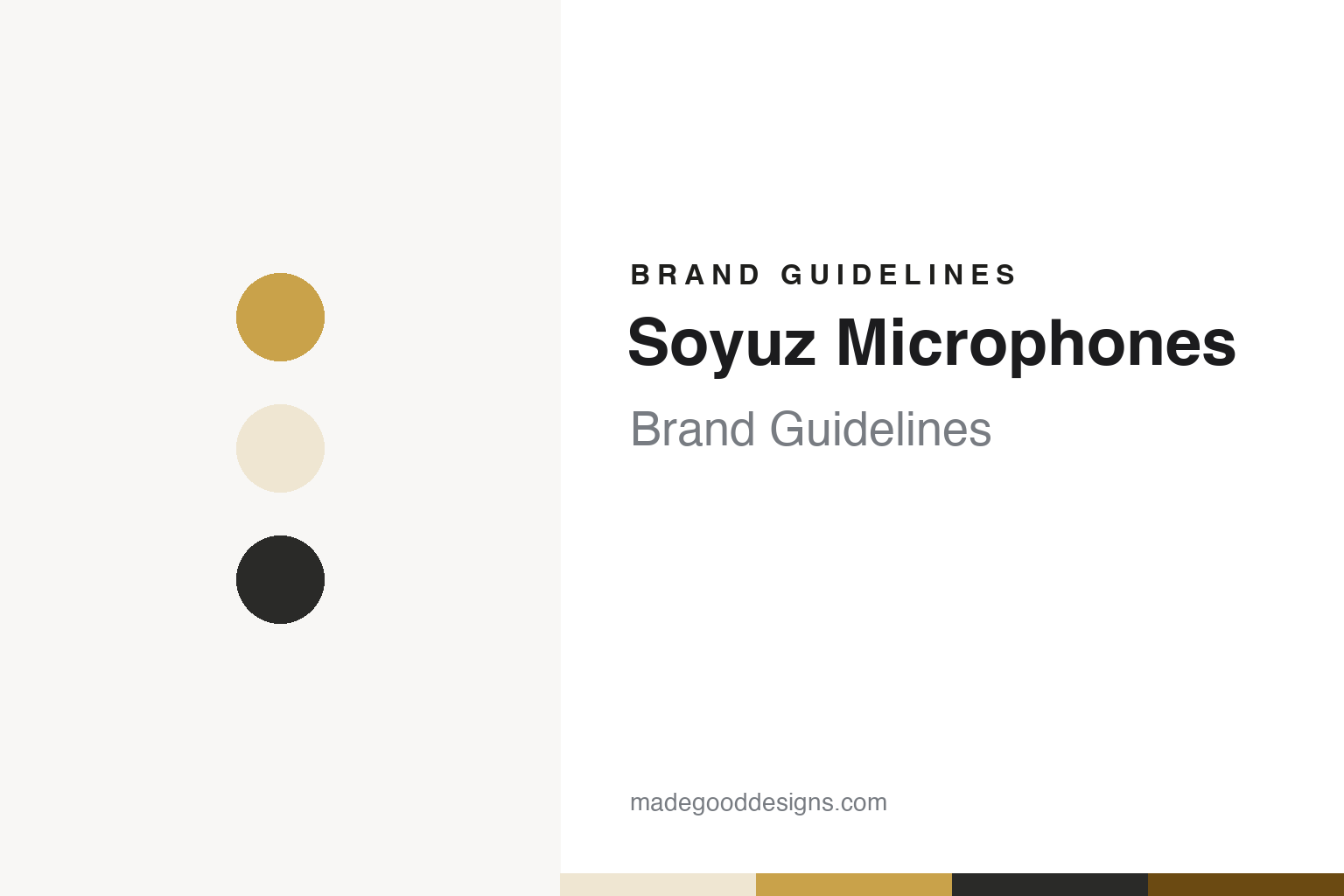
Soyuz Microphones Brand Guidelines
The hand-built studio microphones from Tula, Russia.
Aa
Two constants: a Soyuz cream, gold and graphite palette and a geometric sans register. Abstract homage — not a Soyuz product or mark; no microphone, logo or nameplate is reproduced.
The union
An American singer, a Tula fan and a factory tour.
Soyuz Microphones was founded in 2013 by David Arthur Brown, the American singer and songwriter of the band Brazzaville, and Pavel Bazdyrev, a Russian businessman from Tula. The company’s own history and a 2023 interview in Tape Op tell the same story. Brazzaville had a following in Russia and had toured there since 2003. Brown, who had used inexpensive Oktava condensers in Los Angeles in the 1990s, looked up where they were made and found Tula, about two hours south of Moscow. Soon afterwards Bazdyrev, a fan, invited him to play a solo show in that city; Brown’s condition was a tour of the Oktava factory.
The tour, both founders told the British dealer Funky Junk in 2024, needed clearance from Russia’s security service because Oktava also did military work, and the visitors saw only half the plant. The pair first hoped to have their own designs built at Oktava, but that plan fell away after management changes there, Tape Op reported, and they set up their own workshop instead. A New York investor funded them in stages; the first money bought a lathe and paid for four prototypes of the 017 valve microphone in 2013.
The name was part of the plan. Soyuz is Russian for “union,” and the company says it stands for Russian engineering and manufacturing joined with Western design, quality control and marketing. English Wikipedia, citing a Russian podcasting blog, adds that the founders first meant to call the business Baikal Microphones and dropped the idea because of a similarly named Chinese audio company; Wikipedia says the Russian company is still incorporated under that earlier name. The website lists a US company, Soyuz Microphones LLC, in Los Angeles.
Colour
Brass, cream and a golden ratio.
Soyuz builds in Tula, a city with a long metalworking history; Sound On Sound described it as a centre for metal crafts “over more than four centuries.” Tula is also home to Oktava, which the company dates to 1927, and Soyuz says it has hired engineers, assemblers and machinists trained there. The company describes its factory, called The Base, as deliberately old-fashioned: manual lathes and drill presses, white lab coats and analogue test equipment. It says it does “virtually 100%” of production in-house, including making capsules, building power supplies and winding transformers.
An early independent review backs up much of this. Reviewing the SU-017 valve microphone in May 2015, Sound On Sound’s Hugh Robjohns reported that both of the company’s two models at the time were entirely handmade, with capsules machined, assembled and tuned from raw materials, transformers wound in-house and point-to-point wiring. The box held a test chart and the business cards of the technician who assembled the microphone and of its designer, Vladimir.
The look is as considered as the sound. The company’s marketing described the 017 body as a sphere “bisected and separated by a Golden Ratio,” and Robjohns measured the centre sleeve at 1.618 times its diameter. He reported that the gold-coloured caps were inspired by the domes of Russian Orthodox churches and by Sputnik, and the body by the Soyuz rocket; the finish was a glossy cream. The models carry prime numbers — 011, 013, 017, 023 and 1973 — a habit the company says is deliberate, and it marked its eleventh anniversary rather than its tenth with a waxed-brass 023 “Bomblet” limited to 53 pieces.
Typography
The microphone makers.
This round turns to six more microphone makers: boutique valve and ribbon designers in California, a British maker on the Dorset coast, and a brand made in Russia.
Four are in California. AEA is in Pasadena and says its microphones are “handcrafted” there. Mojave Audio, which says it was co-founded in 2005 by the producer Dusty Wakeman and the designer David Royer, calls itself “family-owned” and based in Los Angeles. Josephson Engineering says it began in San Jose in 1988, moved to Santa Cruz in 2000, and designs and makes all its products there. Bock Audio, which David Bock says he formed in 2007 after co-founding Soundelux Microphones, designs the valve and FET microphones that Universal Audio has sold since 2022, which UA says it hand-builds at its Santa Cruz custom shop.
Sontronics is in Poole, Dorset, and its website names Omnisonic International Ltd. Soyuz is in Tula, Russia; English Wikipedia, citing Reuters, says it was founded in 2013 by the American singer David Arthur Brown and the Russian entrepreneur Pavel Bazdyrev.
This guide sets out what can be checked about each brand — who founded it, who owns it, and what it says about where its products are made — and marks clearly what rests only on the company’s own word.
Aa
A geometric sans for a space-age register. (Specimen set in Jost, a sans STAND-IN; NOT the Soyuz logo.)
Soyuz
Made in Tula, sold abroad.
The range has grown from microphones into electronics. Alongside the 017 and the 013 small-diaphragm series, Soyuz makes the 023 “Bomblet,” the 1973, the 011 FET, the V1 dynamic, a four-capsule 013 Ambisonic microphone, the Launcher inline preamp and the Lakeside preamp, which the company says is designed, developed and made in its Tula factory. Around 2020–21 it added Tula Mics, a portable USB microphone and recorder aimed at podcasters, according to English Wikipedia and the Russian business site vc.ru.
The war in Ukraine changed the story it tells. Speaking to Funky Junk in 2024, Bazdyrev said that after the “military situation” began, many Western brands left the Russian market, which prompted the lower-priced 1973. He also said the company had distanced itself from its old “Handmade in Russia” message because buyers had become sensitive to the word. As of 2026 its website still lists dealers in the United States, Europe and Asia as well as Russia, and contact numbers in the US, Spain, the Czech Republic and Russia. We could not independently verify how sanctions have affected its trade, so we make no claim about it. The founders also say the producer Nigel Godrich placed their first order, for a pair of 017s; that is their account.
For a design guide, Soyuz shows how a small maker can turn a place and a name into a visual language: space-age forms, dome-like caps and cream lacquer that read as Russian without a flag in sight. Compare the German classics it set out to rival in our Neumann brand guidelines, and another hand-built studio microphone in our Brauner brand guidelines. For this guide we use cream, dome gold and graphite with a geometric sans, an unofficial interpretation; no product or logo is reproduced.
Explore & save
Keep Soyuz Microphones’s identity on hand — save it to a board in the Made Good inspiration library.
Soyuz identity set
Pin the Soyuz cream, gold and graphite palette and the geometric sans register to your own board.