Telefunken Elektroakustik Brand Guidelines
The Connecticut company that revived a German microphone name.
Aa
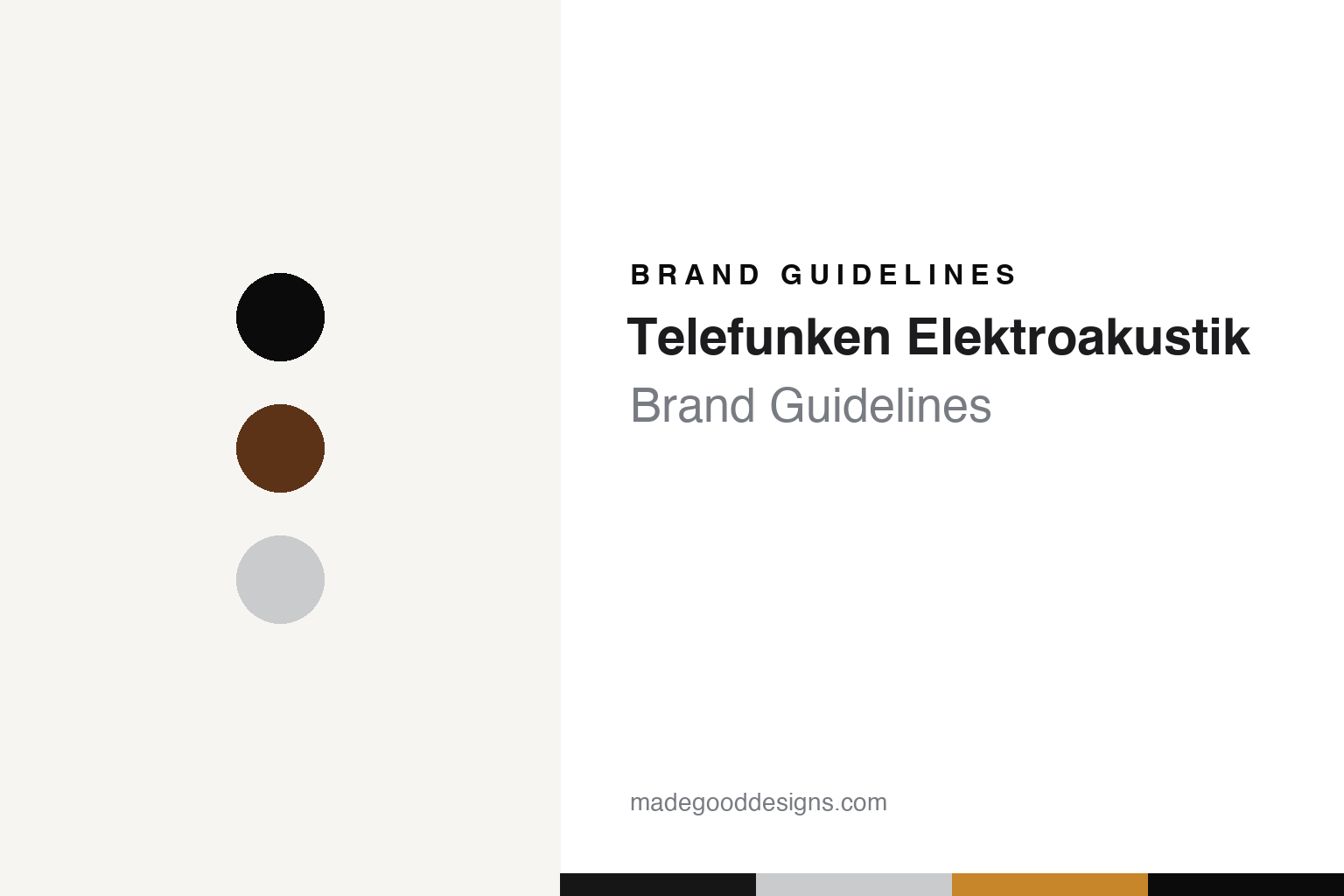
Two constants: a Telefunken Elektroakustik black, nickel and amber palette and an Engineered sans register. Abstract homage — not a Telefunken Elektroakustik product or mark; no microphone, logo or diamond is reproduced.
A switch and a name
An American company with a German name.
Telefunken Elektroakustik is an American company that makes microphones under a German name. It is based in South Windsor, Connecticut, and English Wikipedia, citing Music Connection, says it was founded in 2001 as “a modern revival of the original Telefunken.” The original was the Berlin radio company founded in 1903 by Siemens & Halske and AEG, which we cover in our Telefunken guide. The Connecticut firm is not a continuation of that business; German Wikipedia notes that the products now sold under the Telefunken name share only the name with the original company.
Its founder was Toni Fishman. The NAMM oral-history archive, which interviewed him in 2021 and lists him as “CEO & Founder” of Telefunken USA, says he opened a retail business called Vintage Tones out of his home in 1998, after collecting and researching old microphones. The company’s own account begins with a single broken part: Fishman, it says, bought an original ELA M 251E with a faulty polar-pattern switch, found no suitable replacement and set out to make one in 2000 — the year German Wikipedia gives for the company’s start. The company says it was incorporated in 2001.
NAMM records that Fishman died in July 2024, at the age of 55. The company’s website still describes him as its “current owner”; we could not confirm who owns the business now, and say so rather than guess.
Colour
The diamond and the rights.
The name is the complicated part. The company says that, after recreating the switch, it acquired “the rights to the name and iconic Diamond logo for use in North America.” An archived version of its website from 2009 was more specific: the “current TELEFUNKEN | USA company acquired the TELEFUNKEN Trademark for North America in 2001,” and the business had since been “named the Elektroakustik … arm of TELEFUNKEN,” with exclusive rights to make professional audio products and vacuum tubes bearing the name “in over 27 countries worldwide.” Its earliest archived website, from 2002, was titled “TELEFUNKEN North America.”
Elsewhere the Telefunken marks are handled by Telefunken Licenses GmbH of Frankfurt, which licenses the name to manufacturers. English Wikipedia lists the Connecticut company among the users of the name, as the maker of premium studio equipment, and in August 2023 the American investment firm Gordon Brothers announced that it had bought the Telefunken brand. We have not seen the agreements themselves, so we give the rights as the company describes them.
Its first product was a recreation. The company says it spent two years reverse-engineering the ELA M 251E, showed the new 251 at the 2002 Audio Engineering Society convention and won a TEC Award for it in 2003; the C12 and U47 followed. The originals had been studio standards: English Wikipedia notes that the first Neumann U 47s, made from 1949, were distributed by Telefunken and carried its logo. These recreations now form the Diamond Series — the C12, ELA M 251E, ELA M 251T, U47 and U48 — which the company says are wired point to point rather than on circuit boards.
Cheaper lines followed. The R-F-T Series of 2005, named, the company says, as a nod to the East German electronics brand RFT, used circuit boards and standard metalwork to cut costs; it was reworked as the Alchemy Series in 2019, with the TF29 Copperhead, TF39 Copperhead Deluxe, TF47 and TF51. The M80 dynamic microphone arrived in 2008, the M60 FET, its first transistor microphone, in 2015, and direct boxes in 2016. The company also lists TEC Awards for the M81 in 2013 and the M82 in 2014, which we give as its claims.
Typography
American microphone makers.
The United States has microphone makers at every price. At one end are small workshops that build by hand or recreate classic studio designs; at the other are brands selling inexpensive microphones to home studios and podcasters. The seven makers here cover that range, spread across the country.
Two are small workshops in the West and South. Ear Trumpet Labs says it was founded in Portland, Oregon, by Philip Graham, a former software engineer, and that its microphones are handbuilt in Oregon. Wunder Audio says its showroom, the Wunderbar Room, is in Austin, Texas.
Two revive vintage designs in the East. Peluso Microphone Lab says John Peluso founded it in 2002 after decades of repairing vintage microphones, and calls FloydFest, held near Floyd, Virginia, its local festival. Telefunken Elektroakustik, founded in 2001, says it assembles its microphones in South Windsor, Connecticut, under the name of the German radio company Telefunken.
Three are larger brands. CAD Audio grew out of Astatic, the Ohio microphone maker founded in the 1930s, which formed CAD as a division in 1988, according to English Wikipedia; its website now gives an address in Berlin, Connecticut, and names JAM Industries USA in its footer. MXL is a brand of Marshall Electronics, which gives its headquarters as Torrance, California. Samson, with a mailing address in Hicksville, New York, says it began with wireless systems in 1980.
This guide sets out what can be checked about each brand — who founded it, who owns it, and what it says about where its products are made — and marks clearly what rests only on the company’s own word.
Aa
An engineered sans — TELEFUNKEN in capitals. (Specimen set in IBM Plex Sans, a sans STAND-IN; NOT the Telefunken Elektroakustik logo or diamond.)
Telefunken Elektroakustik
Assembled in South Windsor.
Telefunken Elektroakustik is specific about manufacturing, and we give its statements as its own. It says all its microphones are “assembled and tested in South Windsor, CT, USA by a dedicated team of roughly 20 technicians.” For the Diamond Series it says “almost all parts” are made in the USA, with some critical parts, such as the Haufe T14/1 transformer, imported from the EU, and that all Diamond Series capsules are made in South Windsor. For the Alchemy, small-diaphragm and dynamic models it says “some components … are made overseas,” and are tested and installed in Connecticut; its direct boxes, it says, use British-made OEP/Carnhill transformers. Its 2009 website said the R-F-T line took “advantage of the globalization of technology” to reach lower prices. We found no independent account of its workshop to check these claims against.
Its identity leans on borrowed heritage. It uses the Telefunken name and the diamond logo, which it says it holds the rights to, writes the name in capitals as TELEFUNKEN, and names its premium line after the diamond. We found no published brand guidelines and no official colours.
For a design guide, Telefunken Elektroakustik shows how a historic name can be carried by a new company — and why the original and the revival need to be told apart. Compare Neumann, which made the original U 47, and Peluso Microphone Lab, another American workshop that builds microphones inspired by vintage designs. For this guide we use studio black, nickel and a valve amber with a sans, an unofficial interpretation; no product or logo is reproduced.
Explore & save
Keep Telefunken Elektroakustik’s identity on hand — save it to a board in the Made Good inspiration library.
Telefunken Elektroakustik identity set
Pin the Telefunken Elektroakustik black, nickel and amber palette and the Engineered sans register to your own board.