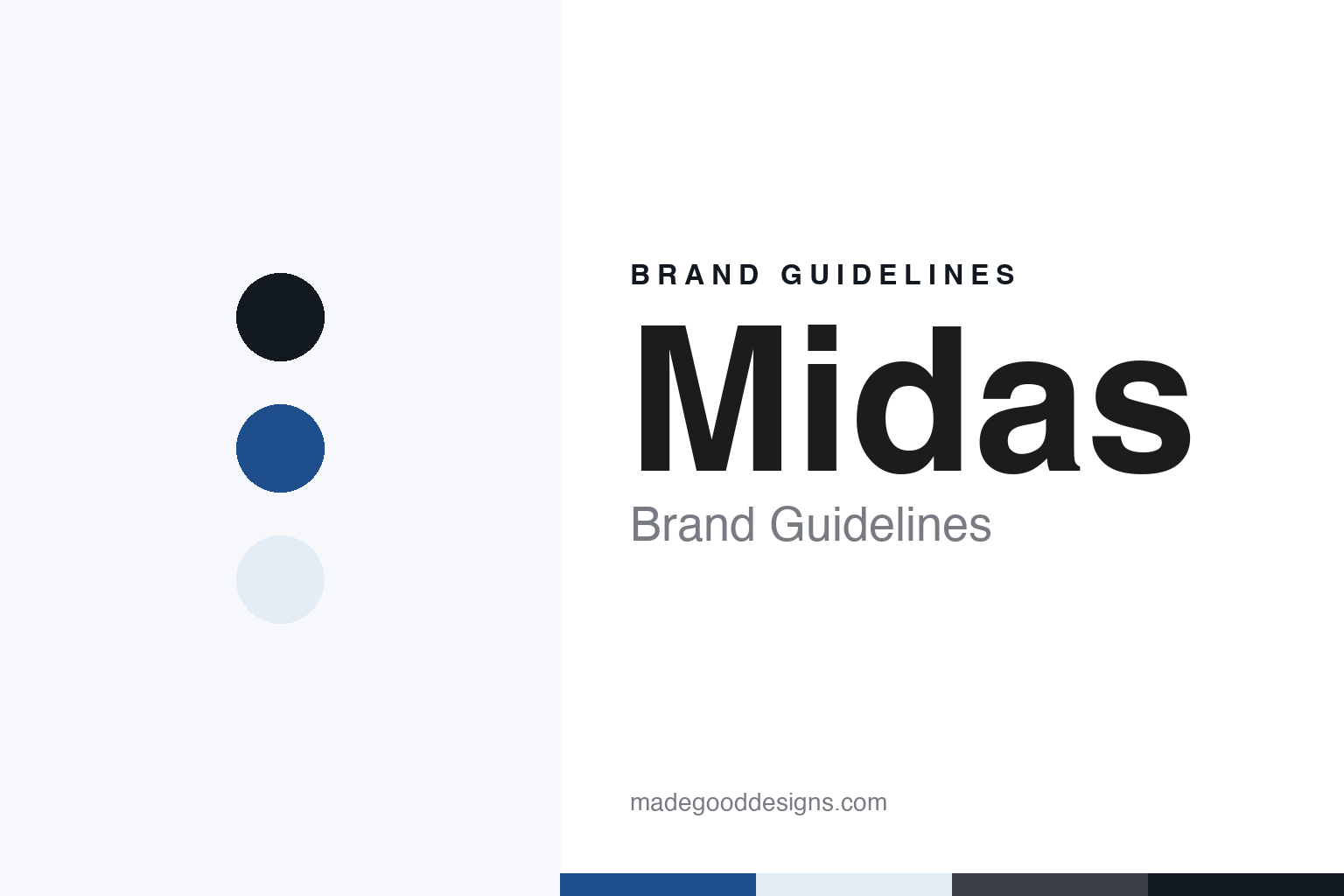
Midas Brand Guidelines
The London amplifier firm that became a touring-console name.
Aa
Two constants: a Midas blue and graphite palette and a Touring sans register. Abstract homage — not a Midas product or mark; no console, logo or nameplate is reproduced.
Stanhope Street
Amplifiers first, consoles second.
Midas did not start as a console maker. It was founded in London in 1970 by Jeff Byers and Charles Brooke and, Sound On Sound reported in December 2019, initially made transistor amplifiers and speaker cabinets; the company’s own timeline says it “evolved from guitar amps to modular PA systems.” In 1972 it moved to premises on Stanhope Street, near Euston Station, next door to Dave Martin’s loudspeaker company, Martin Audio. Through the 1970s, Sound On Sound wrote, the two firms became “synonymous” in the minds of many sound companies and engineers, and it was out of that link that Midas developed its first console.
Sources differ on when that was. The company dates “the first Midas mixing console” to 1972; English Wikipedia says Midas began making its PR System modular mixer in 1974, and the company itself says the PR System, or PRO4, launched in 1974 after touring with Supertramp. Sound On Sound linked the Pro 4 to Supertramp and their rental company, Delicate Productions.
The client list soon grew long. Sound On Sound named Elvis Presley, Yes, Billy Joel and the Beach Boys among mid-1970s users; Frank Zappa appeared in Midas advertisements endorsing his Pro 5; and Midas desks were specified for the stage musicals Cats and Evita. The company says it built custom quadraphonic rigs for Pink Floyd’s The Wall. In the early 1980s the modular PRO40 became its flagship.
Colour
Kidderminster and the XL3.
The next step nearly ended the company. Midas revealed its XL range in New York in 1986, but development had been costly, and “an overstretched Midas were wound up in December 1987,” Sound On Sound reported, with the assets bought by Klark Teknik, the Kidderminster signal-processing firm founded by the brothers Phil and Terry Clarke and known, Sound On Sound noted, for products such as the DN27 graphic equaliser. The company says the purchase moved production to Kidderminster, in Worcestershire.
Under its new owner Midas made the consoles that defined it. The XL2 followed in 1988, a “good workhorse desk,” in Sound On Sound’s words. The XL3 of 1990, designed by Andrew Grayland — reportedly in his shed, in about four months — had 40 input channels and 16 auxiliary sends, and could serve front-of-house or monitor mixing. It added VCA control and eight mute groups, though Sound On Sound noted that its bantam-jack patchbay, at a time when others used quarter-inch jacks, did not help, and that what won engineers over was its sound; the UK’s Science Museum Group holds one, recorded as made in 1990 in Kidderminster. The XL4 arrived in 1995; Mix, marking its tenth anniversary in December 2005, credited its design to the engineer Alex Cooper and pictured it with Big Mick Hughes, Metallica’s front-of-house engineer. In 1996, the company says, research and development was split into separate teams for Klark Teknik and for Midas. The Heritage series followed from 1998 with the H3000, the H4000 of 2002, which the company says was built for the rise of in-ear monitoring, and the Legend 3000, Verona and Siena consoles in the early 2000s; the company calls the Legend 3000, with two faders per channel, the first “Tri-Purpose” console.
Midas moved to digital in 2006 with the XL8, launched at Musikmesse in Frankfurt, which the company says was used for Led Zeppelin’s 2007 reunion concert. The PRO6 followed in 2008, and the smaller PRO3, PRO9, PRO2 and PRO1 between 2010 and 2012, Wikipedia says.
Typography
Live and broadcast consoles.
The mixing consoles and processors behind concerts, theatres and broadcast studios come from a small number of makers, and most of them now sit inside larger groups.
The biggest of those groups is Audiotonix, formed in 2014 by combining Allen & Heath, Calrec and DiGiCo, according to Wikipedia, citing The Wall Street Journal. It bought Solid State Logic in 2017, and the investment firm Ardian took a majority stake in 2019, the Financial Times reported. In 2024 Audiotonix announced an agreement with the investment firm PAI Partners, with Ardian and Astorg keeping minority stakes. DiGiCo gives its address as Chessington, in Surrey; Calrec’s is a mill in Hebden Bridge, West Yorkshire. Harrison, which presents itself as a Nashville brand, was bought by Solid State Logic, which announced the deal in April 2023; Harrison’s own history gives 2022.
Soundcraft, founded in Britain in 1973 by Phil Dudderidge and Graham Blyth, describes itself as part of Harman’s professional division. Samsung Electronics completed its purchase of Harman in 2017.
Midas and Klark Teknik have shared owners since Klark Teknik, of Kidderminster, bought Midas in 1987. Since December 2009 both have belonged to Music Group, now Music Tribe, the company chaired by Uli Behringer and based in Makati, in the Philippines; Midas says it opened a research centre in Manchester.
Lawo, of Rastatt in Germany, was founded in 1970 by Peter Lawo, according to Wikipedia; its website lists his son Philipp on the supervisory board. We found no outside group owner in the sources we checked.
This guide sets out what can be checked about each brand — who founded it, who owns it, and what it says about where its products are made — and marks clearly what rests only on the company’s own word.
Aa
A touring sans — a front-of-house register. (Specimen set in Inter Tight, a sans STAND-IN; NOT the Midas logo.)
Midas
“Part of Music Tribe.”
Ownership then passed through several groups. Wikipedia says the Clarke brothers sold Klark Teknik Group to Mark IV Audio in 1992; that in 1998 Mark IV’s EVI Audio, which owned Klark Teknik, and Telex were merged into Telex Communications; and that Bosch bought Telex in 2006 — its articles disagree on whether that was in January or September. In December 2009 Bosch sold Midas and Klark Teknik to Uli Behringer’s Music Group: the trade site Pro-Music-News reported that the asset deal was signed on 8 December, that 106 staff would transfer, and that the brands would continue under John Oakley. Music Group renamed itself Music Tribe in December 2017.
The new owner changed how Midas consoles are made and sold. In January 2014 Midas launched the M32, which Wikipedia describes as based largely on the Behringer X32 but with Midas Pro preamplifiers. The company says that after the purchase Music Tribe invested more than $20 million in a manufacturing hub in China, “Music Tribe City,” and that Midas opened an R&D centre in Manchester; Wikipedia says Music Tribe completed a new factory complex in Zhongshan in 2018. Today the website promotes the HD96-AIR console, lists training centres in Las Vegas and Manchester, and speaks of the brand’s “Midas Blue” analogue legacy.
For a design guide, Midas shows how a name built in touring sound can survive being wound up and several changes of owner. Compare Behringer, its sister brand under Music Tribe, and Martin Audio, its 1970s neighbour on Stanhope Street. For this guide we use a Midas blue and a graphite with a sans, an unofficial interpretation; no product or logo is reproduced.
Explore & save
Keep Midas’s identity on hand — save it to a board in the Made Good inspiration library.
Midas identity set
Pin the Midas blue and graphite palette and the Touring sans register to your own board.