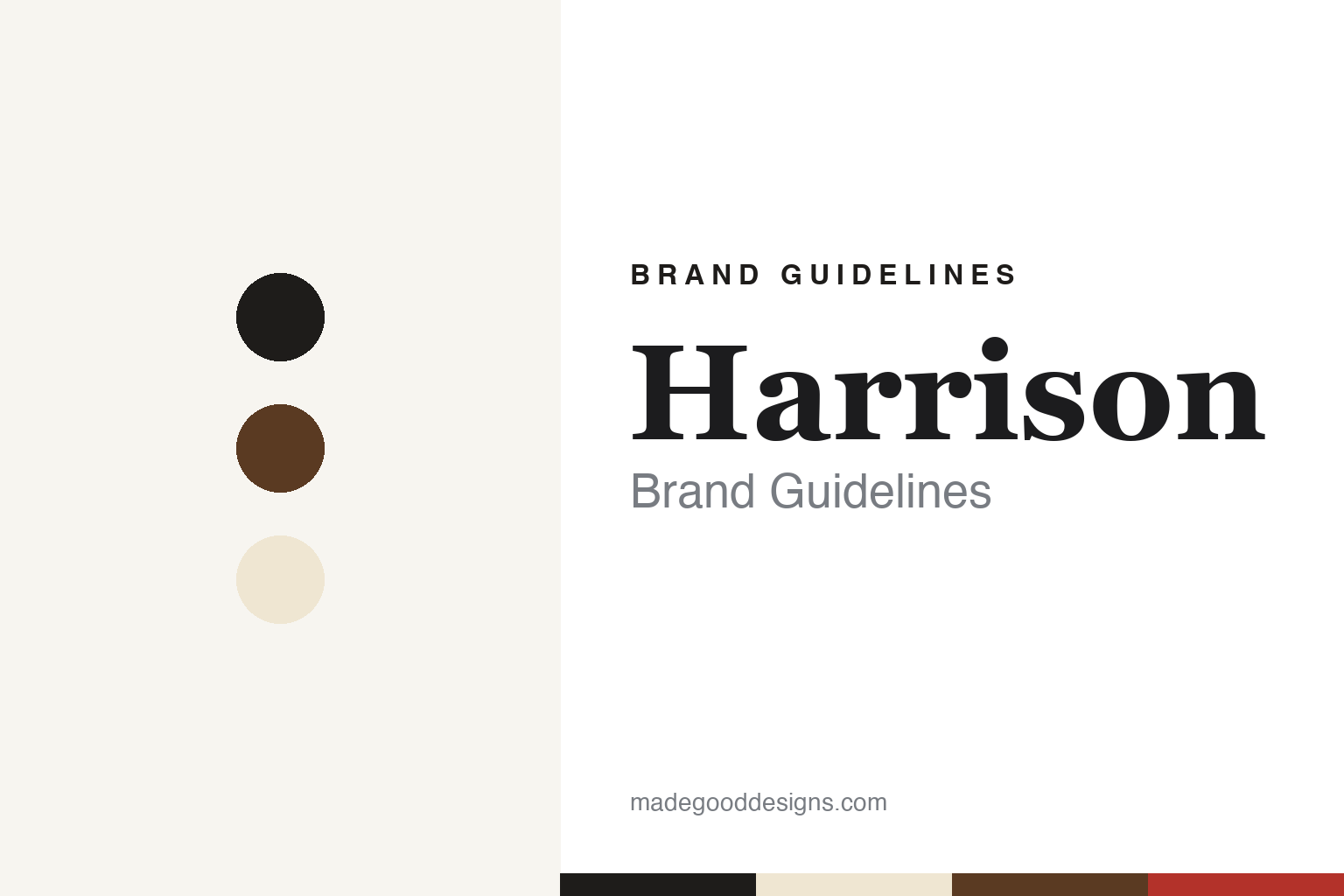
Harrison Brand Guidelines
The Nashville console maker behind the in-line desk.
Aa
Two constants: a Harrison black, walnut and cream palette and a Music City serif register. Abstract homage — not a Harrison product or mark; no console, logo or nameplate is reproduced.
Studio Supply, Nashville
A dealer with a console idea.
Harrison is the work of Dave Harrison, who, the company says, had been a saxophonist and the studio engineer and manager at King Records in Cincinnati, the label of James Brown, before moving to Nashville. There, in the early 1970s, he ran Studio Supply, which sold studio equipment, built studios and acted as a dealer for MCI, a maker of multitrack tape recorders. English Wikipedia, citing a 1980 article in db magazine, says he took MCI’s chief, Jeep Harned, the idea of an “in-line” console in 1972 — a layout that combines each channel’s recording and mixing functions in one strip — and that MCI used it in its JH-400 series. Sound On Sound called that series “the world’s first commercially available ‘in-line’ console” in 2023.
Harrison then designed a larger console, the 3232. The company says Harned “was not interested” in it; English Wikipedia, citing db, says MCI chose to release its own 500 Series instead, and that Pandora Systems — a company Harrison had formed with Tom Piper in late 1973 to make limiters and delay units — built the design, introducing it in December 1975. Studio Supply was sold and Harrison Systems, Inc. was formed in February 1976, the same source says, though the company dates itself to 1975, the year its first console was delivered. It describes the 3232 as the world’s first 32-bus in-line console, and says Dave Harrison was made a Fellow of the Audio Engineering Society for the in-line design.
The consoles found famous rooms. Sound On Sound wrote in December 2023 that Michael Jackson’s Thriller and Bad were recorded by Bruce Swedien through a Harrison 32C, that the console played a part in records by Paul Simon, Janet Jackson, AC/DC, Led Zeppelin, ELO, Genesis, Blondie and Supertramp, and that “big-name artists from ABBA to Zappa had one installed.” The company adds the PP-1 film console of 1979, which it calls the “Hollywood standard,” and the MR-series music consoles of the early 1980s.
Colour
Automation, film and the move to software.
In 1985 Harrison introduced the SeriesTen, which it calls the world’s first totally automated console: its controls governed the analogue audio digitally rather than sitting in the signal path, so every setting could be stored and recalled. In 1989, the company’s own archived history says, Harrison Systems was bought by GLW Incorporated, which kept the Harrison name; a 2000 copy of the website gives the headquarters as La Vergne, on the edge of Nashville.
GLW’s first product was the SeriesTenB, with Mac-based automation and video graphics. It won the 1991 TEC Award for console technology, and the LPC live console, developed with the touring sound company Showco, won the 1999 TEC Award for sound reinforcement console technology, according to the Mix Foundation’s archived winners lists. In the 1990s Harrison moved deeper into film: the company says the first MPC motion-picture console was installed at Sony Pictures in Hollywood on Valentine’s Day 1992, and that a later MPC4-D went into Universal’s Alfred Hitchcock Theater in 2005. It names Spider-Man, Transformers, Pearl Harbor and The Simpsons among the productions mixed on its desks.
The next shift was to software. Harrison built its later systems on Linux and off-the-shelf computers, and in 2009 launched Mixbus, a digital audio workstation developed with an open-source community — English Wikipedia says it is based on the Ardour workstation — which puts a Harrison-style mixer, with EQ, compression and saturation, on screen. A higher tier, Mixbus32C, followed in 2016, and plug-ins that run in other workstations followed in 2018. By 2023 Sound On Sound could say Harrison had become best known for its Mixbus 32C software.
Typography
Consoles for live sound and broadcast.
The mixing consoles and processors behind concerts, theatres and broadcast studios come from a small number of makers, and most of them now sit inside larger groups.
The biggest of those groups is Audiotonix, formed in 2014 by combining Allen & Heath, Calrec and DiGiCo, according to Wikipedia, citing The Wall Street Journal. It bought Solid State Logic in 2017, and the investment firm Ardian took a majority stake in 2019, the Financial Times reported. In 2024 Audiotonix announced an agreement with the investment firm PAI Partners, with Ardian and Astorg keeping minority stakes. DiGiCo gives its address as Chessington, in Surrey; Calrec’s is a mill in Hebden Bridge, West Yorkshire. Harrison, which presents itself as a Nashville brand, was bought by Solid State Logic, which announced the deal in April 2023; Harrison’s own history gives 2022.
Soundcraft, founded in Britain in 1973 by Phil Dudderidge and Graham Blyth, describes itself as part of Harman’s professional division. Samsung Electronics completed its purchase of Harman in 2017.
Midas and Klark Teknik have shared owners since Klark Teknik, of Kidderminster, bought Midas in 1987. Since December 2009 both have belonged to Music Group, now Music Tribe, the company chaired by Uli Behringer and based in Makati, in the Philippines; Midas says it opened a research centre in Manchester.
Lawo, of Rastatt in Germany, was founded in 1970 by Peter Lawo, according to Wikipedia; its website lists his son Philipp on the supervisory board. We found no outside group owner in the sources we checked.
This guide sets out what can be checked about each brand — who founded it, who owns it, and what it says about where its products are made — and marks clearly what rests only on the company’s own word.
Aa
A Music City serif — for a console maker that trades on its Nashville roots. (Specimen set in Libre Baskerville, a serif STAND-IN; NOT the Harrison logo.)
Harrison
Nashville design, an Oxford parent.
On 11 April 2023 Solid State Logic, the Oxfordshire console maker, announced its acquisition of Harrison, bringing it into the Audiotonix group, which also owns DiGiCo, Allen & Heath and Calrec. No price was given in the announcement. Harrison’s president, Gary Thielman, said the deal gave Harrison “access to further manufacturing, knowledge in engineering” and new sales channels. Dates differ elsewhere: Harrison’s own history page says SSL acquired it in 2022, and English Wikipedia gives October 2023, citing an article that itself dates the deal to April; we follow SSL’s announcement.
The first product of the new era was the 32Classic, an analogue console launched in October 2023 and priced at $90,000 in the US, which Sound On Sound reviewed that December. Where it is made is worth stating carefully. audioXpress reported that it is “designed and engineered by Harrison Audio in Nashville, Tennessee, and manufactured in Oxford, England.” Audiotonix’s brand page, by contrast, still describes Harrison as designing and manufacturing consoles in Nashville since 1975. We give both. Harrison has since added 500-series modules, the 32Classic MS channel strip and, in August 2026, the Flex-10 audio interface, and its website still lists the MPC 5 film console and Mixbus. Its address on the web is harrisonaudio.com; the older harrisonconsoles.com appears in the 2023 announcement.
For a design guide, Harrison shows how a console maker’s sound and its record credits can carry a name through several owners. Compare Solid State Logic, its parent since 2023, and AMS Neve. For this guide we use console black, a walnut brown and a cream with a serif, an unofficial interpretation; no product or logo is reproduced.
Explore & save
Keep Harrison’s identity on hand — save it to a board in the Made Good inspiration library.
Harrison identity set
Pin the Harrison black, walnut and cream palette and the Music City serif register to your own board.