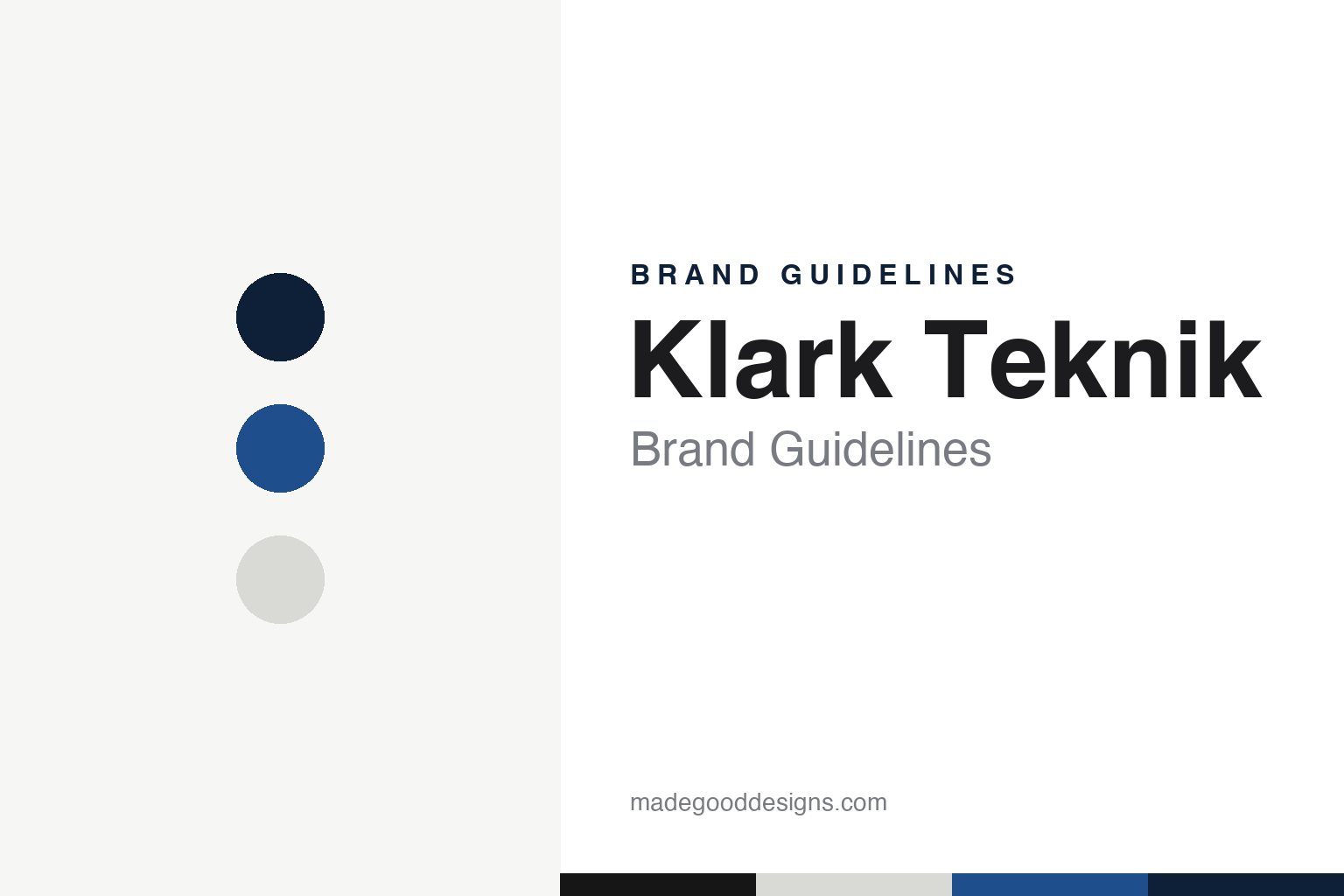
Klark Teknik Brand Guidelines
The Kidderminster equaliser maker that outlived four owners.
Aa
Two constants: a rack black, grey and signal blue palette and a condensed sans register. Abstract homage — not a Klark Teknik product or mark; no equipment, logo or front panel is reproduced.
Two brothers
From garage machines to graphic equalisers.
Klark Teknik was started in Kidderminster, Worcestershire, by two brothers, Terry and Phil Clarke. Sound On Sound, in a 2019 history of the Midas XL3 console, describes the brand as Kidderminster-based, “despite their Teutonic-sounding name,” and says the brothers had spent time in Australia before returning to Britain. English Wikipedia gives the year the Klark Teknik name came into use as 1974.
Audio was not the first business. The company’s own history says Terry went to work for Decca at its cassette duplication plant in Bridgnorth, Shropshire, designing and servicing tape-winding machines, while Phil brought back from Australia the idea of coin-operated car-washing machines for garages; English Wikipedia instead describes forecourt vacuum cleaners and space heaters, so the accounts differ on the detail. Both place the early firm in Nissen huts on the Summerfield site near Kidderminster.
Audio began as a sideline. The company says it made small inductor-based graphic equalisers from 1973, sold mostly to recording studios, and found that batches of 50 or 100 standard units could be sold for about half the price of one-off designs. It also built a small number of quarter-inch reel-to-reel tape machines, the start of what it calls a long relationship with the BBC; Wikipedia says the machine, the SM2, was sold to the BBC and independent broadcasters under the “Teknik” name.
The first product made in real volume was the DN27 graphic equaliser, which Wikipedia dates to 1976 and says sold about 6,500 units between 1977 and 1985. The company says its equalisers were first shown in the United States at the 1976 Billboard Disco show, that a US office opened in New York in 1980, and that by then a third of its production was going to America.
Colour
Equalisers, analysers and a console maker.
In 1978, the company says, it bought a 99-year lease on a plot on Walter Nash Road in Kidderminster, and in 1980 its 15 staff moved into new purpose-built premises there. It gives the headcount as 45 in 1985 and 144 by 1989.
The products of those years made the name. The company lists the DN60 real-time analyser of 1980 and the DN300 series of graphic equalisers of 1982, which it says needed an extension to the building. English Wikipedia dates the DN360 dual graphic equaliser to 1984; the company, introducing its DN370 in 2003, described the DN360 as launched nearly twenty years earlier. Claims that particular models were the first of their kind come from the company and from an unsourced Wikipedia list, so we do not repeat them as fact.
Growth brought a stock-market listing. The company says it became a public limited company and floated on the London Stock Exchange in 1984; English Wikipedia gives 1985 for the formation of Klark Teknik PLC. With the money it bought DDA (Dearden-Davies Associates), the Hounslow studio-console maker — for £2 million, the company says, two years after the flotation. Wikipedia adds a Queen’s Award for export, linked to the Klark Acoustic monitor range; it does not cite a source, and we have not confirmed it.
The biggest purchase was Midas. Sound On Sound reports that the London console maker, overstretched by the cost of its XL range, was wound up in December 1987 and its assets bought by Klark Teknik. Midas’s own history says production moved to Kidderminster. Under that ownership came the XL3 of 1990, which Midas’s history says re-established the brand, and later the XL4.
Typography
Live sound and broadcast.
The mixing consoles and processors behind concerts, theatres and broadcast studios come from a small number of makers, and most of them now sit inside larger groups.
The biggest of those groups is Audiotonix, formed in 2014 by combining Allen & Heath, Calrec and DiGiCo, according to Wikipedia, citing The Wall Street Journal. It bought Solid State Logic in 2017, and the investment firm Ardian took a majority stake in 2019, the Financial Times reported. In 2024 Audiotonix announced an agreement with the investment firm PAI Partners, with Ardian and Astorg keeping minority stakes. DiGiCo gives its address as Chessington, in Surrey; Calrec’s is a mill in Hebden Bridge, West Yorkshire. Harrison, which presents itself as a Nashville brand, was bought by Solid State Logic, which announced the deal in April 2023; Harrison’s own history gives 2022.
Soundcraft, founded in Britain in 1973 by Phil Dudderidge and Graham Blyth, describes itself as part of Harman’s professional division. Samsung Electronics completed its purchase of Harman in 2017.
Midas and Klark Teknik have shared owners since Klark Teknik, of Kidderminster, bought Midas in 1987. Since December 2009 both have belonged to Music Group, now Music Tribe, the company chaired by Uli Behringer and based in Makati, in the Philippines; Midas says it opened a research centre in Manchester.
Lawo, of Rastatt in Germany, was founded in 1970 by Peter Lawo, according to Wikipedia; its website lists his son Philipp on the supervisory board. We found no outside group owner in the sources we checked.
This guide sets out what can be checked about each brand — who founded it, who owns it, and what it says about where its products are made — and marks clearly what rests only on the company’s own word.
Aa
A condensed sans for rack labels and model numbers. (Specimen set in IBM Plex Sans Condensed, a sans STAND-IN; NOT the Klark Teknik logo.)
Klark Teknik
Mark IV, Telex, Bosch, Music Tribe.
The Clarkes did not keep the business. English Wikipedia says they sold Klark Teknik Group to Mark IV Audio in 1992; Mark IV Industries’ annual report filed in May 1994 lists Klark Teknik Plc among its subsidiaries, credits Klark Teknik with the Midas XL3 and names DDA as “another Mark IV Audio company.” The next step is often dated wrongly. US securities filings show that on 10 February 1997 a company owned by Greenwich Street Capital Partners bought the parent of EV International from Mark IV, and that on 2 February 1998 EVI merged with Telex and took the name Telex Communications; Wikipedia’s account puts the sale in 1998. By 2001 the klarkteknik.com address was serving Telex’s corporate pages.
Kidderminster stayed a factory through those years. Telex’s annual report filed in March 2006 lists an owned 35,800 sq ft site there, used for manufacturing, sales, product development and service. On 28 June 2006 Telex announced that Bosch would buy it for $420 million including debt, naming Midas and Klark Teknik among its brands. In December 2009 Bosch sold Midas and Klark Teknik to Music Group, Uli Behringer’s company, in an asset deal signed on 8 December, Pro-Music-News reported; 106 staff moved across and the brands were to run autonomously. Music Group renamed itself Music Tribe in 2017 and is based in Makati, in the Philippines, according to Wikipedia.
Where the products are made today is less clear. Klark Teknik’s website lists DI boxes, the 369 stereo compressor — which it says uses custom-built Midas transformers — and network and expansion cards, but the pages we checked do not say where they are made. Music Tribe’s Midas history says that after the 2009 purchase it invested more than $20 million in a manufacturing hub in China, and Wikipedia, citing Systems Integration Asia, places the group’s factory complex in Zhongshan, opened in 2018. The UK company set up in 2009 as Midas Klark Teknik Limited is now registered at Companies House as a research and development company, under the name Empower Tribe Innovations UK. We found no current record of Klark Teknik manufacturing in Kidderminster, and we do not assign its products a country.
For a design guide, Klark Teknik shows how a model-number language — DN27, DN360 — can carry a brand through four owners. Compare Midas, the console maker it bought in 1987, and Behringer, its sister brand under Music Tribe. For this guide we use rack black, grey and a signal blue with a condensed sans, an unofficial interpretation; no product or logo is reproduced.
Explore & save
Keep Klark Teknik’s identity on hand — save it to a board in the Made Good inspiration library.
Klark Teknik identity set
Pin the Klark Teknik rack black, grey and signal blue palette and the condensed sans register to your own board.