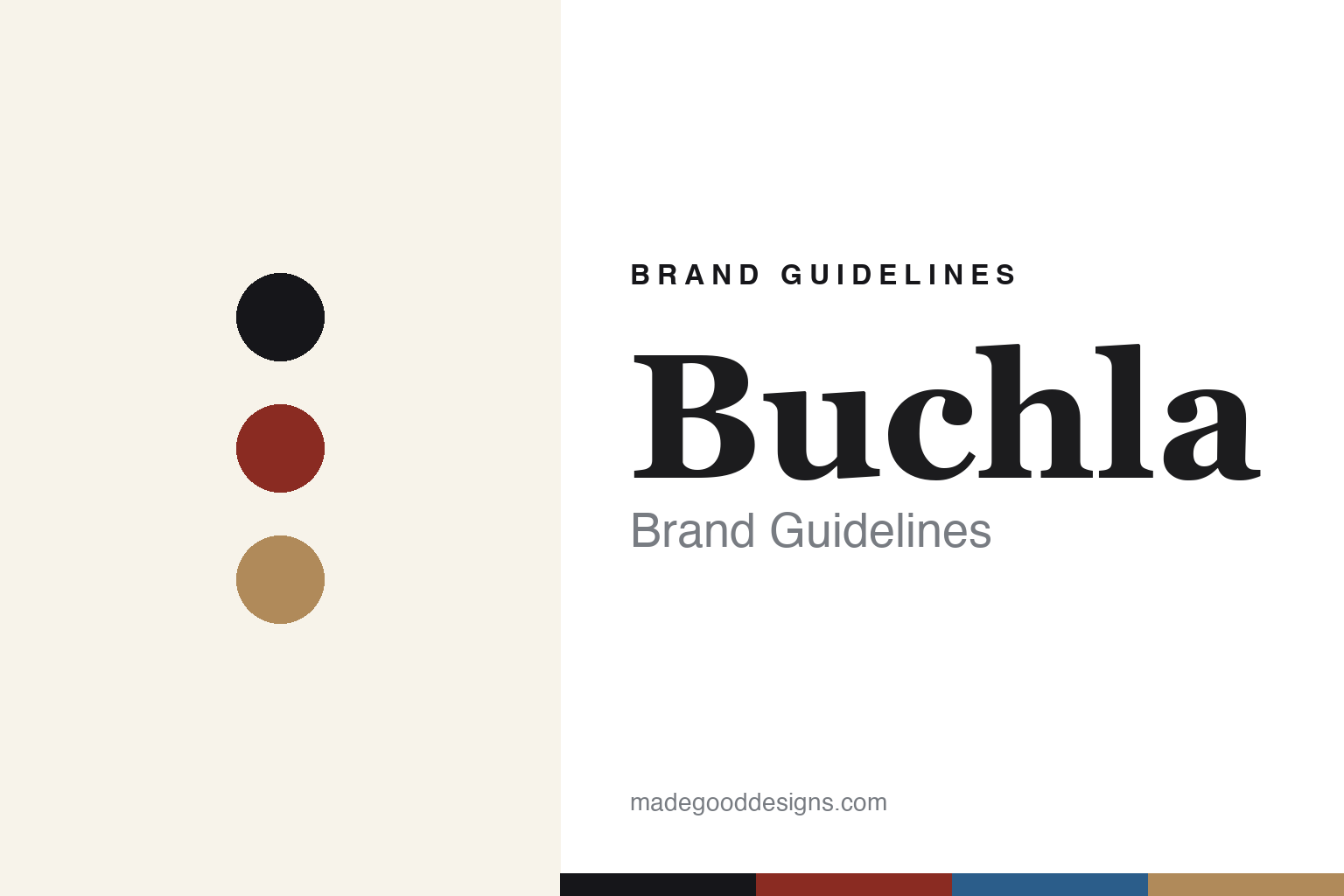
Buchla Brand Guidelines
The Berkeley instruments that refused to be called synthesizers.
Aa
Two constants: a Buchla panel black, patch red, signal blue and oak palette and an Instrument serif register. Abstract homage — not a Buchla product or mark; no instrument, logo or nameplate is reproduced.
Buchla & Associates
A commission from the San Francisco Tape Music Center.
Buchla began in Berkeley, California, with the designer Don Buchla, who studied physics at the University of California there. English Wikipedia dates his company, Buchla & Associates, to 1962 in one article and 1963 in another, so we give both. Its first instrument came from a commission: the composers Morton Subotnick and Ramon Sender of the San Francisco Tape Music Center wanted an electronic instrument for composition and live performance and, according to Wikipedia, put $500 from a Rockefeller Foundation grant toward it. “I put an ad in the paper and he showed up,” Subotnick told The Guardian in 2016.
The result, later called the Series 100 Modular Electronic Music System, was built from separate modules — oscillators, envelope generators, voltage-controlled amplifiers and some of the earliest analog sequencers — patched together with cables and played from touch- and pressure-sensitive plates rather than a piano keyboard. The earliest modules were labelled “San Francisco Tape Music Center.” Wikipedia says a system was installed at the Tape Music Center in 1965 and moved to Mills College in 1966, and that Subotnick made Silver Apples of the Moon on another unit shipped to New York. The Guardian wrote that Buchla “independently invented the first modern synthesizer, at the same time as Robert Moog, in 1963.” In 1969 the line was briefly sold to CBS Musical Instruments, which soon dropped it, Keyboard’s Mark Vail wrote.
The 200 series Electric Music Box followed in 1970. In 1971 came the 500 series, which the Encyclopedia of Recorded Sound calls the first digitally controlled analog synthesizer, then the hybrid 300 series and, in the early 1970s, the portable Music Easel, a compact instrument that could be reprogrammed with plug-in program cards.
Colour
Complex oscillators, lopass gates and no piano keyboard.
Buchla’s instruments were built on a different idea of what an electronic instrument is for. The company’s history page says Don Buchla avoided the word “synthesizer” because it suggested imitating existing sounds; his aim was new ones. That shows in the names on the panels: a Complex Waveform Generator, a Multiple Arbitrary Function Generator, a Source of Uncertainty, a Quad Dynamics Manager. Where many synthesizers shape a simple waveform with a resonant filter, Buchla designs lean on complex oscillators, frequency and amplitude modulation and waveshaping, and on “lopass gates” built with vactrols, light-dependent components used as voltage-controlled resistors, English Wikipedia explains. Buchla U.S.A. now describes the result as a style of synthesis “often associated with the western coast of America.”
He explained the philosophy in a 1982 Keyboard interview quoted by The Guardian: engineers “design from the inside out,” he said, but a designer of legitimate instruments “has to design them from the outside in.”
The catalogue kept moving. The company’s history lists the Touché of 1978, the Buchla 400 with a video display in 1982 and the MIDI-equipped 700 in 1987, then a turn to controllers: Thunder in 1990, Lightning in 1991, the Marimba Lumina at the end of the decade and the Piano Bar of 2002, later made and sold by Moog Music. For Oberheim, then owned by Gibson, he designed the OB-Mx in the mid-1990s. In 2004 he returned to the modular format with the 200e, a hybrid system whose panels behave like analog modules but whose settings can be stored digitally. In 2002 he received the SEAMUS Lifetime Achievement Award from the Society for Electro-Acoustic Music in the United States, the company says.
Typography
Design and documentation.
Beyond the largest names in electronic instruments sits a tier of smaller synthesizer makers, some dating from the 1960s and others barely a decade old. Many have changed hands.
Oberheim, founded by Tom Oberheim in 1969, passed to Gibson after a 1988 bankruptcy; English Wikipedia says Gibson returned the trademark to its founder in 2019. Focusrite plc says it bought the Oberheim brand and trademarks from Tom Oberheim in 2022, and the brand, based in San Francisco, now works alongside Focusrite’s Sequential. Buchla began with Don Buchla in Berkeley in 1963; Australian investors bought it in 2012, and in 2018 its assets passed to Buchla U.S.A., which says many products are hand-built to order.
Waldorf, founded in 1988, went insolvent in 2004; Waldorf Music GmbH, set up in 2006, gives its address as Remagen, Germany. Access, maker of the Virus, calls itself a privately held German manufacturer; its website is published by Kemper GmbH of Recklinghausen, and German Wikipedia says no Virus has been produced since February 2024.
Modal Electronics, a British company incorporated in 2013, entered administration in 2023; after a 2024 restructuring involving Alltronics Holding, Modal calls itself a brand of a Hong Kong–registered company. Polyend, founded by Piotr Raczyński, is based in Olsztyn, Poland. 1010music, which debuted in 2016, gives Los Angeles as its home and lists China as the country of origin for its current hardware.
This guide sets out what can be checked about each brand — who founded it, who owns it, and what it says about where its products are made — and marks clearly what rests only on the company’s own word.
Aa
An instrument serif — for a maker that named its modules like scientific apparatus. (Specimen set in Fraunces, a serif STAND-IN; NOT the Buchla logo.)
Buchla
From Buchla & Associates to Buchla U.S.A.
The business has changed hands twice. At the January 2012 NAMM Show, Buchla & Associates announced new ownership and a new name, Buchla Electronic Musical Instruments, with Don Buchla staying on as chief technology officer, Keyboard reported. The buyer was Audio Supermarket, “an Australia-based music distributor,” FACT later wrote. The new company reissued the Music Easel in 2013. In 2015 Don Buchla sued its owners for breach of contract, FACT reported; federal court records show the case was closed in August 2016, and Wikipedia says the parties settled out of court. Don Buchla died in Berkeley on 14 September 2016, aged 79, The New York Times and The Guardian reported.
In January 2018 a new company, Buchla U.S.A., announced that it had bought Buchla Electronic Musical Instruments and all its assets, CDM reported. It was headquartered in Minneapolis under the chief executive Eric Fox, owner of the distributor Foxtone Music, and brought back the engineer Joel Davel, who had worked with Don Buchla for more than twenty years; CDM said design and manufacturing would remain in the San Francisco Bay Area. The company’s website today says Buchla U.S.A. acquired Don Buchla’s “50-year body of intellectual property.” It sells and supports the 200e alongside an EASEL family — a Music Easel, an EASEL and an EASEL Command — reissued 200 series modules “redesigned by Roman Filippov of Black Corporation,” and a new instrument without patch cords, Ziggy, in an enclosure of oak and steel. The site does not say where current products are made, and we could not confirm whether manufacturing is still in the Bay Area.
For a design guide, Buchla shows how an instrument maker can build an identity from vocabulary and panel layout as much as from a logo. Compare Make Noise, a modular maker, and Arturia, which released a software emulation of the Music Easel in 2017. For this guide we use panel black, a patch red, a signal blue and oak with a serif, an unofficial interpretation; no product or logo is reproduced.
Explore & save
Keep Buchla’s identity on hand — save it to a board in the Made Good inspiration library.
Buchla identity set
Pin the Buchla panel black, patch red, signal blue and oak palette and the Instrument serif register to your own board.