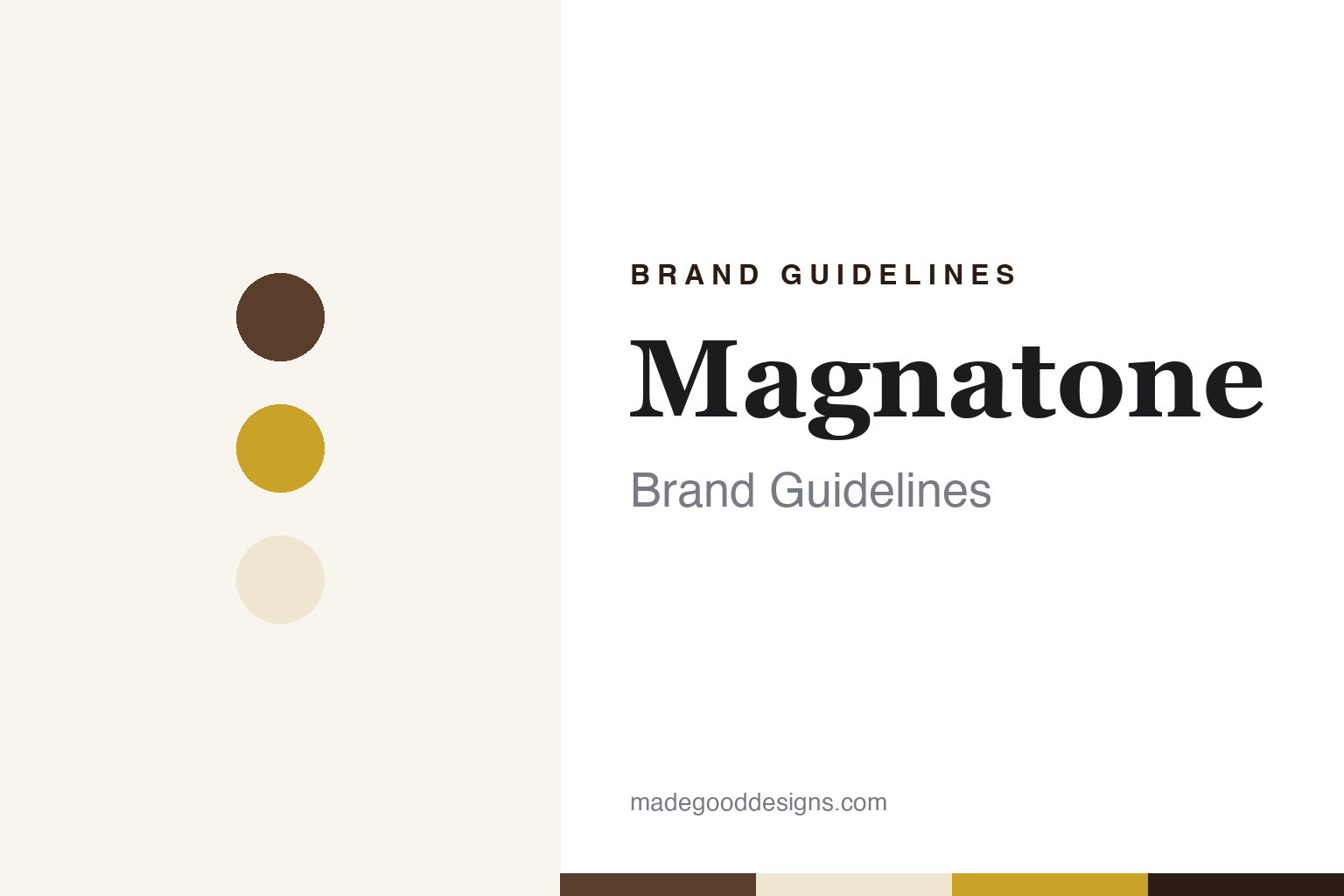
Magnatone Brand Guidelines
The vibrato amp brand revived in St. Louis.
Aa
Two constants: a Magnatone brown and gold palette and a Mid-century serif register. Abstract homage — not a Magnatone product or mark; no amplifier, chevron, logo or nameplate is reproduced.
Dickerson to Magna
A steel-guitar workshop in Los Angeles.
Magnatone’s story begins with Delbert J. Dickerson, a machinist who, the British magazine Guitarist reported in 2014, had worked in a radio factory in Salt Lake City before moving to Los Angeles in the early 1930s. When his daughter, a guitar student, needed an electric steel guitar and amplifier, he built them himself, and word of mouth did the rest among Southern California’s Hawaiian-guitar players. By the late 1930s the Dickerson Musical Instrument Manufacturing Company was making steel guitars and matching amplifiers in Los Angeles, The Music Trades reported in a 2016 profile. The present company dates the brand to 1937, as does English Wikipedia.
The early amps were known for their look as much as their sound. Dickerson and early Magnatone amplifiers wore pearloid coverings — collectors call them “mother of toilet seat” — and, Vintage Guitar’s John Teagle wrote in the late 1990s, a stencilled Dickerson logo first seen around 1938; after the war, ordinary window screen sat behind a two-tone “fuzz” grille.
The business changed hands in the mid-1940s. In 1946 it passed to Art Duhamell, whose Magna Electronics made portable radios and phonographs; he changed the brand to Magnatone and the business name to Magna Electronics Company, according to Guitarist. Accounts differ on the details: English Wikipedia names Gaston Fator Guitar Studios of Los Angeles as an owner in between, while The Music Trades spells the new owner’s name “DuHammell” and says he bought Dickerson’s business directly. We give both.
Colour
True vibrato.
Magnatone’s claim to fame is its vibrato. Where many makers’ “vibrato” circuits varied volume — properly called tremolo — Magnatone’s varied pitch. Its 200 series, the 213, 260 and 280, arrived with that pitch-bending vibrato in 1957, Teagle wrote, in a new dark-brown cabinet with the baffle tipped back 15 degrees; light-brown leatherette had been standard from about 1955. A US patent for a vibrato circuit by Don L. Bonham, filed in October 1958, was granted in June 1961. The company today says it invented true pitch-shifting vibrato in 1957, and its amplifiers still use silicon-carbide varistors, the component at the heart of the original circuit.
The players are well documented. Vintage Guitar has written about Buddy Holly’s 1958 Magnatone 280; Guitarist reported that he obtained a Custom 280 in September 1958, with stereo vibrato, two 12-inch Jensen speakers and two 5-inch tweeters. Lonnie Mack used Magnatone vibrato amps almost exclusively, English Wikipedia says, and Guitarist points to his “Wham!” to hear the effect; Bo Diddley and Robert Ward are also named. Neil Young has long used a vintage 280.
Guitars came too. Paul Bigsby designed the Mark series of solid-body electrics from about 1955 to 1957, according to Guitarist and Andy Babiuk’s 2009 history of Bigsby, and Paul Barth, formerly a Rickenbacker designer, drew a later line.
Then came the decline. The company was sold again in 1957 and turned towards organs in the early 1960s; The Music Trades says it passed through a series of owners, including the Estey Organ Company of Brattleboro, Vermont. New Custom and Starlite amps appeared in 1963 and Barth’s Starstream series in 1964, Guitarist reported, before financial trouble, a move away from Southern California and the end of valve-amp production around 1967–68. The name disappeared after 1969.
Typography
Design and documentation.
American guitar amplification runs from mass manufacturers to small workshops and old names bought back and revived. The seven brands in this guide cover that range.
The largest is Peavey, founded by Hartley Peavey in 1965 and privately owned and based in Meridian, Mississippi; in 2014, as it closed a Meridian plant, Hartley Peavey said most of the lower end of the range had gone offshore while the expensive products stayed in the United States. Randall was founded around 1970 by Don Randall, formerly in charge of Fender’s sales, and its website now calls it a division of JAM USA; JAM, founded in Montreal, says it was bought by Ireland’s DCC in 2018, and its website now carries the name Nexora, DCC’s technology business.
Three carry the names of the engineers who started them. Soldano was founded by Michael Soldano in Los Angeles in 1986 and later moved to Seattle; English Wikipedia says he agreed in 2019 to sell it to Boutique Amps Distribution and stay on as designer. Rivera was founded by Paul Rivera in Southern California in 1985, and Egnater grew from the repair shop Bruce Egnater opened near Detroit in 1975.
Two are revived mid-century names. Magnatone, rooted in a southern Californian maker of the late 1930s, was revived in 2013 by Ted Kornblum, and now issues its news from St. Louis. Supro, made in Chicago by Valco until 1968, was revived on Long Island — its trademark bought in late 2013, its first new amps shown in 2014 — and has been owned since 2020 by the New York group behind D’Angelico Guitars.
Soldano, Magnatone and Supro each describe at least some of their amplifiers as hand-built in the USA.
This guide sets out what can be checked about each brand — who founded it, who owns it, and what it says about where its products are made — and marks clearly what rests only on the company’s own word.
Aa
A mid-century serif — “True Dimensional Sound.” (Specimen set in DM Serif Display, a serif STAND-IN; NOT the Magnatone logo.)
Magnatone
The chevron stayed.
The revival came from St. Louis. Ted Kornblum is the grandson of Bernard Kornblum, who founded St. Louis Music in 1922, and the son of Gene Kornblum, who created the Alvarez and Crate lines and revived Ampeg, The Music Trades reported in 2016. Finding the Magnatone trademarks abandoned, he registered them; his family sold St. Louis Music to Loud Technologies in 2005, and the magazine noted that Magnatone has no link to either. The company’s own dates for the revival vary — “the early 2000s” on its About page, 2007 in a 2023 press release — but the new amplifiers made their debut at the NAMM Show in January 2013: six models, developed with input from Billy Gibbons and Neil Young’s technician Larry Cragg. In an August 2024 release the company still named Kornblum as president and chief executive.
The range has grown into Traditional, Master and Point-to-Point collections, plus signature lines for Billy Gibbons and Slash, whose 100-watt SL-100 head was announced in January 2024 in a run of 100 covered in green “anaconda.” New models — the Kingston, the Starlite Reverb 10 and a limited Point-to-Point Varsity Reverb — were shown at NAMM in January 2026.
Magnatone says its amplifiers are “hand-built in St. Louis, Missouri using premium American-made parts,” and pledges to use “American-made parts and labor.” The Music Trades described a small St. Louis workshop where builders hand-wire each chassis; we give the origin claim as the company’s own.
Its look is unusually deliberate. The 2016 profile described cabinets covered not in Tolex but in a cotton-backed cloth used for binding books, leather handles made by Amish saddle makers, and a 14-carat gold chevron on brown grille cloth. In September 2026 the company explained the chevron: on vintage amps one chevron meant mono and two meant stereo; today one chevron means one speaker and two mean two. They come in 14K gold-plate or silver and are fitted by hand in St. Louis, it says.
For a design guide, Magnatone shows how a revived name can carry its identity in small details. Compare Ampeg, the brand Kornblum’s father revived in St. Louis, and Fender, whose tremolo circuits English Wikipedia contrasts with Magnatone’s vibrato. For this guide we use a grille brown and a chevron gold with a serif, an unofficial interpretation; no product or logo is reproduced.
Explore & save
Keep Magnatone’s identity on hand — save it to a board in the Made Good inspiration library.
Magnatone identity set
Pin the Magnatone brown and gold palette and the Mid-century serif register to your own board.