Supro Brand Guidelines
The budget amp brand that landed on rock records.
Aa
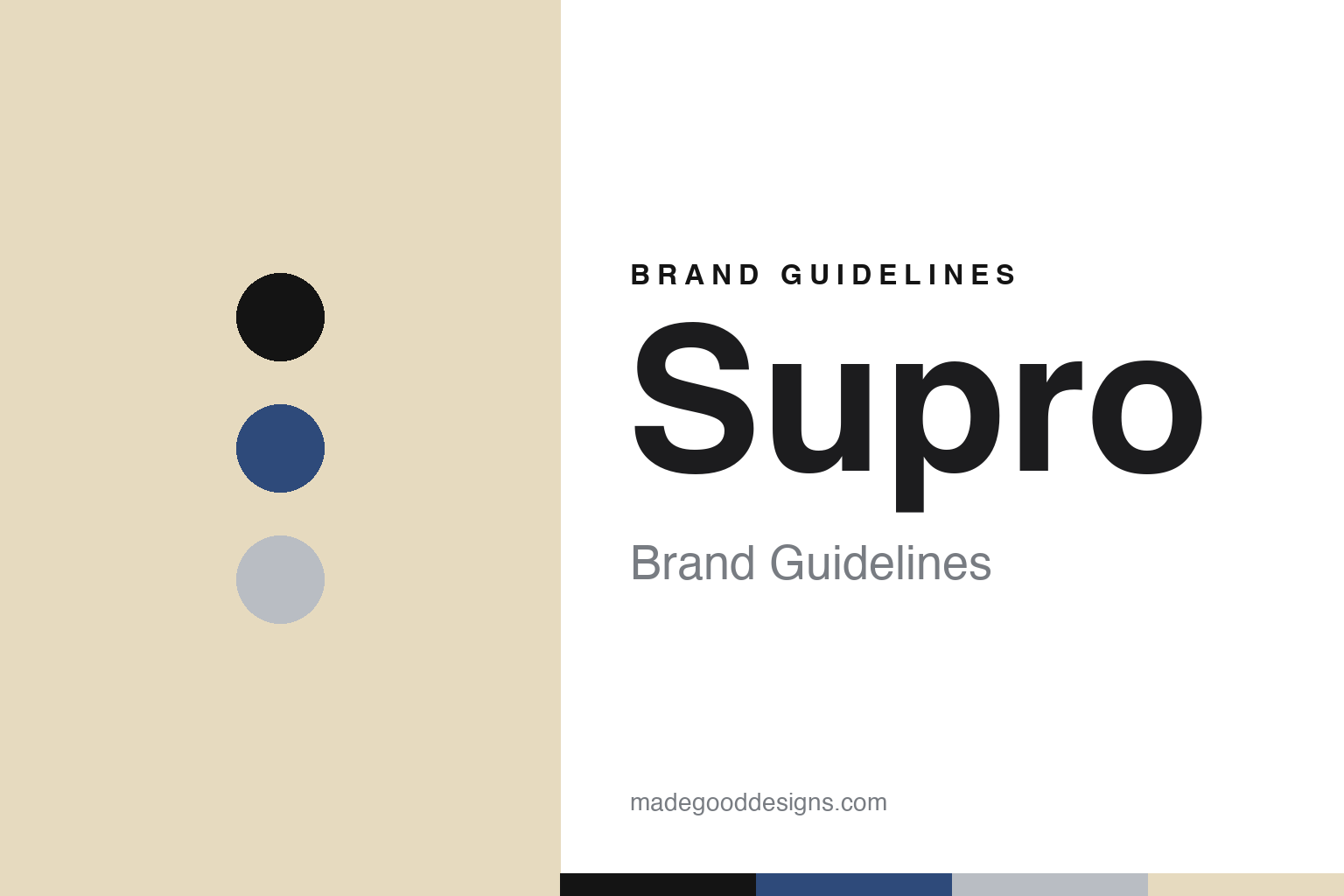
Two constants: a Supro black, blue and silver palette and a Deco sans register. Abstract homage — not a Supro product or mark; no amplifier, logo or nameplate is reproduced.
The budget brand
Born in Los Angeles, raised in Chicago.
Supro began as a second name. In his history of the brand for Vintage Guitar in 2002, Michael Wright called it “basically the ‘budget’ brand of the National Dobro, and later, the Valco company” — the makers best known for National and Dobro resonator guitars. National and Dobro, rival Los Angeles firms tied to the Dopyera brothers, merged in 1935, and the first Supro instruments followed in late 1935, Wright writes, though they were not announced until March 1936: an aluminium Hawaiian lap steel, electric Spanish and tenor guitars, an electric mandolin and an amplifier.
Those first Supros were not made in Chicago. Wright notes that the cast-aluminium lap steels were made in Los Angeles; National Dobro’s move to Chicago, then the centre of American instrument making and home to the mail-order giants Sears and Montgomery Ward, began early in 1936 and took about a year and a half. Supro’s own website today says it was “first manufactured in Chicago from 1935 to 1968,” which compresses that story.
Ownership then passed to Valco, named from the initials of Victor Smith, Al Frost and Louis Dopyera. English Wikipedia dates Valco to 1940; Premier Guitar, in a 2013 history of Chicago guitar making, says the three bought the company around 1934 — so the sources differ. Either way, Valco made guitars and valve amplifiers under the Supro, National and Airline names, and built amplifiers under contract for Gretsch, Harmony and Kay, English Wikipedia says. Premier Guitar adds that the Airline versions were sold through Montgomery Ward, a reminder that much of Valco’s trade went out under other people’s names.
Colour
Amps-in-cases, fibreglass and two famous players.
Wright’s history opens with a list of what made the brand unusual: “some of the earliest electric guitars, amps-in-cases, pickups under the bridge, fiberglass guitars, built-in electronic vibratos.” The fibreglass models, sold as Res-O-Glas, came in shapes such as the Holiday, Sahara and Coronado, according to the collector quoted by Premier Guitar. Wright also warns that National Dobro and Valco were “notorious” for using bodies and parts from other makers, so instruments often differ from their catalogue descriptions. The amplifiers drew the strongest praise: Bruce Zinky, who later owned the name, told Premier Guitar in 2013 that “every Supro amp from the ’30s through the ’50s sounds like a good rock record when you turn it all the way up.”
Two players gave Supro an afterlife. In mid-1959, English Wikipedia says, Jimi Hendrix’s father bought him a white Supro Ozark as his first electric guitar; the collector interviewed by Premier Guitar identifies it as a 1957 Ozark 1560S bought at Myers Music in Seattle for $89. And on Led Zeppelin’s first album, released in 1969, Jimmy Page played a Telecaster through a Supro amplifier, according to English Wikipedia, citing a 1977 Guitar Player interview. Supro’s website goes further and lists Led Zeppelin, the Rolling Stones and David Bowie among the artists whose records feature its amps; we give that as its claim.
None of this saved the company. Valco merged with Kay in 1967 and the combined business folded in 1968, English Wikipedia and Premier Guitar say. Supro’s own technical chief has since put the brand’s end in 1969, so we note the difference.
Typography
American amplifier makers.
American guitar amplification runs from mass manufacturers to small workshops and old names bought back and revived. The seven brands in this guide cover that range.
The largest is Peavey, founded by Hartley Peavey in 1965 and privately owned and based in Meridian, Mississippi; in 2014, as it closed a Meridian plant, Hartley Peavey said most of the lower end of the range had gone offshore while the expensive products stayed in the United States. Randall was founded around 1970 by Don Randall, formerly in charge of Fender’s sales, and its website now calls it a division of JAM USA; JAM, founded in Montreal, says it was bought by Ireland’s DCC in 2018, and its website now carries the name Nexora, DCC’s technology business.
Three carry the names of the engineers who started them. Soldano was founded by Michael Soldano in Los Angeles in 1986 and later moved to Seattle; English Wikipedia says he agreed in 2019 to sell it to Boutique Amps Distribution and stay on as designer. Rivera was founded by Paul Rivera in Southern California in 1985, and Egnater grew from the repair shop Bruce Egnater opened near Detroit in 1975.
Two are revived mid-century names. Magnatone, rooted in a southern Californian maker of the late 1930s, was revived in 2013 by Ted Kornblum, and now issues its news from St. Louis. Supro, made in Chicago by Valco until 1968, was revived on Long Island — its trademark bought in late 2013, its first new amps shown in 2014 — and has been owned since 2020 by the New York group behind D’Angelico Guitars.
Soldano, Magnatone and Supro each describe at least some of their amplifiers as hand-built in the USA.
This guide sets out what can be checked about each brand — who founded it, who owns it, and what it says about where its products are made — and marks clearly what rests only on the company’s own word.
Aa
A geometric Deco sans — a nod to the mid-century Chicago styling the company describes. (Specimen set in Josefin Sans, a sans STAND-IN; NOT the Supro logo.)
Supro
A name bought back and rebuilt.
The name did not stay dormant. Bruce Zinky, an amplifier designer, used Supro for a series of amps from 2005 through his company Zinky Electronics, English Wikipedia says. In December 2013 Vintage Guitar reported that Absara Audio, the parent company of the effects maker Pigtronix, had acquired the Supro trademark for amplifiers and guitars from Zinky, kept him on as a design engineer, and built a new production facility in Port Jefferson Station, on Long Island, to make “U.S.-made, vintage-inspired” tube amps. The new amps were shown at the Winter NAMM Show in January 2014. Supro dates its revival to 2014; a later company release says 2013, the year of the purchase.
In June 2020 D’Angelico Guitars, the Manhattan guitar brand, acquired Supro and Pigtronix, which had both been owned by Absara Audio on Long Island, the company announced and Guitar.com reported. Dave Koltai, described as a former co-owner of both, stayed on as chief technology officer. Supro’s website now says the brand was acquired in 2020 by Bond Audio, “parent company of D’Angelico Guitars and Pigtronix,” and gives a Manhattan contact address.
Where today’s amps are made is only partly stated. The website says the Delegate Custom and Ambassador Custom combos are “built by hand in the USA”; for the rest of the range — the Black Magick, Delta King, Amulet, Keeley Custom and Airwave models, among others — the product pages we checked do not name a country of manufacture, so we make no claim either way. Several current models nod to the past: the Black Magick, the company says, set out to capture “the famed modded 1959 Coronado model used by Jimmy Page.”
For a design guide, Supro shows how a budget badge can become a heritage brand through the records made with it. Compare Fender, the Californian amp and guitar maker of the same era, and Vox, the British maker of the era’s other famous combos. For this guide we use black, a tolex blue and grille silver with a sans, an unofficial interpretation; no product or logo is reproduced.
Explore & save
Keep Supro’s identity on hand — save it to a board in the Made Good inspiration library.
Supro identity set
Pin the Supro black, blue and silver palette and the Deco sans register to your own board.