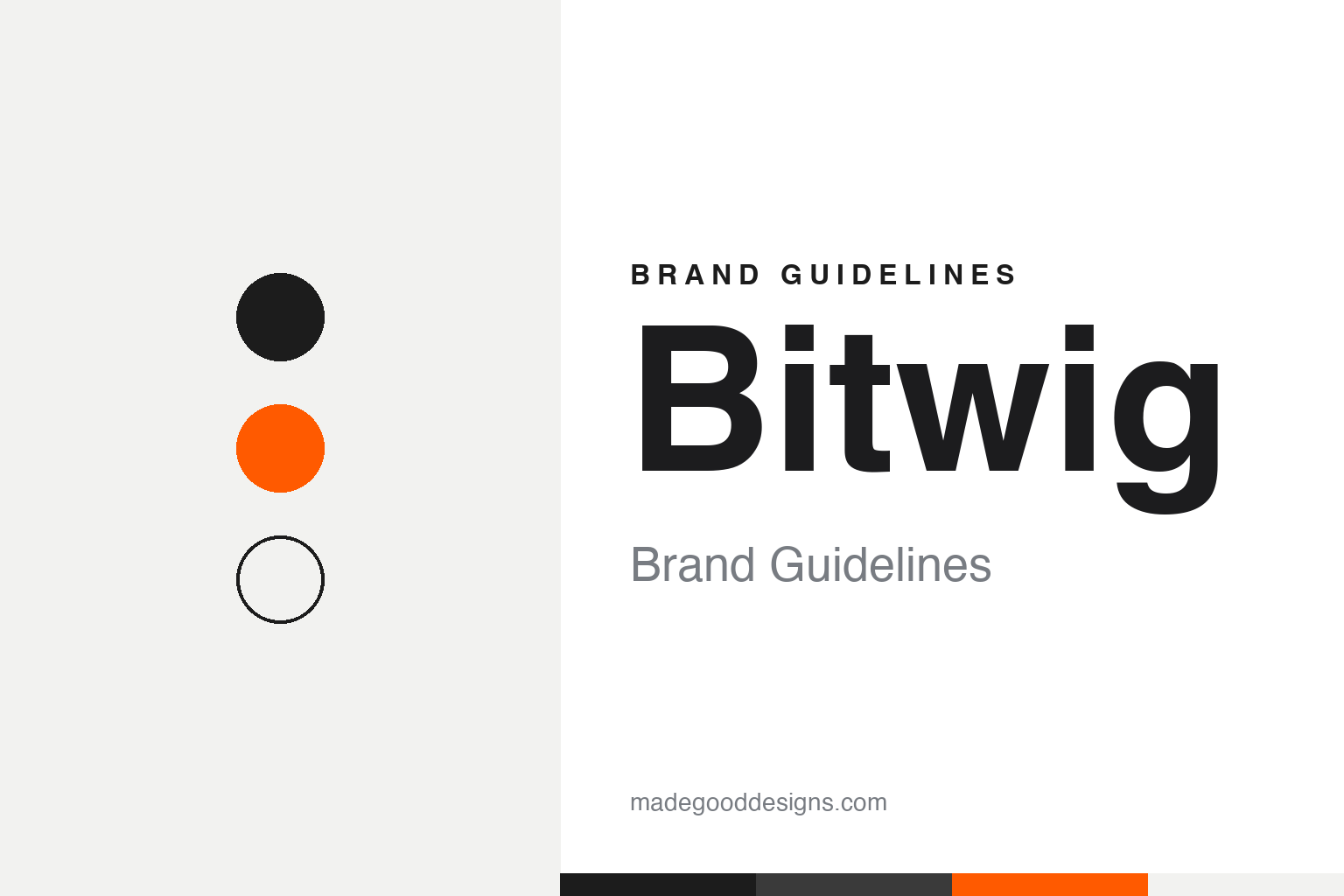
Bitwig Brand Guidelines
The Berlin DAW maker founded by ex-Ableton engineers.
Aa
Two constants: a Bitwig graphite, white and orange palette and a grotesque sans register. Abstract homage — not a Bitwig product or mark; no software screen, hardware, logo or nameplate is reproduced.
Four from Berlin
A software house started by people who had built Live.
Bitwig is a Berlin software company, Bitwig GmbH, and the maker of one digital audio workstation, Bitwig Studio. Its own “About us” page says it was founded in 2009 in Berlin by four people; an archived version of that page from August 2011 names them as Claes Johanson, Pablo Sara, Nicholas Allen and Volker Schumacher, and English Wikipedia gives the same four names and the same year.
The link to Ableton, the Berlin company behind Live, is the part most often repeated, and it rests on two sources. The 2011 page said the founders’ experience included Ableton, “where we were all part of the development team behind the successful music software Live,” as well as Vember Audio, maker of the Surge software synthesizer, which its project site says has since been released as open-source software thanks to Vember Audio’s owner. Independently, Sound On Sound, reviewing the first release in its June 2014 issue, described Bitwig as “a small music software house based in Berlin and founded by ex-Ableton engineers.” English Wikipedia adds that Placidus Schelbert, formerly an international sales manager at Ableton, has been chief executive since 2010, a detail it sources only to a professional profile; the company’s legal notice today names Schelbert and Volker Schumacher as its managing directors.
The software took about five years to arrive. Bitwig Studio 1.0 was released on 26 March 2014, English Wikipedia says, and MusicRadar reviewed it that day. Sound On Sound’s reviewer, Nick Rothwell, noted “startling similarities” with Ableton Live — docked editing panels, a session view of launchable clips, tracks with horizontal chains of devices — and called it “an impressive first offering from a small startup company,” with the rough edges to be expected of a version 1.
Colour
Modulation, Linux and open standards.
Bitwig’s case since then has rested on what it does differently. Reviewers have singled out its modulation system, greatly expanded with version 2 in 2017, which lets almost any parameter be driven by modulators, and its hybrid tracks, which hold audio and note data on the same track. Version 3, in July 2019, added The Grid, a modular sound-design environment; the company says it won MusicTech’s Excellence award in 2019. Bitwig Studio is also one of the few commercial workstations that runs on Linux as well as Windows and macOS, and it is sold in three editions — Essentials, Producer and the full Bitwig Studio.
The press has noticed. Computer Music named Bitwig Studio 2 its DAW of the Year in its January 2018 issue, and Future Music gave Bitwig Studio 5 the same title in January 2024, according to English Wikipedia, which cites the magazines’ issues. Version 6 followed in 2026, with a refreshed look and a large overhaul of automation editing, the company says.
A second thread is open standards. In June 2022 Bitwig and the plug-in maker u-he announced CLAP, an open-source plug-in format, MusicRadar reported; in 2023 Bitwig and PreSonus introduced DAWproject, an open file format for moving projects between workstations. The company also publishes an open controller API for mapping hardware.
Not every decision landed well. In 2022 Bitwig announced a set of spectral effects, the Spectral Suite, as a separate purchase. About a week later, after objections from users, it apologised in a statement titled “To Our Community,” folded the devices into Bitwig Studio 4.4 for customers with a current upgrade plan, offered buyers a refund or an extended plan, and promised that all future feature development, “including devices,” would be covered by its 12-month Upgrade Plan.
Typography
Software as a design object.
The seven makers in this guide build the tools of the home and project studio: digital audio workstations, the software in which music is now recorded, edited and mixed, and — in TASCAM’s case — the hardware that came before them. TEAC introduced the first Portastudio, a four-track cassette recorder with a built-in mixer, at a New York audio convention in 1979.
The oldest software house here is Steinberg of Hamburg, founded in 1984 by Karl Steinberg and Manfred Rürup and the maker of Cubase; Yamaha says it acquired the company in 2005. Cakewalk began in Boston in 1987 as Greg Hendershott’s Twelve Tone Systems, came under Roland’s majority control in 2008 and Gibson’s in 2013, and has been a brand of BandLab Technologies of Singapore since 2018.
Three are European and younger. Reason Studios, founded in Stockholm in 1994 as Propellerhead Software, was bought in January 2026 by LANDR of Montreal, Music Business Worldwide reported. Image-Line, the maker of FL Studio, was founded by Jean-Marie Cannie and Frank Van Biesen and gives its headquarters as Ghent, Belgium. Bitwig was founded in Berlin in 2009, and its company is registered there.
Cockos, the maker of REAPER, says it was founded in 2004; archived copies of its website show its postal address moving from San Francisco to Manhattan and, by late 2024, to Rosendale, New York. TASCAM is a brand of TEAC Corporation, which is listed in Tokyo, based in Tama, Tokyo, and was majority-owned by Gibson from 2013 to 2020.
This guide sets out what can be checked about each brand — who founded it, who owns it, and what it says about where its products are made — and marks clearly what rests only on the company’s own word.
Aa
A grotesque sans — for a brand known by one orange. (Specimen set in Archivo, a sans STAND-IN; NOT the Bitwig logo.)
Bitwig
A small Berlin team, and its first hardware.
Bitwig remains a small company: its website says its Berlin headquarters is a base for a team of 30 people, and in the sources we checked we found no outside owner announced — its legal notice names two managing directors and no parent company. In 2025 it released its first hardware product, the Bitwig Connect 4/12, a four-in, twelve-out audio interface with CV and MIDI connections, a large touch-sensitive dial and a dedicated mode for controlling Bitwig Studio. The company says it was “designed and engineered by Bitwig in Germany”; it does not say where the unit is manufactured, and we found no source that does. Sound On Sound, reviewing it in September 2025, called it Bitwig’s first hardware product, noted an all-metal case and a price of £439 including VAT, or $599, and described a colour scheme “incorporating Bitwig’s signature bright orange.”
That orange is the closest thing to a documented visual identity. Bitwig does not publish brand colours or name a typeface in the sources we checked, so the tones here are our reading of its software and hardware rather than official values.
For a design guide, Bitwig shows how a newcomer can define itself against an established rival — through modulation, open standards and a single colour — rather than by imitation. Compare Ableton, where the company says its founders worked on Live, and PreSonus, its partner on DAWproject. For this guide we use graphite, studio white and a signal orange with a sans, an unofficial interpretation; no product or logo is reproduced.
Explore & save
Keep Bitwig’s identity on hand — save it to a board in the Made Good inspiration library.
Bitwig identity set
Pin the Bitwig graphite, white and orange palette and the grotesque sans register to your own board.