Ableton Brand Guidelines
The Berlin founders who built Live, then Push.
Aa
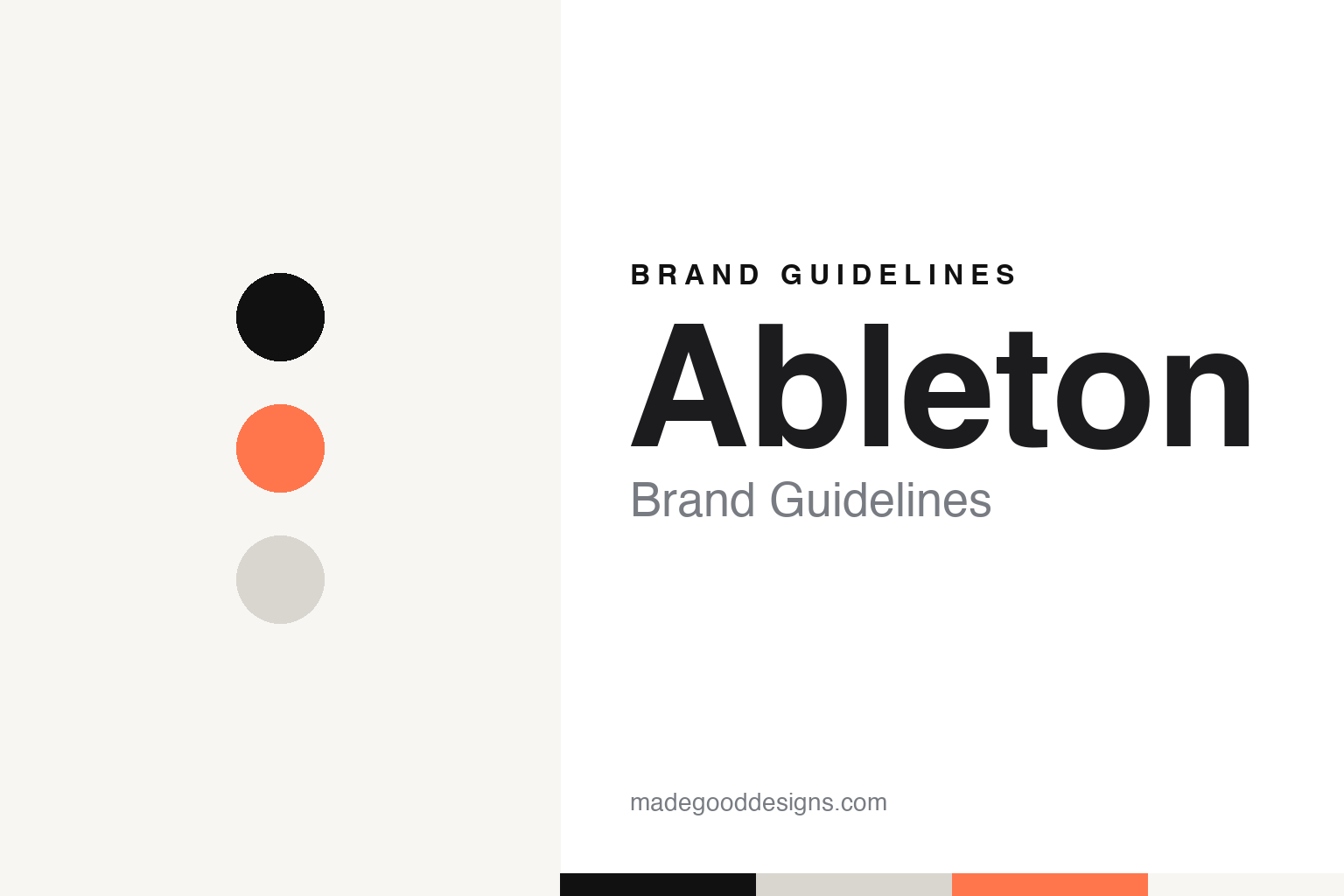
Two constants: a session black, warm grey and clip orange palette and a grotesque sans register. Abstract homage — not an Ableton product or mark; no software interface, controller, logo or nameplate is reproduced.
Monolake to Live
Two musicians, a programmer and a loop.
Ableton was founded in Berlin in 1999 by Gerhard Behles, Robert Henke and Bernd Roggendorf, according to English Wikipedia, which cites the 2005 book The Art of Digital Music. Behles and Henke met while studying at the Technische Universität Berlin and performed techno together as Monolake, using software they had written in the music programming language Max, Vice reported in 2021; Roggendorf, a software engineer, joined them in the late 1990s and helped turn those patches into a product that could be sold. German Wikipedia adds that Behles and Roggendorf had both worked at the Berlin software company Native Instruments; English Wikipedia says Behles worked on granular synthesis for its Reaktor software.
German Wikipedia also says the founders won a main prize in 1998 in the Gründerwettbewerb Multimedia, a start-up competition run by the federal economics ministry, and that money from the FUTOUR support programme paid for the company’s formal founding the following year.
The first commercial version of Live came out on 30 October 2001. Unlike programs built around multitrack recording, it was designed for performing with loops, and its time-stretching, called “Warping,” let users change a loop’s tempo without changing its pitch. Henke told Vice that one of the first industry figures to see its potential was the film composer Hans Zimmer. Live’s Session View, a grid of clips that can be launched in any order, soon gave other makers a layout to build hardware around.
Colour
From Max for Live to Push 3.
Ableton stayed a software company for more than a decade. In 2007 it began working with Cycling ’74, the Californian maker of Max, and in 2009 the two announced Max for Live, which lets Max patches run inside Live as instruments and effects. In June 2017 Ableton bought Cycling ’74; Resident Advisor reported that its founder, David Zicarelli, said there would be no immediate changes. Ableton’s own instruments, such as the Operator synthesizer of 2005, come with Live’s Suite edition, and other makers built controllers for it: Akai Professional’s APC40, which English Wikipedia describes as designed to work solely with Live, and Novation’s Launchpad.
Its first hardware under its own name, Push, arrived with Live 9 in March 2013. Sound On Sound’s review said Push was designed in-house but engineered by Akai Professional, and quoted Ableton’s project manager explaining that deep integration with Live meant bringing the design in-house, while Akai’s engineers made “the ideas real.” Push 2, launched in November 2015 at the end of Ableton’s first Loop summit, carried no Akai logo: Sound On Sound wrote that Ableton had “brought all their engineering in-house,” and MusicRadar called it “100% Ableton,” noting its aluminium top surface and colour display. Resident Advisor reported that Ableton would refurbish and donate traded-in first-generation units.
Push 3 followed in May 2023 in two forms: a controller tethered to a computer, and a standalone version with its own processor, battery and storage that can run Live internally. In October 2024 the company added Move, a portable groovebox; it also makes Note, a mobile app, and Link, a technology for keeping devices in time. The sources we checked — Ableton’s product pages and help centre and the reviews cited here — do not say in which country Push or Move is manufactured, so we do not give one.
Typography
Software that became an instrument.
The modern studio runs on software: the digital audio workstation, or DAW, in which music is recorded and arranged, and the plug-ins that load inside it to equalise, compress, tune and colour sound. The seven companies in this guide make one or both.
Waves Audio was founded in Tel Aviv in 1992, and English Wikipedia credits its Q10 equaliser as the first commercially available audio plug-in; Waves received a Technical Grammy in 2011, and Celemony, the Munich maker of Melodyne, in 2012. FabFilter, founded in 2002, is based in Amsterdam. Ableton, maker of the Live DAW, was founded in 1999, is based in Berlin and says it is still run by its founders.
Soundtoys, which began in the mid-1990s as Wave Mechanics, a company started by former Eventide designers in New Jersey, gives its address as Burlington, Vermont. Slate Digital, which Audiotonix described as based in Los Angeles and Grenoble, was bought by that company in October 2022; Audiotonix is the British group that also owns Solid State Logic.
Ownership has moved fastest at iZotope, of Cambridge, Massachusetts. It joined Native Instruments in a group backed by Francisco Partners in 2021; after Native Instruments entered preliminary insolvency and was sold to inMusic in 2026, iZotope was acquired in July 2026 by the visual-effects software company Boris FX, MusicTech reported.
Because these products are code, “where it is made” means where the developers work: English Wikipedia lists Waves development centres in India and Ukraine, and Celemony says its staff work across Germany and beyond.
This guide sets out what can be checked about each brand — who founded it, who owns it, and what it says about where its products are made — and marks clearly what rests only on the company’s own word.
Aa
A plain grotesque sans, after the labels of a software interface. (Specimen set in Archivo, a sans STAND-IN; NOT the Ableton logo.)
Ableton
Still run by the people who started it.
Ableton is a private German stock corporation, Ableton AG, with its head office in Berlin’s Prenzlauer Berg district. Its imprint names Gerhard Behles and Jan Bohl as the management board and Uwe Struck as chair of the supervisory board. The company says it was “founded in 1999 by the same people who run the company today” and has grown to “over 350 people” from more than 30 countries; in 2019 its about page gave a figure of more than 270, divided between Berlin, Los Angeles and Tokyo. German Wikipedia says a US office opened in New York in 2005 and moved to Pasadena, California, in 2011, and English Wikipedia lists subsidiaries in the United States and Japan as well as Cycling ’74. We found no published list of its shareholders in its own pages or in the encyclopedias we checked, so we say only that it is privately held and that, by its own account, its founders still run it.
German Wikipedia gives revenue of €14.7 million for 2012, more than 90 percent of it earned abroad. The company has also published beyond software: the 2015 book Making Music: 74 Creative Strategies for Electronic Music Producers by Dennis DeSantis, its head of documentation, and free browser lessons called Learning Music and Learning Synths. In November 2017 it held its Loop festival at the Funkhaus Nalepastraße in Berlin, the taz reported.
For a design guide, Ableton shows how a software interface — a grid of clips — can become the organising idea for a company’s hardware, teaching and identity. Compare Native Instruments, where Behles worked before Ableton, and Novation, whose Launchpad was designed for use with Live. For this guide we use session black, warm grey and clip orange with a grotesque sans, an unofficial interpretation; no product or logo is reproduced.
Explore & save
Keep Ableton’s identity on hand — save it to a board in the Made Good inspiration library.
Ableton identity set
Pin the Ableton session black, warm grey and clip orange palette and the grotesque sans register to your own board.