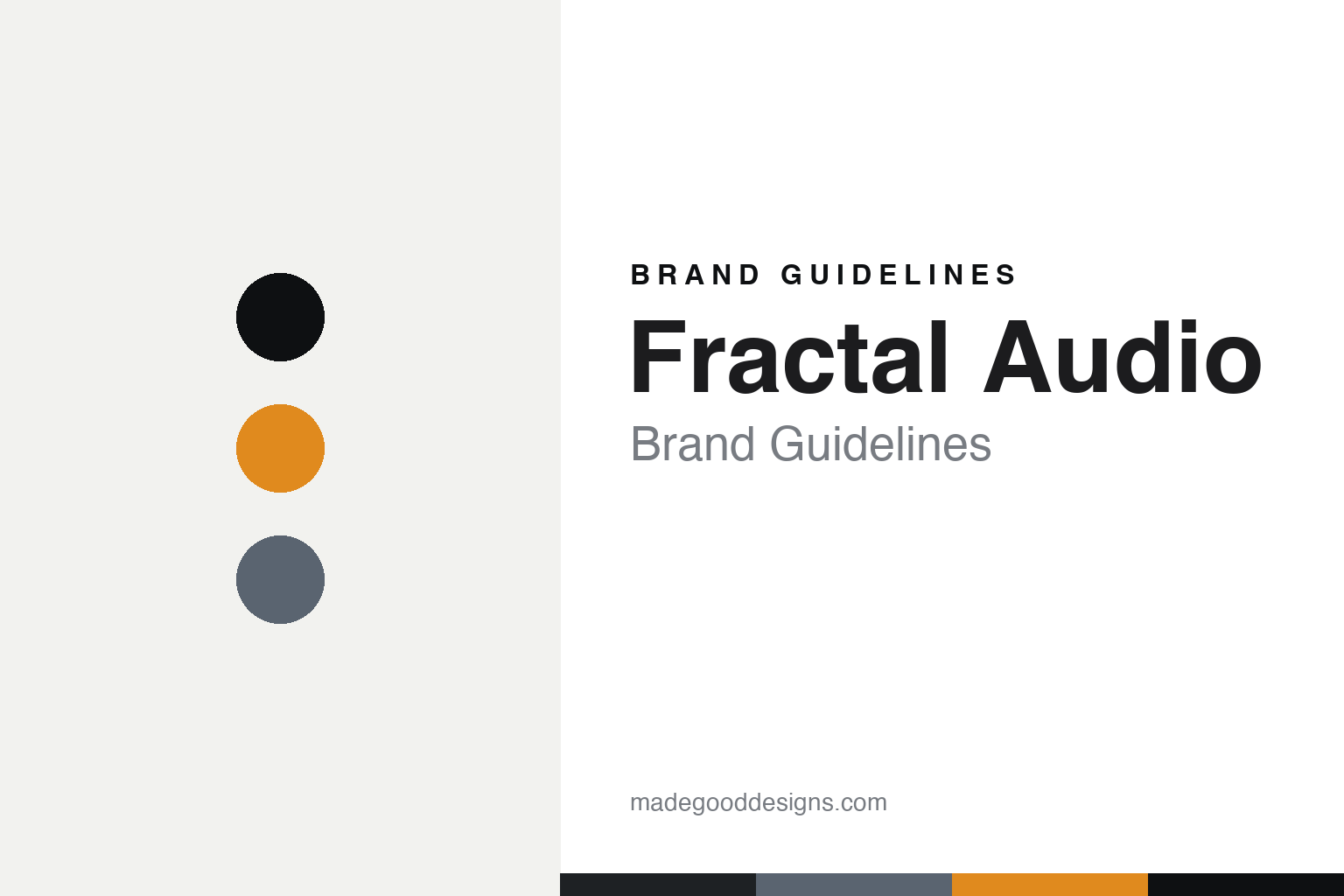
Fractal Audio Brand Guidelines
The New Hampshire firm that grew from one engineer’s DSP code.
Aa
Two constants: a graphite, steel and amber palette and a technical sans register. Abstract homage — not a Fractal Audio product or mark; no unit, logo or front panel is reproduced.
Cliff built it
One engineer, one product, a New Hampshire base.
Fractal Audio Systems traces itself to one engineer, Cliff Chase, and one product, the Axe-Fx. The company’s own timeline begins in March 2005, when, it says, the first internet forum posts about “an AxeFx” appeared, stating: “This guy Cliff built it from scratch and did all the DSP coding.” Its website says Fractal Audio Systems “was founded in 2006 to create the revolutionary Axe-Fx line of preamp/effect processors,” and the timeline records fractalaudio.com going live in November 2006 and the first firmware update that December. The earliest copy of the site in the Internet Archive is dated 9 December 2006.
Chase has described the start as gradual. “It wasn’t really one day I just said ‘hey, you know, I’m going to make an Axe-Fx,’” he told Guitar Messenger in June 2011; he had been tinkering with reverb algorithms on a PC before moving them onto a DSP development kit. He said he had started in electronics at about eight, played clarinet and saxophone, and switched to guitar after hearing Boston’s first album. Of an earlier employer, which he did not name in that interview, he said: “One of the things I vowed when I left my last company was not to let the accountants design the products.”
The company is based in New Hampshire. Its careers page describes work “on-site at our HQ in Plaistow NH,” a town on the Massachusetts border, and English Wikipedia gives the same location; in 2011 Guitar Messenger’s interviewer visited “Fractal Audio headquarters in New Hampshire,” where Chase counted “five people, a couple engineers.” The website’s copyright line names Fractal Audio Systems LLC. Wikipedia lists Fractal as a privately held New Hampshire company, and no outside investor, parent company or acquisition appears in the sources we checked.
Colour
From a rack unit to floor boxes and plug-ins.
The first Axe-Fx was a rack-mounted preamp and effects processor. A 2007 copy of the website advertised the Axe-Fx and the Axe-Fx Ultra — announced in April 2007, the timeline says — with a “500 MHz, dual-core processor” and the promise of “not only the sound, but the FEEL of a real tube amp.” The Axe-Fx II followed in May 2011, the XL in 2014 and the XL+ in 2015, and the Axe-Fx III was announced in January 2018. Reviewing it in July 2018 at €2,899, Guitar.com wrote that the original Axe-Fx “redrew the high-end digital modelling landscape when it arrived on the scene a decade ago.”
Floor units came later. The company calls the AX8, announced in February 2015, its first all-in-one floor unit; the effects-only FX8 began shipping that April. The compact FM3 was announced in 2019 and shipped in February 2020, the larger FM9 followed, and Turbo versions with more processing power arrived between 2022 and 2024. In October 2024 Fractal announced the VP4 Virtual Pedalboard, an effects unit, and in November 2025 the AM4, a small amp modeler listed at $699 on its website. In February 2026 it moved into software with ICONS, amp-modeling plug-ins for macOS and Windows, beginning with ICONS: Fullerton.
Much of the brand’s reputation rests on free firmware updates and named modeling methods — Quantum, G3, MIMIC and Cygnus, and in 2022 what it calls “Chase Nonlinear Feedback,” after its founder. Its artist roster, by its own account, includes Steve Vai and John Petrucci (both added in 2010), Alex Lifeson, The Edge of U2 and John Mayer, whom Fractal added in 2021 after he used an Axe-Fx III on his album Sob Rock. Mixdown reported in 2023 that Metallica first tried the Axe-Fx for a show in Antarctica, where amplifiers would have been impractical to ship.
Typography
Modelers, profilers and plug-ins.
The guitar amplifier has split into two camps. One makes the amp out of code: a digital processor that models, or “profiles,” the sound of valve amplifiers and speaker cabinets and fits it into a floor unit, a rack or a laptop plug-in. The other still builds the real thing, with valves, transformers and hand wiring.
The digital makers are spread widely. Kemper is a German company, Kemper GmbH, which gives its seat as Recklinghausen; Christoph Kemper, who designed the Access Virus synthesizer, turned to guitar products in 2006, English Wikipedia says. Fractal Audio Systems, founded in 2006 to make the Axe-Fx, says its headquarters are in Plaistow, New Hampshire. Neural DSP, founded in 2017, is based in Helsinki, English Wikipedia says. Positive Grid, which says it was founded in 2011, began in California with a team in Taiwan and now dates its press releases from Chandler, Arizona.
One of these brands is part of a larger group. Line 6, founded in 1996 and based in Calabasas, California, has been part of Yamaha since 2014; the company says that led in 2017 to Yamaha’s first guitar division, now Yamaha Guitar Group.
The valve builders are both Californian. Two-Rock works from Rohnert Park, in Sonoma County, and has been owned since 2016 by Eli Lester and Mac Skinner, the trade press reports. Matchless, founded in 1989, says its amplifiers are wired point-to-point by hand in Los Angeles.
The modelers offer many amps in one box, updated by software; the boutique makers offer a fixed circuit, built by hand.
This guide sets out what can be checked about each brand — who founded it, who owns it, and what it says about where its products are made — and marks clearly what rests only on the company’s own word.
Aa
A technical sans for an engineering-led brand. (Specimen set in Saira, a sans STAND-IN; NOT the Fractal Audio logo.)
Sold direct
Designed in New Hampshire; assembled where, it does not say.
Fractal sells differently from most of its rivals. Its dealers page says customers in the USA and Canada order hardware and software directly from its own online shop, with authorised dealers elsewhere; in 2011 Chase told Guitar Messenger, “we mainly sell direct in the U.S.” Its FM9 page adds that “the first production run will be dedicated to our domestic customers.”
Where the products are made is less clear than where they are designed. The Axe-Fx III page says the unit “features a DSP module that is made in the USA”; that is the company’s claim, and it covers one module rather than the whole unit. We found no statement from Fractal on where final assembly takes place for the Axe-Fx III or for the floor units, so we do not say.
The field it helped open has grown crowded. English Wikipedia describes an “arms race” among modeler makers after the Axe-Fx, naming Line 6, Neural DSP and Kemper; Guitar.com in 2018 named Kemper, Positive Grid and Line 6 as the competition.
For a design guide, Fractal Audio shows how an engineering-led brand can be built on a product name and a steady stream of updates rather than on styling. Compare Kemper, the German maker of profiling amplifiers, and Neural DSP, the Helsinki company behind the Quad Cortex. For this guide we use graphite, steel and an amber with a technical sans, an unofficial interpretation; no product or logo is reproduced.
Explore & save
Keep Fractal Audio’s identity on hand — save it to a board in the Made Good inspiration library.
Fractal Audio identity set
Pin the Fractal Audio graphite, steel and amber palette and the technical sans register to your own board.