Positive Grid Brand Guidelines
The guitar-app maker that built the Spark smart amp.
Aa
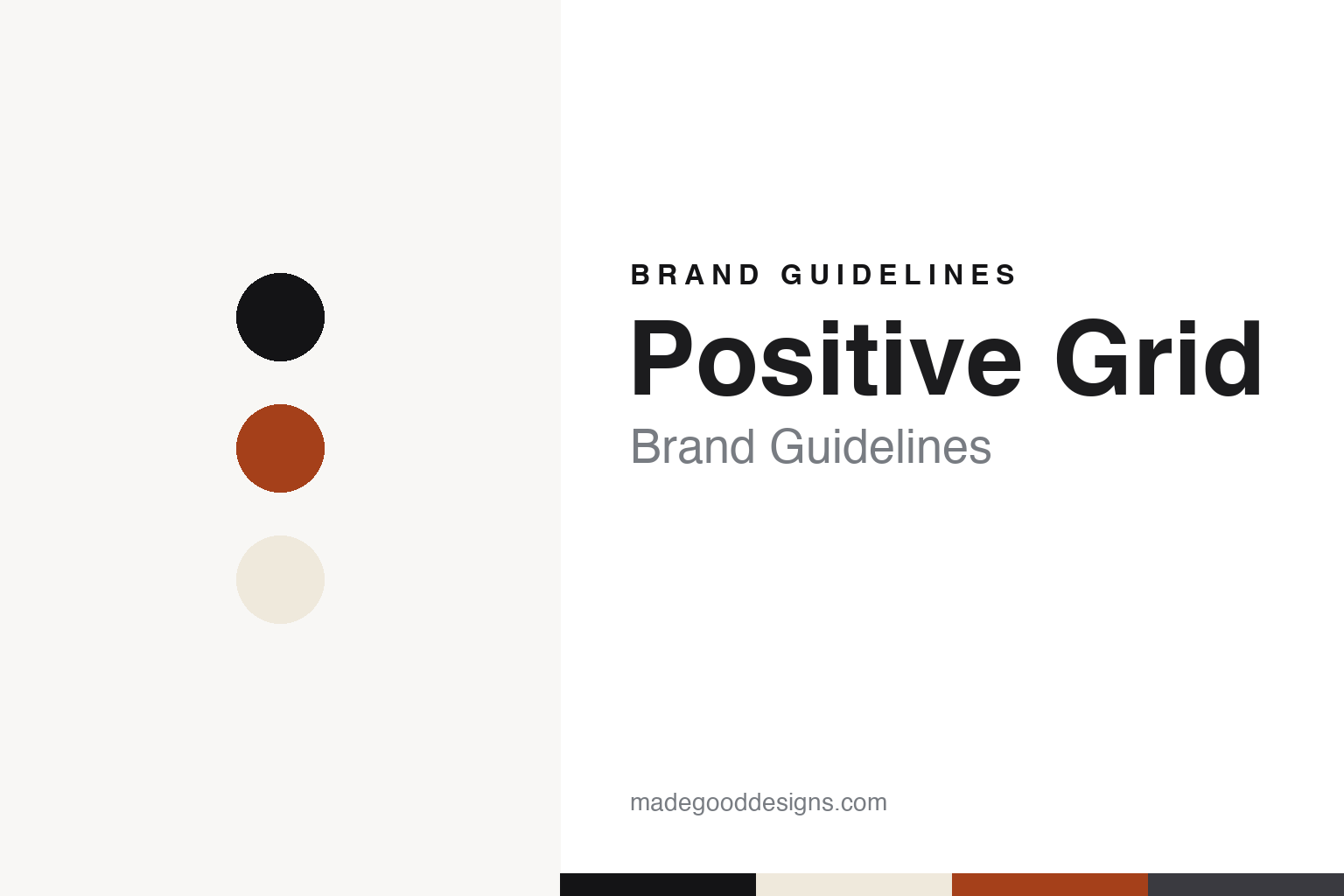
Two constants: a Positive Grid black, ember and cream palette and a Geometric sans register. Abstract homage — not a Positive Grid product or mark; no amplifier, app screen, logo or grille is reproduced.
JamUp
A few engineers, too many cables.
Positive Grid says it was “founded in 2011 by a team of musicians and tech obsessives.” In February 2014 Business Insider interviewed its co-founder Calvin Abel, who described the start this way: “It started with few friends who are engineers and guitar players.” Practising along to backing tracks, he said, meant connecting four or five cables between an iPod, a guitar, an audio interface and a computer. The iPhone looked like a way round that, and in 2011 the company released its first products: the JamUp app and the JamUp Plug audio interface, which turned an iPhone or iPad into a multi-effects unit with a jam player, phrase sampler and eight-track recorder. Premier Guitar reported the JamUp launch in November 2011.
Who else founded it takes some digging. In February 2015 Meet, the start-up site of the Taiwanese magazine Business Next, named the founders as “Calvin” and 蕭義崧 — romanised here as Hsiao Yi-sung — and described Positive Grid as a music-technology company “from Silicon Valley.” Its fact box gave two founding dates: 2011 for the American company and 2014 for the Taiwanese one. In 2019 Business Next called Hsiao the company’s co-founder and chief technology officer. One source differs on the start: a 2014 company description printed by audioXpress said Positive Grid had been developing its core technologies “since 2008,” so we give both dates.
The idea that made its name came next. BIAS let players design a virtual amplifier. Abel told Business Insider that users could change the look — the tolex, the knobs, a nameplate with their own name — move the microphone on the speaker, or go as deep as changing the transformer and adjusting the bias of a tube. It came with 36 factory amps, and designs could be swapped on ToneCloud, the company’s sharing network, which then held more than 10,000 user presets. In July 2014 the iPad app became BIAS Desktop, a plug-in for Mac and Windows with an Amp Matching feature, audioXpress reported; BIAS FX, an effects app billed as the first cross-platform one of its kind, followed in 2015.
Colour
From apps to amplifiers.
The company grew up in two places. In March 2014, Meet reported, Positive Grid set up a Taiwanese subsidiary for hardware and app development; of about 30 staff worldwide, 20 were in Taiwan, many of them working remotely. By November 2017 Business Next described offices in Taiwan and Silicon Valley, more than 100 employees and more than five million app downloads, and said the company had won a “best guitar effect” award at the Musikmesse in Frankfurt that year, which we have not confirmed independently.
By then it was making hardware too, including the BIAS Head amplifier. Hsiao compared the move to the iPhone: people buy the phone, but it is the apps that give it value, and hardware, he told Business Next, makes the software’s value stand out more. In 2019 the magazine reported that Positive Grid had moved into hardware in 2016 — the 2017 article implies 2015 — and that a beginner’s app called GoGuitar would be renamed Spark, alongside a practice amp that doubled as a Bluetooth speaker.
That amp, the Spark 40, launched in 2019, the company says. Reviewing it in November 2020, MusicRadar described a 40-watt desktop amp with two 4-inch speakers, about 30 amp models and 40 effects, plus Smart Jam, which builds a backing track around a riff, and Auto Chord, which shows the chords of a streamed song. It reported that some 25,000 people had pre-ordered the amp and that more than 100,000 owned one within its first year. English Wikipedia’s article on amplifier modelling calls the Spark the industry’s most popular “smart” amp.
The range has since spread out: the Spark MINI in 2022, the Spark GO in 2023, a Spark MINI Zakk Wylde edition in 2023, the Spark LIVE, the 50-watt Spark 2 in July 2024 and the Spark EDGE amp-and-PA that October, according to Premier Guitar, Guitar.com, Guitar Player and the company’s own releases. In February 2025 came Spark NEO, headphones with the amp built in; in September 2025 BIAS X, which the company calls the first fully generative tone-design software, turning a written description or an audio clip into a sound; and in June 2026 REACTOR, which Premier Guitar covered as an “intelligent” guitar amplifier.
Typography
Modellers, boutique amps and the record.
The guitar amplifier has split into two camps. One makes the amp out of code: a digital processor that models, or “profiles,” the sound of valve amplifiers and speaker cabinets and fits it into a floor unit, a rack or a laptop plug-in. The other still builds the real thing, with valves, transformers and hand wiring.
The digital makers are spread widely. Kemper is a German company, Kemper GmbH, which gives its seat as Recklinghausen; Christoph Kemper, who designed the Access Virus synthesizer, turned to guitar products in 2006, English Wikipedia says. Fractal Audio Systems, founded in 2006 to make the Axe-Fx, says its headquarters are in Plaistow, New Hampshire. Neural DSP, founded in 2017, is based in Helsinki, English Wikipedia says. Positive Grid, which says it was founded in 2011, began in California with a team in Taiwan and now dates its press releases from Chandler, Arizona.
One of these brands is part of a larger group. Line 6, founded in 1996 and based in Calabasas, California, has been part of Yamaha since 2014; the company says that led in 2017 to Yamaha’s first guitar division, now Yamaha Guitar Group.
The valve builders are both Californian. Two-Rock works from Rohnert Park, in Sonoma County, and has been owned since 2016 by Eli Lester and Mac Skinner, the trade press reports. Matchless, founded in 1989, says its amplifiers are wired point-to-point by hand in Los Angeles.
The modelers offer many amps in one box, updated by software; the boutique makers offer a fixed circuit, built by hand.
This guide sets out what can be checked about each brand — who founded it, who owns it, and what it says about where its products are made — and marks clearly what rests only on the company’s own word.
Aa
A geometric sans — a software company’s register. (Specimen set in Space Grotesk, a sans STAND-IN; NOT the Positive Grid logo.)
Positive Grid
A software company that learned to make boxes.
We found no public record of who owns Positive Grid. Its website and terms of service name Positive Grid Limited “and/or its affiliates and subsidiaries” without saying where that company is registered; the terms send disputes to courts in Los Angeles or Manhattan, and the company’s press releases since at least 2024 carry a Chandler, Arizona dateline, after earlier descriptions of it as Californian. In Taiwan it trades as 佳格數位, which should not be confused with 佳格食品, the unrelated food group. The website does not say where Spark amps or headphones are built, and we found no documentation of it, so we leave that question open.
Design is part of how it talks about itself. In 2017 the company told Business Next that, having started as a software company, it pays close attention to UI and UX, so that its gear is intuitive to use. Its 2026 anniversary post goes further: “Design is never just aesthetic. It’s part of the instrument.” Reviewers noticed the restraint: MusicRadar said the Spark 40 “looks like a guitar amplifier,” finished in black vinyl with nothing intimidating on the front panel, and WIRED praised its “compact, good-looking design.” Swappable front grilles let owners personalise the amp; in July 2025 the company sold a limited “See the Sound” grille for the Spark EDGE by PosterLad, the art project of the Czech designer Vratislav Pecka, for $49.
For a design guide, Positive Grid shows how a company that started on a phone screen made its hardware look like the gear players already trust, and kept the personality in the software. Compare Boss, whose Katana amps compete with the Spark, and Blackstar. For this guide we use black, an ember orange and cream with a sans, an unofficial interpretation; no product or logo is reproduced.
Explore & save
Keep Positive Grid’s identity on hand — save it to a board in the Made Good inspiration library.
Positive Grid identity set
Pin the Positive Grid black, ember and cream palette and the Geometric sans register to your own board.