Soldano Brand Guidelines
The Seattle builder whose SLO-100 set the high-gain standard.
Aa
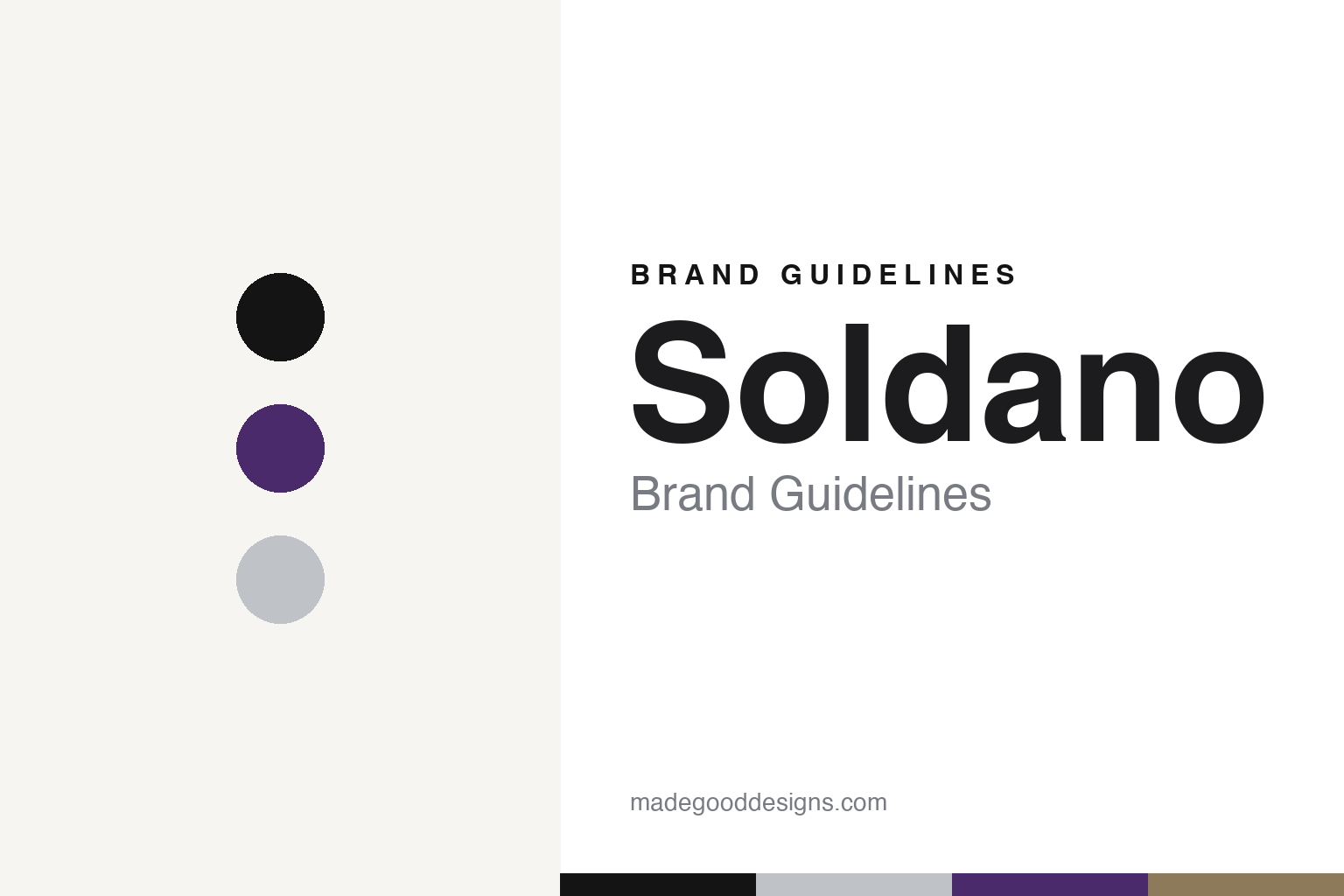
Two constants: a Soldano black, chrome and purple palette and a Condensed sans register. Abstract homage — not a Soldano product or mark; no amplifier, logo or nameplate is reproduced.
Mr. Science
A Seattle hot-rodder, a plywood prototype and a move to Los Angeles.
Soldano Custom Amplification is the work of Mike Soldano (Michael J. Soldano), whom both Guitar Player and the company describe as a native of Seattle. The company’s own history says he came to the guitar late, at around 21, and that his first amp was a hand-built copy of a tweed Fender Bassman that blew up so often he learned to repair it himself. He opened a guitar-building shop in 1977, it says, and later began work on a prototype amplifier mounted on a sheet of plywood, which he called “Mr. Science.”
The company’s account then moves between three cities. It says Soldano spent a period at Stars Guitars in San Francisco, a shop it describes as now defunct, modifying amplifiers, and returned to Seattle with a new partner, Bill Sundt; that around 1985 he built a first run of three amps in his parents’ basement; and that he then moved to Los Angeles, where his first shop was in a former bordello. Wikipedia gives 1986 and Los Angeles as the company’s founding date and place, without a source, so we treat that date as Wikipedia’s.
The breakthrough is well documented, though accounts differ on the year. Guitar Player wrote in 2023 that Soldano had taken a roadie job to stave off bankruptcy when, after a prototype reached Heart guitarist Howard Leese, he came home to answering-machine messages from Lou Reed, Michael Landau and Vivian Campbell, all wanting amps. Guitar Player, Guitar World and Vintage Guitar date the SLO-100 to 1987, and the company says it showed the amp at the 1987 NAMM show. Its longer history, though, puts the messages after Christmas 1987 and says that by the summer of 1988 Eric Clapton, Mark Knopfler and the Scorpions had ordered amps.
Colour
The Super Lead Overdrive and the players who took it up.
The SLO-100, short for Super Lead Overdrive, 100 watts, made the name. Guitar Player lists four 6L6GC output valves, four 12AX7 preamp valves, two channels (Normal and Overdrive), cascading gain stages, a master volume for each channel and solid-state rectification. It says the design was “inspired somewhat” by the Mesa/Boogie Mark II, which Soldano had copied as a DIY project, while the tone stage derives from a modified Fender Bassman. Vintage Guitar called the SLO “a high-concept modern design rather than a modified vintage circuit,” and noted that the amps were built on circuit boards but assembled by hand, a choice the company’s FAQ defends on grounds of consistency and reliability.
The list of players is long. Guitar World, writing in September 2024, said Eddie Van Halen used an SLO-100 to record For Unlawful Carnal Knowledge in the early 1990s and that the amp “significantly inspired” his signature Peavey 5150; that Joe Satriani relied on one for The Extremist; that Vivian Campbell, Adrian Vandenberg and Steve Vai used them in Whitesnake; and that Clapton, Gary Moore and Warren Haynes took up the amp too. The magazine went further: “The boutique amp market thrives and exists as it does today largely thanks to the pioneering efforts and success of Mike Soldano.”
The range has since widened. Besides the SLO-100 Classic and the SLO-30, a smaller valve head that Guitar Player reviewed in 2021 and noted could be ordered in bright purple or even snakeskin as well as black, the website lists the ASTRO-20 head, the solid-state SLO Mini, cabinets and two pedals: the SLO Pedal and the two-channel SLO Plus.
Typography
American amplifier makers.
American guitar amplification runs from mass manufacturers to small workshops and old names bought back and revived. The seven brands in this guide cover that range.
The largest is Peavey, founded by Hartley Peavey in 1965 and privately owned and based in Meridian, Mississippi; in 2014, as it closed a Meridian plant, Hartley Peavey said most of the lower end of the range had gone offshore while the expensive products stayed in the United States. Randall was founded around 1970 by Don Randall, formerly in charge of Fender’s sales, and its website now calls it a division of JAM USA; JAM, founded in Montreal, says it was bought by Ireland’s DCC in 2018, and its website now carries the name Nexora, DCC’s technology business.
Three carry the names of the engineers who started them. Soldano was founded by Michael Soldano in Los Angeles in 1986 and later moved to Seattle; English Wikipedia says he agreed in 2019 to sell it to Boutique Amps Distribution and stay on as designer. Rivera was founded by Paul Rivera in Southern California in 1985, and Egnater grew from the repair shop Bruce Egnater opened near Detroit in 1975.
Two are revived mid-century names. Magnatone, rooted in a southern Californian maker of the late 1930s, was revived in 2013 by Ted Kornblum, and now issues its news from St. Louis. Supro, made in Chicago by Valco until 1968, was revived on Long Island — its trademark bought in late 2013, its first new amps shown in 2014 — and has been owned since 2020 by the New York group behind D’Angelico Guitars.
Soldano, Magnatone and Supro each describe at least some of their amplifiers as hand-built in the USA.
This guide sets out what can be checked about each brand — who founded it, who owns it, and what it says about where its products are made — and marks clearly what rests only on the company’s own word.
Aa
A condensed sans for a hot-rod amplifier brand. (Specimen set in Oswald, a sans STAND-IN; NOT the Soldano logo.)
Soldano
From a Seattle workshop to a California distributor.
For three decades the business stayed small. Guitar Player reported in 2021 that from the early 1990s Soldano and a small team built all the company’s amps in his Seattle workshop, and that in late 2018 he announced he would sell the company to Boutique Amps Distribution (B.A.D.); NAMM’s oral-history biography of him dates the sale to 2019. Manufacturing was to move to B.A.D.’s headquarters in Huntington Park, California, where, Guitar Player said, the company also hand-built amps for brands including Friedman, Morgan, Synergy and Tone King. Mike Soldano stayed on as an adviser and designer.
The company’s website now gives its registered office and principal place of business as Commerce, California, in Los Angeles County, the same town B.A.D. lists, and its returns page points customers to a B.A.D. support address. B.A.D. describes itself on its own site as the “exclusive worldwide distributors” of Soldano, alongside Friedman, Bogner, Egnater and others. Wikipedia still gives Seattle as Soldano’s headquarters, which is out of date.
On where things are made, the company says that “every Soldano tube amplifier is hand-built in the USA.” It describes the SLO-100 Classic as “hand wired in the USA using premium worldwide components,” and the ASTRO-20 and the SLO Plus pedal as assembled in the USA; those are its claims. The same website says plainly that the solid-state SLO Mini is “Made in China,” so the American claim covers the valve amps, not the whole range.
For a design guide, Soldano shows how one builder’s name can carry on after production has left his workshop. Compare Mesa/Boogie, whose Mark II influenced the SLO, and Friedman, another brand B.A.D. builds and distributes. For this guide we use black, chrome and a deep purple with a condensed sans, an unofficial interpretation; no product or logo is reproduced.
Explore & save
Keep Soldano’s identity on hand — save it to a board in the Made Good inspiration library.
Soldano identity set
Pin the Soldano black, chrome and purple palette and the Condensed sans register to your own board.