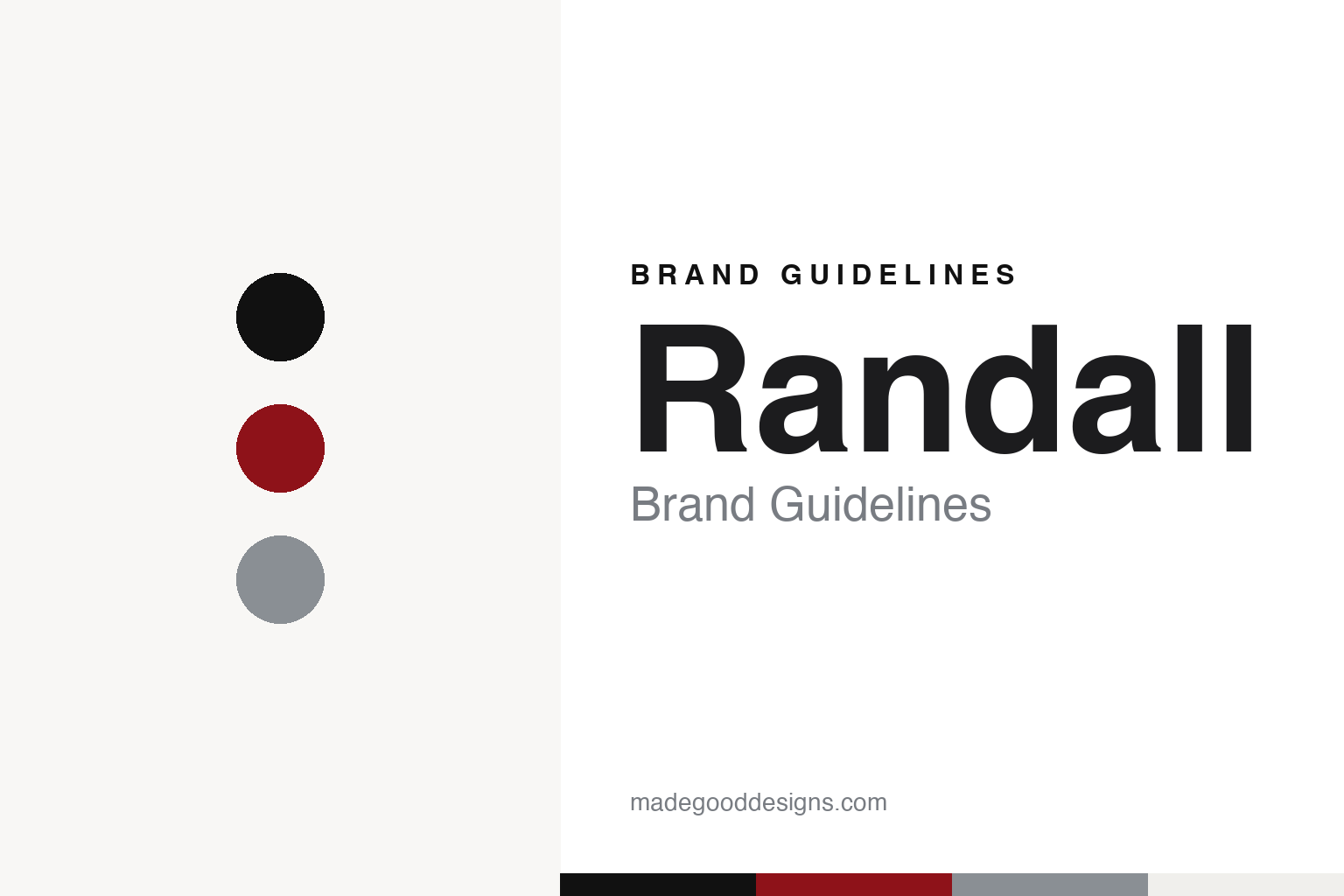
Randall Brand Guidelines
The amp brand founded by the Fender salesman who named the Telecaster.
Aa
Two constants: a Randall black, red and steel palette and a condensed sans register. Abstract homage — not a Randall product or mark; no amplifier, logo or nameplate is reproduced.
Don Randall
The Fender salesman who named the Telecaster.
First, a correction to a common mix-up. Randall Amplifiers was not founded by Randall Smith, who founded Mesa/Boogie; its founder was Don Randall, the sales chief who helped build Fender. The company’s website and English Wikipedia both say so, and with two Randalls in the history of American guitar amplifiers, the confusion is easy to make.
Don Randall met Leo Fender before the Second World War while selling radio parts, English Wikipedia says. After the war, managing F.C. Hall’s Radio-Tel business in Santa Ana, California, he proposed that it distribute Fender’s steel guitars and amplifiers, and the partnership began in 1946. He became president of Fender Sales in February 1953 and ran the company’s sales, distribution and advertising as it grew. The Los Angeles Times, in its 2009 obituary as cited by Wikipedia, credited him with naming the Telecaster and the Stratocaster; Wikipedia and the Randall website add the Esquire, the Broadcaster, the Precision Bass, the Twin Reverb and the Bassman.
Randall spoke for Fender in the 1964 negotiations that led to its sale to CBS, then served as vice president and general manager of CBS’s Fender divisions until he left in 1969, both the website and Wikipedia say. He was among the first six people inducted into the Fender Hall of Fame in 2007, and he died in December 2008, aged 91, according to that obituary.
Colour
Solid state, then a string of owners.
Randall’s own company followed. The Randall website and the NAMM Oral History programme, which interviewed him in 2003, date it to 1970; English Wikipedia says he left Fender in 1969 to found the Randall Amplifier Company in Irvine, California. The website says the brand focused from the start on solid-state circuits instead of vacuum tubes, and that many of its early FET transistor circuits “are still the benchmark for solid-state amps to this day” — its own claim. It describes the current RG80, an 80-watt, two-channel FET combo, as “a classic Randall workhorse that’s been around for decades.”
When Don Randall sold the business is disputed. English Wikipedia says 1987; the company’s website says 1990, to “US Music Corp in Wisconsin”; and the NAMM biography says the late 1990s. The website goes on to say that Washburn International acquired the brand in 1995 and renamed its own operations U.S. Music Corp — but the same page, as archived in 2013, gave that date as 2002. The documented date is 15 December 2002, when Washburn International announced that it had acquired U.S. Music Corporation and would fold its assets into it, according to a company press release cited by Wikipedia.
The best-known Randalls of the 2000s were the MTS, or Modular Tube System, amps developed with Bruce Egnater: a head with slots for interchangeable tube preamp modules voiced after other amplifiers. George Lynch, Kirk Hammett and Scott Ian had signature modules and heads. The company dates the launch to 2002 on its current website and to 2006 on its 2013 one, and in April 2012 Randall said the line had been discontinued.
Typography
American amplifiers, documented.
American guitar amplification runs from mass manufacturers to small workshops and old names bought back and revived. The seven brands in this guide cover that range.
The largest is Peavey, founded by Hartley Peavey in 1965 and privately owned and based in Meridian, Mississippi; in 2014, as it closed a Meridian plant, Hartley Peavey said most of the lower end of the range had gone offshore while the expensive products stayed in the United States. Randall was founded around 1970 by Don Randall, formerly in charge of Fender’s sales, and its website now calls it a division of JAM USA; JAM, founded in Montreal, says it was bought by Ireland’s DCC in 2018, and its website now carries the name Nexora, DCC’s technology business.
Three carry the names of the engineers who started them. Soldano was founded by Michael Soldano in Los Angeles in 1986 and later moved to Seattle; English Wikipedia says he agreed in 2019 to sell it to Boutique Amps Distribution and stay on as designer. Rivera was founded by Paul Rivera in Southern California in 1985, and Egnater grew from the repair shop Bruce Egnater opened near Detroit in 1975.
Two are revived mid-century names. Magnatone, rooted in a southern Californian maker of the late 1930s, was revived in 2013 by Ted Kornblum, and now issues its news from St. Louis. Supro, made in Chicago by Valco until 1968, was revived on Long Island — its trademark bought in late 2013, its first new amps shown in 2014 — and has been owned since 2020 by the New York group behind D’Angelico Guitars.
Soldano, Magnatone and Supro each describe at least some of their amplifiers as hand-built in the USA.
This guide sets out what can be checked about each brand — who founded it, who owns it, and what it says about where its products are made — and marks clearly what rests only on the company’s own word.
Aa
A condensed sans — a loud, stage-poster register. (Specimen set in Oswald, a sans STAND-IN; NOT the Randall logo.)
Randall
A Fortin-engineered revival inside a distribution group.
That April 2012 announcement, datelined Chicago, named Mike Fortin, founder of Fortin Amplification, as Randall’s exclusive design engineer, with a 150-watt Kirk Hammett signature head and a range of high-gain tube amps “to be manufactured in North America” — a plan stated at the time. Fortin-engineered models followed, including the Thrasher and the RD/Diavlo and RG series that Randall says it showed at the 2013 NAMM show, and the current KH103, a 120-watt, three-channel Kirk Hammett head. Wikipedia says the partnership ended at the close of 2015.
The 2012 release also showed the company Randall kept: U.S. Music, based in Buffalo Grove, Illinois, then listed brands including Washburn and Parker guitars, Eden Electronics, Oscar Schmidt and Hagstrom. Today the Randall website lists heads, combos, cabinets and pedals across the Thrasher, RD, RG, Kirk Hammett, Isolation and RX series. The RD/Diavlo series runs, the company says, “from 1 Watt to 100 Watts,” and the ISO12C is sold as a sound isolation cabinet. Randall’s warranty runs for two years and, the website says, covers only products sold within the continental United States, with other markets served by regional distributors.
Ownership has passed through ever-larger groups. U.S. Music was sold to JAM Industries of Montreal — on 24 August 2009, according to Music Inc as cited by Wikipedia, though JAM’s own timeline says 2005 and Randall’s says 2010. JAM says it was acquired in 2018 by DCC, the Irish group; DCC says its remaining technology distribution business has traded as Nexora since December 2025, and that it intends to agree a sale of Nexora by the end of 2026. Randall’s website calls the brand “a division of JAM USA LLC.” Neither the website, its product pages nor the manuals we checked say where Randall amplifiers are made.
For a design guide, Randall shows how a founder’s name can carry a brand through several owners. Compare Fender, where Don Randall made his name, and Mesa/Boogie, the company of the other Randall. For this guide we use amp black, a deep red and steel grey with a condensed sans, an unofficial interpretation; no product or logo is reproduced.
Explore & save
Keep Randall’s identity on hand — save it to a board in the Made Good inspiration library.
Randall identity set
Pin the Randall black, red and steel palette and the condensed sans register to your own board.