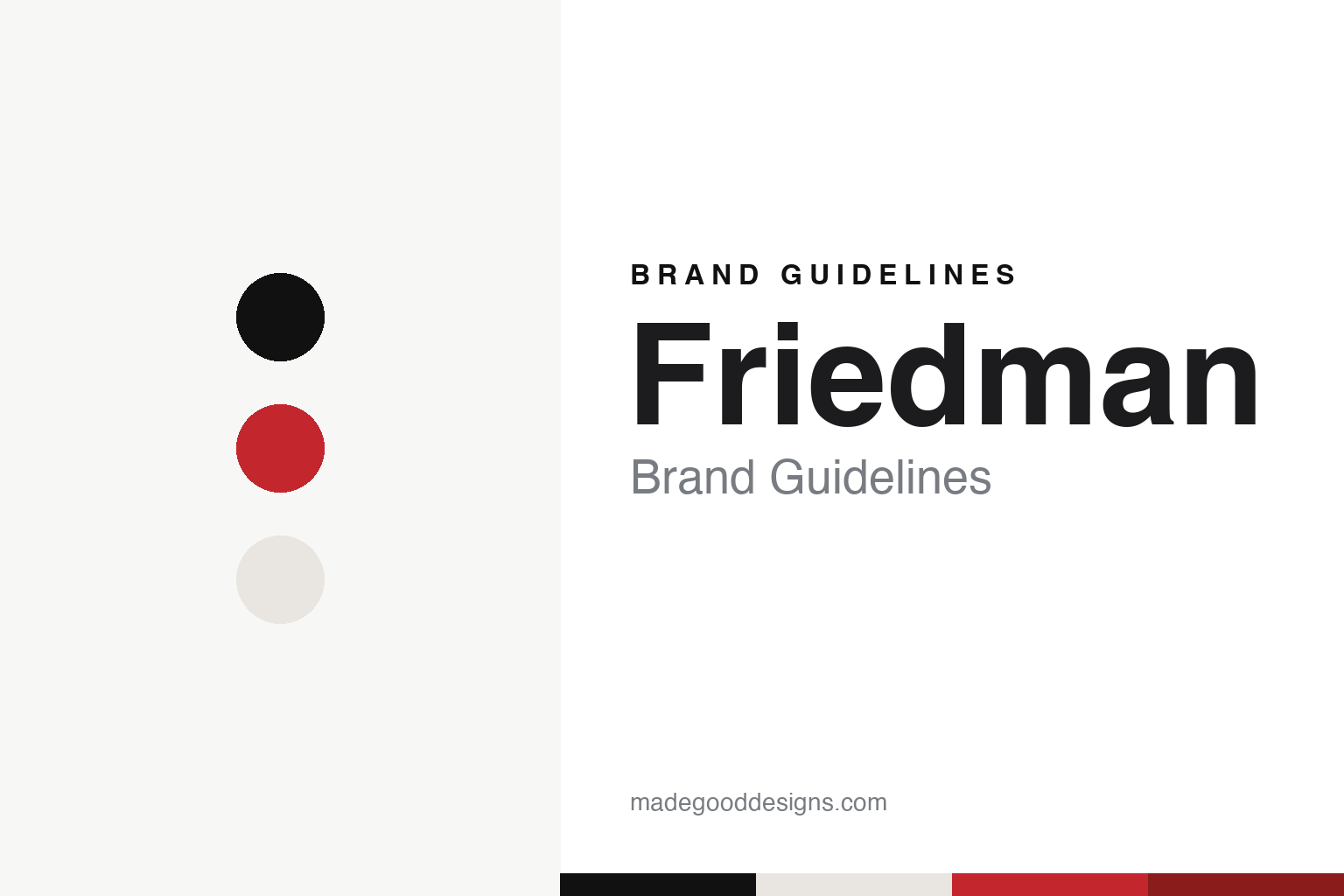
Friedman Brand Guidelines
The Detroit rig builder who turned Marshall mods into a brand.
Aa
Two constants: a Friedman black and red palette and a Condensed sans register. Abstract homage — not a Friedman product or mark; no amplifier, logo or nameplate is reproduced.
Rig builder
From cartage at a rental shop to the studio racks.
Dave Friedman grew up in Detroit, a guitarist obsessed with tone. In interviews with Guitar.com in 2020 and Guitar World in 2023, he said he moved to Southern California around 1987, at 18, and went to work at Andy Brauer Studio Rentals in Los Angeles, first carting gear to and from sessions. The shop supplied studio players such as Steve Lukather and Michael Landau and had, he told Guitar World, “every vintage and modern amp that you could think of.” When its main rig builder left, Friedman took the job.
Brauer later went into partnership with Greg Bales, whose Chicago music store Make’n Music opened a Los Angeles branch, and Friedman worked there. A customer brought in a Soldano preamp modified by Bruce Egnater; Friedman asked Egnater to build a four-channel preamp that he could sell to his clients, and the two developed it together. “This is when I really started learning electronics and Bruce became my mentor,” he told Guitar World. Guitar.com describes him as a partner in Egnater preamps, including the original hand-wired IE-4.
By 1993 he had left Make’n Music. He says he designed the front end of the Budda Superdrive amplifiers and, with Roy Blankenship, the Blankenship Variplex, and began modifying Marshalls with the channel he had developed with Egnater. It was the same Los Angeles world in which Reinhold Bogner had started out a few years earlier, also at Brauer’s shop.
Colour
Marsha, then Friedman.
The road to a brand ran through custom work. For Billy Howerdel of A Perfect Circle, Friedman built an amplifier that combined the front end of a Naylor Superdrive 60 with the power section of a 100-watt Marshall; Howerdel recorded A Perfect Circle’s first album with it, Friedman told Guitar.com, and a short run of clones followed under the name Naked Amplifiers in the late 1990s or early 2000s, including about a dozen for Japan.
Around 2008 he started his own line as Marsha Amps. “But after getting a cease and desist from Marshall, I changed the name to Friedman Amplification,” he told Guitar World. His contacts from years of building rigs helped: Steve Stevens, Jerry Cantrell and others could hear the amps early.
The flagship is the BE-100. Friedman told Guitar.com that its BE channel was designed to clone his own 1968 50-watt Marshall Plexi run through a Variac, “the Van Halen school of Plexi,” and that he voices amplifiers at low volume so they still sound full when turned down. The range grew to include the Small Box and Dirty Shirley and 20-watt EL84 heads, the Pink Taco and Little Sister. The company says its first signature amplifier, the SS-100 for Steve Stevens, was created in 2011; a limited Jake E. Lee head, the JEL-100, ran to 200 units, Friedman told Guitar World. In 2021 came the BE-Mini, a small solid-state head, Wikipedia says.
His view of design is conservative by intent: “Guitar players generally don’t want to hear completely new sounds,” he told Guitar World. “They want to hear tones based on a set of sounds from the past but with some variation.”
Typography
Design and documentation.
Marshall and Fender are the amplifier names most guitarists know, but many smaller makers began with one or two engineers. Their histories are easier to check than their ownership: several are private companies that publish little about who holds them.
Germany has three of the makers in this guide. Hughes & Kettner was founded in Saarland in 1984 by the brothers Hans and Lothar Stamer and was based for decades in St. Wendel, Wikipedia says; since 1 May 2025 it has belonged to the retailer Thomann, the German magazine Gitarre & Bass reported. ENGL trades as ENGL Gerätebau GmbH from Tittmoning in Bavaria, according to its imprint, and says Edmund Engl founded it in 1983. Diezel, which Peter Diezel and Peter Stapfer started in Munich and which dates itself to 1992, now builds its amplifiers in Bad Steben, also in Bavaria, and calls itself “a small family business.”
Two are in Los Angeles. Bogner was founded there in 1989 by the German-born Reinhold Bogner, and Friedman in 2008 by Dave Friedman, who in 2014 signed a deal with Boutique Amps Distribution to build and distribute his amps, English Wikipedia says.
Two are English. Laney, founded by Lyndon Laney in 1967, is owned by Headstock Group, a family-owned company in the Black Country, Headstock says. Blackstar, launched in 2007 by four former Marshall engineers, is based in Northampton; the UK companies register lists two founders as each holding over a quarter of its parent group.
This guide sets out what can be checked about each brand — who founded it, who owns it, and what it says about where its products are made — and marks clearly what rests only on the company’s own word.
Aa
A condensed sans for a loud, plain-spoken brand. (Specimen set in Oswald, a sans STAND-IN; NOT the Friedman logo.)
Friedman
Signed by hand, built with a partner.
In 2014 Friedman made a deal with Boutique Amps Distribution, known as BAD. “They now build and distribute our amps,” he told Guitar World in 2023, adding that he still tests and signs every amplifier that leaves and answers customer emails himself. The ties are close: the Friedman website’s terms give its principal place of business in Commerce, a city in Los Angeles County, the same city BAD gives as its address, and its contact page refers to “the Boutique Amps Distribution group of companies.” Wikipedia lists Friedman as private; we found no published account of who owns what, so we describe the arrangement only as the two sides do.
On manufacturing, the company says that “each Friedman amplifier is built in the U.S.A.,” and that Friedman inspects, tubes, plays and signs every chassis. Its product pages are more precise: the BE-100 Deluxe is “hand-wired in the USA,” the Plex head is “assembled in the USA” with US-made transformers, and the BE-OD pedal is “built in USA (using premium worldwide components).” Some product pages, including the BE-Mini’s, state no country of origin, so we do not extend the claim to every product. The range now also includes pickups, pedalboards and a line of guitars that Guitar.com reported in 2020 had been designed with Grover Jackson.
BAD’s own website lists other brands it distributes, among them Bogner’s effects pedals and, in captures from 2015 on, Diezel — so several names in this guide share a distributor.
For a design guide, Friedman shows how a builder’s personal standard — a signature on every chassis — can carry a brand that someone else helps to make. Compare Marshall, whose name Friedman had to give up, and Bogner, another builder who began at Andy Brauer’s shop. For this guide we use black, signal red and oxblood with a sans, an unofficial interpretation; no product or logo is reproduced.
Explore & save
Keep Friedman’s identity on hand — save it to a board in the Made Good inspiration library.
Friedman identity set
Pin the Friedman black and red palette and the Condensed sans register to your own board.