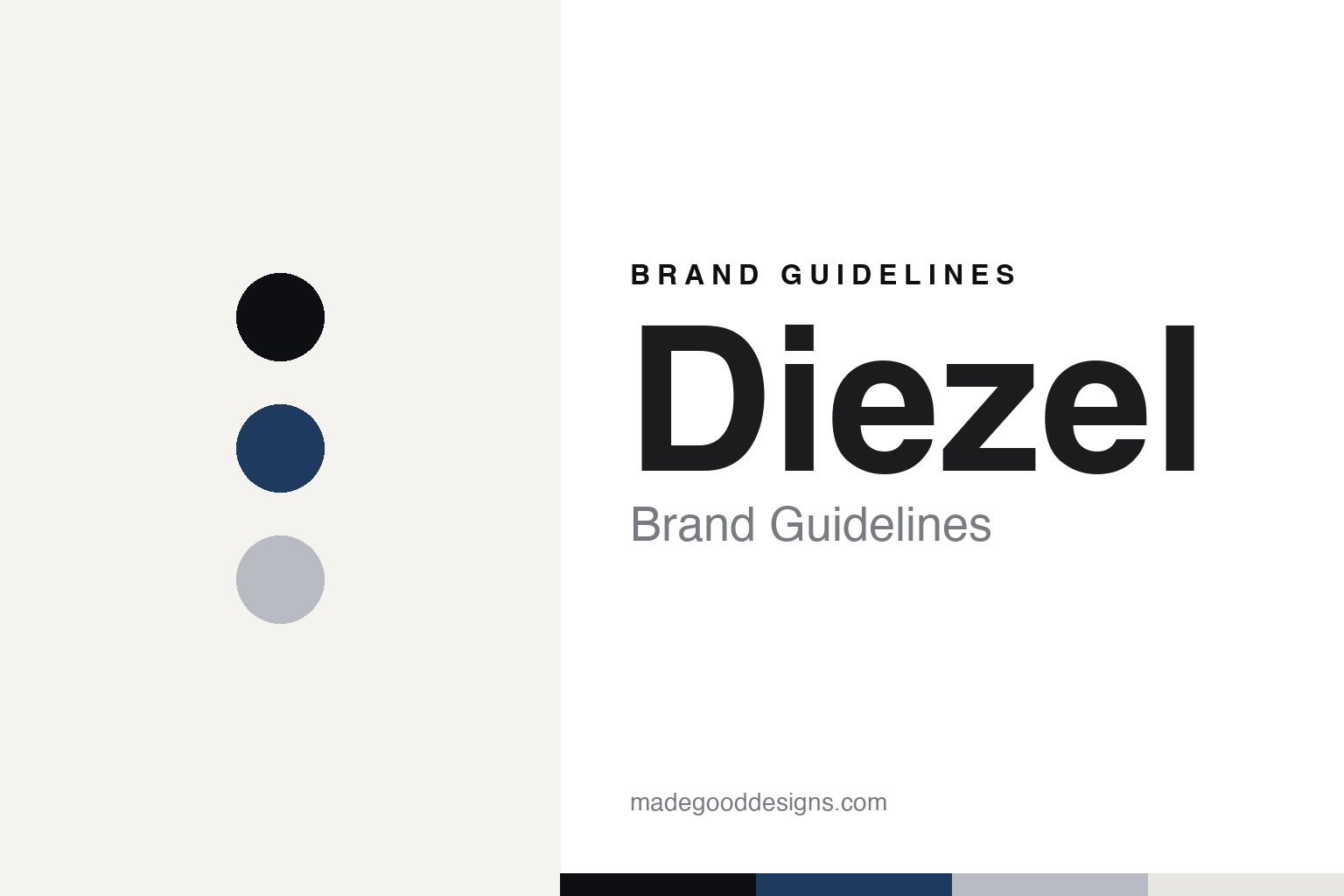
Diezel Brand Guidelines
The Munich-born, Bavarian-built four-channel amp maker.
Aa
Two constants: a Diezel black, blue and steel palette and an Engineered sans register. Abstract homage — not a Diezel product or mark; no amplifier, logo or nameplate is reproduced.
Two Peters in Munich
A guitarist who rebuilt his Marshalls.
Diezel is often described as a Bad Steben company, and that is where its amplifiers are built today. But its own history puts the start somewhere else: in Munich. A company history archived in November 2004 says that in the 1980s Peter Diezel “started to modify Marshalls in Munich, where he lived and studied electrics/electronics,” played in several bands and met the professional musician Peter Stapfer. German Wikipedia adds that Diezel trained as a sound engineer and electrician, and compares him with Reinhold Bogner, another Bavarian who began by reworking Marshall amplifiers before moving to the United States.
A longer version of the history, archived in 2007, tells the story in the company’s own voice. Diezel, it says, was not satisfied with his Marshalls, modified them, and was soon modifying amplifiers for other players; he was “famous for tweaking amps on stage during gigs.” The limits of what it called “the Marshall platform” led him to a new idea: a MIDI-switchable amplifier with four channels. Stapfer, described as “a pro-musician with a strong sales/marketing background,” joined him to build the business. “The company was still located in Munich,” the history says, with Diezel making the amplifiers and Stapfer running sales.
The founding date depends on the source. The company’s website today says “EST. 1992” and calls Diezel “a small family business founded by Peter Diezel and Peter Stapfer”; English Wikipedia also gives 1992. The 2004 history said the GmbH was founded in 1993, and German Wikipedia files the company under the 1980s, when Diezel’s modifying work began. We give 1992 as the company’s own date and note the others.
Colour
The VH4, Herbert and the mid-cut.
The amplifier that made the name was the VH4, which German Wikipedia says was first shown at the Frankfurt Musikmesse in 1994. It had four independent channels — on the current version, Clean, Crunch, Mega and Lead, each with its own gain, tone and volume controls — plus MIDI switching and inserts that let a player add effects to one channel at a time. The company’s website calls it the amplifier that “put Diezel on the map” and says it is still made “the exact same way as in 1992,” although the same page says Diezel created it in 1994. Its 2004 history noted that the first VH4s were easy to spot by their blue front panels.
Early sales, the 2007 history says, were “limited to Germany and Austria,” until, by what it calls “the legend,” one VH4 reached a studio in Los Angeles, after which bands including Metallica and Guns N’ Roses recorded with the amplifier. German Wikipedia repeats the story with the same caution. One of the company’s own examples is Adam Jones of Tool, who, it says, still plays his first VH4 on stage.
The Herbert, named after Peter Diezel’s father, followed in 2002, after prototypes were finished in 2001. It added a switchable “mid-cut” that sharply reduces the midrange, so one amplifier could move between classic rock tones and the scooped sound of modern metal; the current model uses six KT77 power valves for about 180 watts. The Einstein, named after Diezel’s dog, was launched at the NAMM show in 2005, and the company’s 2007 history also recorded a MIDI switcher, Columbus, in 2006, the Class A Schmidt shown as a prototype the same year, and a first bass amplifier, Lucy, designed with Jochen Mayer.
The current range, on the company’s website, runs from the VH4 and Herbert to the Hagen, the compact D-Moll — “Herbert’s little brother” — the VH2, the lower-powered Paul and BigMax, and the VH-X, an all-valve head with digital control, stored presets and built-in effects. A feature the company calls Tube-Fault Technology removes a failed power valve’s circuit so the amplifier keeps playing, slightly quieter. German Wikipedia lists reviews in Guitar Player in 2004 and in the German magazines Gitarre & Bass in 2005 and Guitar in 2006.
Typography
Design and documentation.
Marshall and Fender are the amplifier names most guitarists know, but many smaller makers began with one or two engineers. Their histories are easier to check than their ownership: several are private companies that publish little about who holds them.
Germany has three of the makers in this guide. Hughes & Kettner was founded in Saarland in 1984 by the brothers Hans and Lothar Stamer and was based for decades in St. Wendel, Wikipedia says; since 1 May 2025 it has belonged to the retailer Thomann, the German magazine Gitarre & Bass reported. ENGL trades as ENGL Gerätebau GmbH from Tittmoning in Bavaria, according to its imprint, and says Edmund Engl founded it in 1983. Diezel, which Peter Diezel and Peter Stapfer started in Munich and which dates itself to 1992, now builds its amplifiers in Bad Steben, also in Bavaria, and calls itself “a small family business.”
Two are in Los Angeles. Bogner was founded there in 1989 by the German-born Reinhold Bogner, and Friedman in 2008 by Dave Friedman, who in 2014 signed a deal with Boutique Amps Distribution to build and distribute his amps, English Wikipedia says.
Two are English. Laney, founded by Lyndon Laney in 1967, is owned by Headstock Group, a family-owned company in the Black Country, Headstock says. Blackstar, launched in 2007 by four former Marshall engineers, is based in Northampton; the UK companies register lists two founders as each holding over a quarter of its parent group.
This guide sets out what can be checked about each brand — who founded it, who owns it, and what it says about where its products are made — and marks clearly what rests only on the company’s own word.
Aa
An engineered sans — four channels, one box. (Specimen set in Archivo, a sans STAND-IN; NOT the Diezel logo.)
Diezel
An office in Swabia, a workshop in Upper Franconia.
Diezel has stayed in its founders’ hands. Its imprint names Diezel GmbH with two managing directors: Peter Diezel, responsible for production and development, and Peter Stapfer, responsible for sales and finance. We found no outside owner, investor or parent company in the sources we checked. Its website describes “four people located in the heart of Germany.”
The company has two Bavarian addresses more than 200 kilometres apart. Its registered office is in Dillingen an der Donau, in Swabia, near Ulm — where, the 2007 history said, Stapfer organised sales. Production is listed in Bad Steben, a spa town in the district of Hof in Upper Franconia, near the border with Thuringia. The workshop moved there from Munich in 2003, the company’s history says, because Bad Steben was Peter Diezel’s home town.
On where the amplifiers are made, the company is consistent: “Every Diezel Amp is handbuilt in Germany, personally tubed and checked by myself,” its website quotes Peter Diezel as saying, and the VH-X page says that “as with all Diezel amps” it is “handmade in Germany.” Its cabinets page says the cabinets are made in its own wood shop in Dillingen, with front-loaded models in 18mm African okoume and rear-loaded models in birch. We give these as the company’s claims; we found no independent account of its workshops.
One web-address trap: the domain diezel.de belonged, in the earliest archived records we found, to an unrelated office-supplies business in Gera, in Thuringia. The amplifier maker uses diezelamplification.com, and its Swiss address, diezel.ch, now redirects there.
For a design guide, Diezel shows how a small workshop can build an identity around one engineering idea — four channels in one box — and the names of family members. Compare Marshall, whose amplifiers Peter Diezel began by modifying, and ENGL, another German high-gain valve-amp maker. For this guide we use black, a VH4 blue and a steel grey with a sans, an unofficial interpretation; no product or logo is reproduced.
Explore & save
Keep Diezel’s identity on hand — save it to a board in the Made Good inspiration library.
Diezel identity set
Pin the Diezel black, blue and steel palette and the Engineered sans register to your own board.