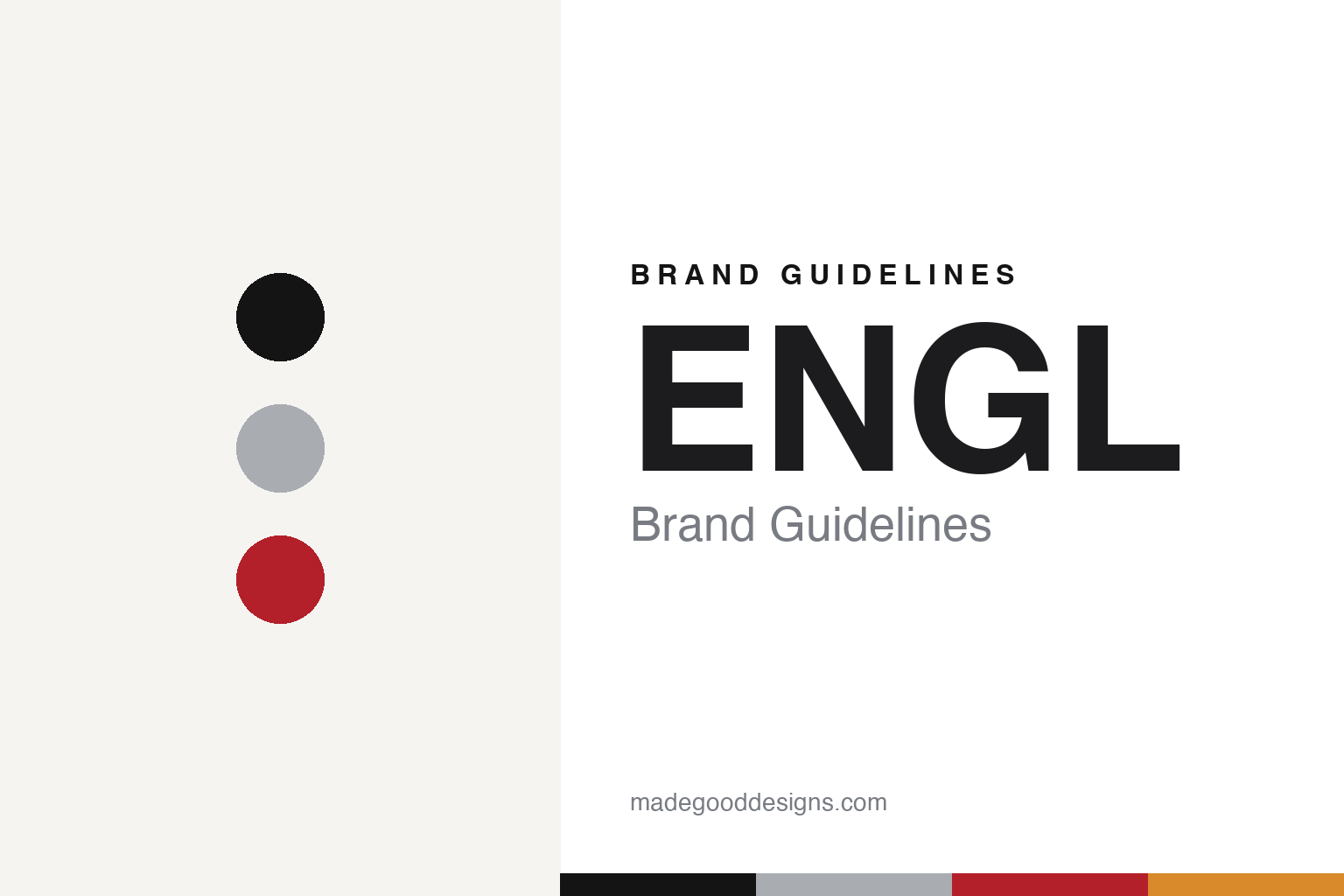
ENGL Brand Guidelines
The Bavarian tube-amp maker from Tittmoning.
Aa
Two constants: an ENGL black, silver and red palette and a Condensed sans register. Abstract homage — not an ENGL product or mark; no amplifier, logo or nameplate is reproduced.
A musician’s idea
A programmable amp from the Bavarian provinces.
ENGL was founded in 1983 by Edmund Engl in Tittmoning, a small town on the Salzach river in south-east Bavaria, on the Austrian border near Burghausen and about 90 kilometres east of Munich. German Wikipedia calls it a small company and dates its founding to around 1983; ESP Guitars, its North American distributor, and the company’s website give 1983.
Engl was not an electronics engineer. Gitarre & Bass, profiling the company after a factory visit in its February 2013 issue, wrote that he played drums and guitar in bands and came up with the idea of a programmable amplifier — one that could switch between very different sounds — because of what he needed as a musician. Unable to build it himself, he found a qualified engineer from Rosenheim who worked on it part-time; the magazine says it took three years before the “Digital-Amp” was ready for production in 1983.
The breakthrough came at the Frankfurt Musikmesse in 1984, where the amplifier was demonstrated in a sound booth. The company’s website calls that show the moment “where ENGL really began.” Gitarre & Bass wrote that international distributors queued up, but some players were unconvinced by the tone: the first version had a tube power stage but only one preamp tube, because its programming relied on CMOS chips.
The first workshop was domestic. Materials were kept in a family attic and amplifiers were built in the cellar, the magazine wrote, and for many years the company wound its own transformers. In 1989 it moved to Kay, a district of Tittmoning, and hired its first two employees.
Colour
Horst Langer and the high-gain heads.
The engineer behind the sound is Horst Langer, whom both the company and Gitarre & Bass call its technical mastermind. The magazine says he was a friend of a relative of Edmund Engl and was studying electrical engineering; he first designed the “Effect Multiplex,” which it calls probably the world’s first programmable signal looper, and then a conventional amplifier, the Straight of 1985. It had two channels and, for the time, a great deal of gain, and it became popular with hard-rock players. The programmable Digital-Amp was dropped in 1987.
The Savage of 1993 set the pattern for the multi-channel heads ENGL is now known for: four channels built from two, with two master volumes and two presence controls switched by footswitch. In 1995 Ritchie Blackmore, the Deep Purple and Rainbow guitarist, took an interest in the Savage, and his signature amplifier followed in 1996; the company says it is still in production. Steve Morse, his successor in Deep Purple, later got a signature head with four separate midrange controls. The Powerball and Fireball followed in 2002, and German Wikipedia says ENGL amplifiers are widely used in rock and heavy metal.
The model codes are part of the system: almost every product carries an E-number, from the E610 Savage to the E650 Blackmore signature. In the United States and Canada, ESP Guitars has distributed ENGL since 2019, ESP says, and Gitarre & Bass described an ENGL showroom in North Hollywood in 2013. A reissue of the E670 Special Edition later marked the company’s 40th anniversary, the magazine reported.
Typography
German amplifiers and their makers.
Marshall and Fender are the amplifier names most guitarists know, but many smaller makers began with one or two engineers. Their histories are easier to check than their ownership: several are private companies that publish little about who holds them.
Germany has three of the makers in this guide. Hughes & Kettner was founded in Saarland in 1984 by the brothers Hans and Lothar Stamer and was based for decades in St. Wendel, Wikipedia says; since 1 May 2025 it has belonged to the retailer Thomann, the German magazine Gitarre & Bass reported. ENGL trades as ENGL Gerätebau GmbH from Tittmoning in Bavaria, according to its imprint, and says Edmund Engl founded it in 1983. Diezel, which Peter Diezel and Peter Stapfer started in Munich and which dates itself to 1992, now builds its amplifiers in Bad Steben, also in Bavaria, and calls itself “a small family business.”
Two are in Los Angeles. Bogner was founded there in 1989 by the German-born Reinhold Bogner, and Friedman in 2008 by Dave Friedman, who in 2014 signed a deal with Boutique Amps Distribution to build and distribute his amps, English Wikipedia says.
Two are English. Laney, founded by Lyndon Laney in 1967, is owned by Headstock Group, a family-owned company in the Black Country, Headstock says. Blackstar, launched in 2007 by four former Marshall engineers, is based in Northampton; the UK companies register lists two founders as each holding over a quarter of its parent group.
This guide sets out what can be checked about each brand — who founded it, who owns it, and what it says about where its products are made — and marks clearly what rests only on the company’s own word.
Aa
A condensed sans — ENGL in capitals. (Specimen set in Oswald, a condensed sans STAND-IN; NOT the ENGL logo.)
ENGL
Built in Tittmoning, with Czech cabinets.
ENGL is one of the few amp makers whose production has been described in detail by the trade press. In 2013 Gitarre & Bass found it in a hall of about 500 square metres in Tittmoning, where it had moved in 2002. Circuit boards were populated by hand at semi-automatic stations and soldered by machine; front and back panels were screen-printed in-house; two technicians tested every chassis; output tubes were matched in-house and printed with the ENGL logo. But the amplifier housings and all of the speaker cabinets, Langer told the magazine, were made by a subcontractor in the Czech Republic, and the cabinets went straight to the company’s sales operation in Bochum. Transformers had come from a supplier since the late 1990s.
The company today says it “consistently implements the quality standards of Made in Germany” and describes itself as “based in Germany since our inception.” The 2013 account is the most detailed we found; we have not seen a more recent independent description of where each part is made.
ENGL still trades as Engl Gerätebau GmbH in Tittmoning, and its website names two managing directors. We found no record of a sale of the company in the sources we checked. Its look is plain and heavy: black cabinets, the name in capitals and anodised bars across many front panels, which the company told the magazine in 2013 were costly to make. ESP says buyers can order custom Tolex colours, corners, knobs and light colours. We found no published brand guidelines or colour values.
For a design guide, ENGL shows how a small engineering company can build an identity from consistency — black boxes, model codes and a long list of rock players. Compare Hughes & Kettner, the other German maker that started with a programmable amplifier in the 1980s, and Mesa/Boogie. For this guide we use tolex black, anodised silver and a deep red with a condensed sans, an unofficial interpretation; no product or logo is reproduced.
Explore & save
Keep ENGL’s identity on hand — save it to a board in the Made Good inspiration library.
ENGL identity set
Pin the ENGL black, silver and red palette and the Condensed sans register to your own board.