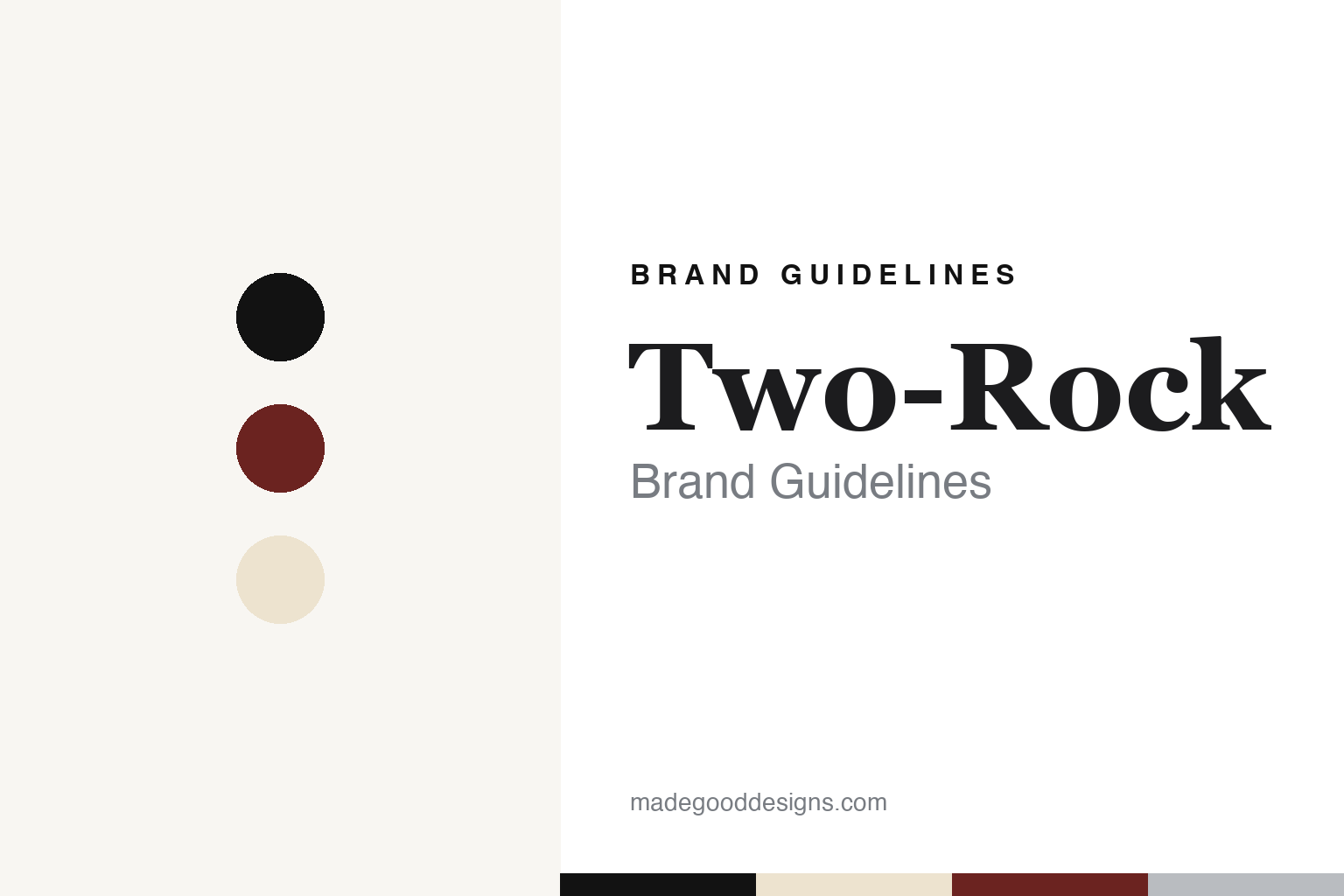
Two-Rock Brand Guidelines
The Sonoma County amp builder named after the hamlet of Two Rock.
Aa
Two constants: a Two-Rock black, oxblood and wheat palette and a Vintage serif register. Abstract homage — not a Two-Rock product or mark; no amplifier, logo or nameplate is reproduced.
K&M Analog Designs
A designer, a guitarist and a borrowed place name.
Two-Rock began as K&M Analog Designs, LLC, which the company’s 2007 website says was founded in 1999 by Bill Krinard and Joe Mloganoski. That page described Krinard as a designer who had worked in tube-amp technology for some 40 years, had built hi-fi tube amplifiers and was “already known locally as the tube-amp guru.” Mloganoski was a guitarist who had played the Boston club scene before moving west, and had run his own electronics repair business for 13 years before teaming up with Krinard. English Wikipedia also dates the founding to 1999 and places the company in Rohnert Park, in Sonoma County.
The name came from the map. “Our first 10 amps were labeled K&M Analog Designs,” the company wrote. “We were building amps very close to Two Rock, CA at the time and thought Two Rock was a cool name. As luck would have it, tworock.com was taken, so we put a – in it.” Two Rock is a rural community in Sonoma County. Every amp after those first ten carried the Two-Rock name, and the K&M label was kept for occasional custom builds for artists.
The early sound had a clear model. MusicRadar wrote in 2016 that Two-Rock was “originally based on the infamous Overdrive Special amplifiers designed and built by Howard (Alexander) Dumble in the 70s and 80s,” before moving on to designs of its own. The company’s own history says that after 11 September 2001 business “virtually halted,” and that it kept going partly by building amps to match the tone of the guitarist Steve Kimock’s 50-watt Dumble; that design, sold first as the K&M Custom, later became the Two-Rock Custom Reverb. By its tenth anniversary the company could say it had weathered “a recession,” “four moves, and a flood that nearly ended our company.” It marked the year with a limited run of 50 anniversary packages, each signed by Krinard and Mloganoski.
Colour
A sale, a collapse and a rebuild.
In 2010 Krinard and Mloganoski sold Two-Rock to Premier Builders Guild, Premier Guitar and MusicRadar reported. The guild, founded in 2009 by Michael Bernstein and Howard Swimmer according to English Wikipedia, gathered small guitar and amp makers including Tone King and Gjika. That same year Two-Rock released the TS1, the “Tone Secret,” which the company still calls one of its most iconic amplifiers. The arrangement did not last: MusicRadar reported that the guild “folded in late 2016,” and Premier Guitar wrote that by then Two-Rock was “teetering on collapse.”
It was bought in 2016 by Eli Lester and Mac Skinner. Lester, who calls himself “probably the biggest Two-Rock fan in the world,” had done research work with the company; he says he worked in guitar and amp repair from about 18 and toured as a player with Robben Ford. Skinner had run operations since 2004 — MusicRadar described him as the former general manager. “We literally started all over,” Lester told Premier Guitar in 2025. “We threw away chassis, transformers, and all the old inventory.” They also brought back Krinard to help with design.
They went big when the market was going small. Small amps were in fashion in 2016, Lester said, but they built 100-watt amps because that was what he liked to play; in 2021 he told Guitar World that 95 per cent of the amps they build are 100- or 150-watt platforms and that 99 per cent of the line is based on the 6L6 tube. The aim, he says, is “the biggest, most three-dimensional, clean amplifier you can.” Two-Rock is still compared with Dumble, but Lester insists “we don’t make Dumble clones,” and names Leo Fender as an equal influence.
The current line includes the Classic Reverb Signature, which Lester calls the company’s flagship, the two-channel Bloomfield Drive, the TS1, the Traditional Clean, the Silver Sterling Signature, the Studio Signature, the tweed-style Burnside and the Vintage Deluxe. Players named in the press include John Mayer, Joe Bonamassa, Matt Schofield, Ariel Posen, Eric Johnson and Doyle Bramhall II. None of it is cheap: in 2017 MusicRadar put the TS-1 at “nearly five grand” and called it one of the most expensive heads it had reviewed.
Typography
Modellers, boutique amps and the record.
The guitar amplifier has split into two camps. One makes the amp out of code: a digital processor that models, or “profiles,” the sound of valve amplifiers and speaker cabinets and fits it into a floor unit, a rack or a laptop plug-in. The other still builds the real thing, with valves, transformers and hand wiring.
The digital makers are spread widely. Kemper is a German company, Kemper GmbH, which gives its seat as Recklinghausen; Christoph Kemper, who designed the Access Virus synthesizer, turned to guitar products in 2006, English Wikipedia says. Fractal Audio Systems, founded in 2006 to make the Axe-Fx, says its headquarters are in Plaistow, New Hampshire. Neural DSP, founded in 2017, is based in Helsinki, English Wikipedia says. Positive Grid, which says it was founded in 2011, began in California with a team in Taiwan and now dates its press releases from Chandler, Arizona.
One of these brands is part of a larger group. Line 6, founded in 1996 and based in Calabasas, California, has been part of Yamaha since 2014; the company says that led in 2017 to Yamaha’s first guitar division, now Yamaha Guitar Group.
The valve builders are both Californian. Two-Rock works from Rohnert Park, in Sonoma County, and has been owned since 2016 by Eli Lester and Mac Skinner, the trade press reports. Matchless, founded in 1989, says its amplifiers are wired point-to-point by hand in Los Angeles.
The modelers offer many amps in one box, updated by software; the boutique makers offer a fixed circuit, built by hand.
This guide sets out what can be checked about each brand — who founded it, who owns it, and what it says about where its products are made — and marks clearly what rests only on the company’s own word.
Aa
A vintage serif — a nod to the American amps Two-Rock measures itself against. (Specimen set in Libre Baskerville, a serif STAND-IN; NOT the Two-Rock logo.)
Two-Rock
Still in Rohnert Park.
Two-Rock is privately owned by Lester, its chief executive, and Skinner, its chief operating officer. In January 2024 they added a second brand: “As of Jan 1st 2024 Mac & I have purchased Divided by 13 Amplifiers,” Lester announced, buying the company from its founder, Fred Taccone, and saying the amps would be built “in our existing Two-Rock shop in Northern California.” The shop is in Rohnert Park: MusicRadar reported in 2017 that the revived company was “still based in the original Rohnert Park premises,” and its website gives the town as its address. Premier Guitar put the staff at about 25 in 2025, “between the amp factory and the cabinet shop.” Lester says they drill every eyelet by hand, that the output transformer is a proprietary design made for them and that capacitors, resistors and potentiometers are built to their specifications; the company also fits its own TR12 speaker. Lester says they have turned down large retailers to stay small.
The look is quiet and vintage. Reviewing the small Cardiff head in 2016, MusicRadar admired its grey vinyl and four white chickenhead knobs but found the control-panel lettering “a little too minimalist to read easily,” adding: “We’d use a bolder font.” Today’s range leans on American amp styling: the Vintage Deluxe in blonde tolex with wheat grille cloth and cream knobs, the Burnside in blond tolex with an oxblood stripe, and the Silver Sterling Signature on a silver anodised chassis, the company says.
For a design guide, Two-Rock shows how a small maker can stand for one sound — big, clean and expensive — and let the finish say “vintage” without copying anyone’s logo. Compare Fender, whose 1950s and 1960s amps Two-Rock measures itself against, and Friedman, another builder that grew out of modifying classic designs. For this guide we use black, oxblood and wheat with a serif, an unofficial interpretation; no product or logo is reproduced.
Explore & save
Keep Two-Rock’s identity on hand — save it to a board in the Made Good inspiration library.
Two-Rock identity set
Pin the Two-Rock black, oxblood and wheat palette and the Vintage serif register to your own board.