Chandler Limited Brand Guidelines
The Iowa maker licensed to rebuild Abbey Road’s EMI gear.
Aa
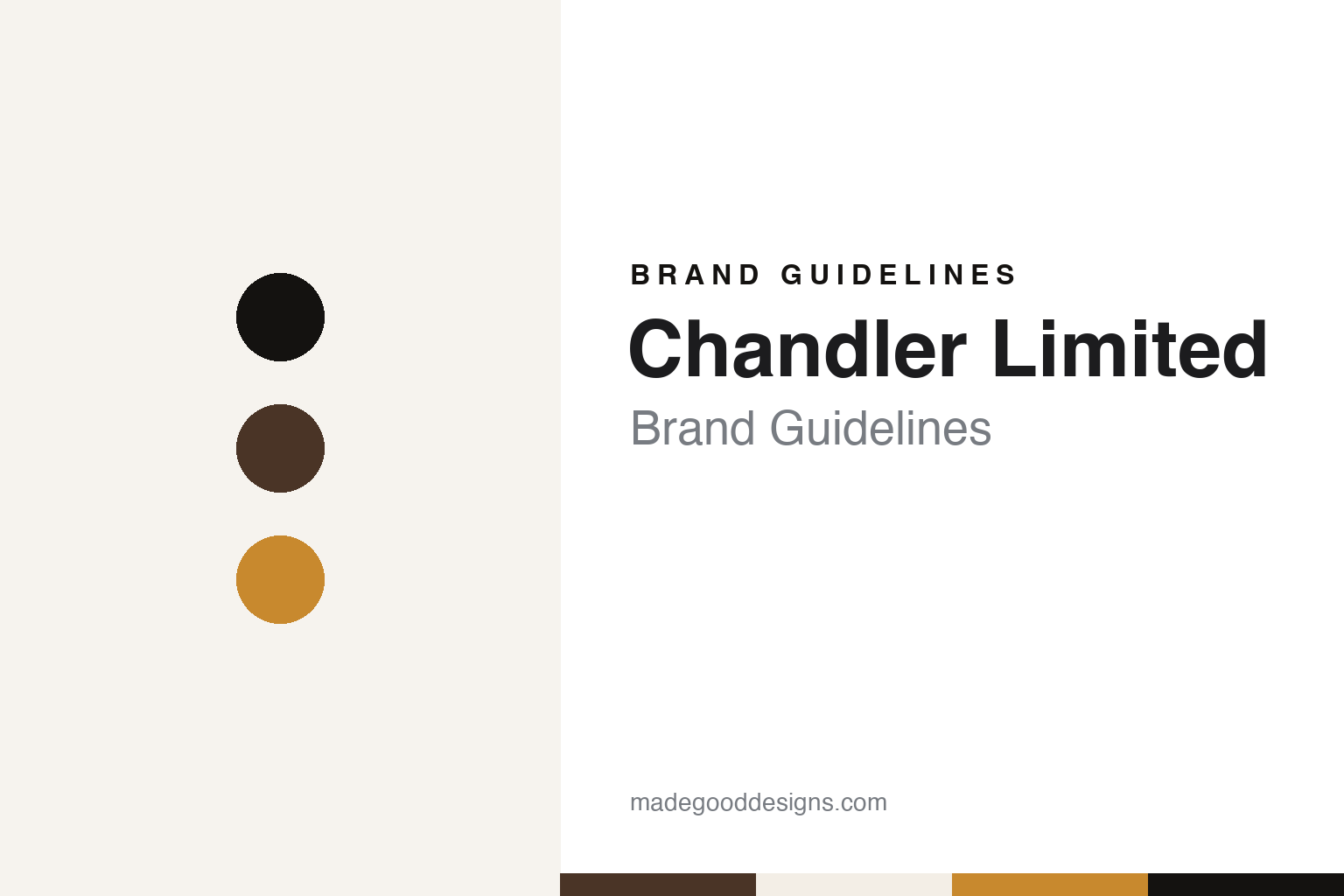
Two constants: a Chandler fascia brown and valve amber palette and a Utilitarian sans register. Abstract homage — not a Chandler Limited product or mark; no unit, logo or nameplate is reproduced.
A Closet in North Hollywood
An Iowan in Los Angeles, rebuilding Neve modules.
Chandler Limited did not begin in Iowa. According to the company’s own history, published for its 15th anniversary in May 2014, Wade Goeke — its “founder, owner, and chief product designer” — started it in 1999 while living in North Hollywood, California, working a day job and building equipment at night in the walk-in closet of a rented house. Its first sale, he says, was six LTD-1 preamp-equalisers; after that he sold units one at a time from home, sometimes borrowing money or selling pieces from his own collection of vintage gear to keep going. The company marked its 20th anniversary in 2019, which fits the same date.
Goeke described his route into the trade to Tape Op, in an interview by Walt Szalva. An Iowan, he moved to Los Angeles after high school, played in bands and assisted in studios, and began building Neve-style modules from scratch because he could not afford to buy them. Parts for those came from the Neve-module specialist Brent Averill, who then hired him; Goeke said he worked there for “a year and a half or so” and “kind of ran the shop,” and added that “I don’t actually have a technical background.”
The earliest archived version of the company’s website, captured in March 2002, shows where it started. “At Chandler Limited we love Neve,” it read, promising “honest & accurate re-creations” of vintage discrete modules, with point-to-point wiring and, in many cases, vintage parts. The LTD-1 was described there as an “expanded 1073 circuit,” after the Neve module. By 2004 the range listed on the archived site had grown to the TG1, TG2, LTD-1, LTD-2 and a channel strip.
Colour
Abbey Road found its designer.
The turn came with EMI. The company says it introduced the TG1 Limiter in 2001 and soon afterwards the TG2 Pre Amp/DI, which it describes as a recreation of the EMI TG12428 preamp used in EMI and Abbey Road recording and mastering consoles in the late 1960s and early 1970s. Goeke told Tape Op that “the first two units I did on my own.” Abbey Road heard them. A news page on Chandler’s website, archived in 2006 and filed under May 2004, quotes Dave Holly, described as managing director of EMI Studios, saying the studio had been looking for someone to develop products from its old designs and that “we realized that we’d found our designer,” with EMI making “original designs and drawings and designer notes” available. The first result was an Abbey Road Special Edition of the two units.
Goeke described the deal to Tape Op as one in which “I give them a royalty but I also have access to their full archive of technical information and to their pile of equipment,” and to its engineers; he spoke of going through boxes of drawings by Mike Batchelor, whom he called the main designer of the TG equipment. In August 2014 Chandler and Abbey Road Studios announced a new long-term agreement, and Mirek Stiles, then Abbey Road’s head of audio products, said that “a whole new generation of engineers and producers today have access to EMI hardware.” Sound On Sound has called it a licensing arrangement (2016) and an exclusive agreement (2023); Chandler itself says it is the only company licensed to develop and market the official equipment of EMI and Abbey Road Studios.
The range has grown well beyond the first two units. Its TG products derive from what Sound On Sound called EMI’s mid-period transistorised equipment. The valve REDD.47 preamp, reviewed by Hugh Robjohns in December 2015, revives an amplifier whose sound, he wrote, is on “virtually all the Beatles tracks” recorded in Abbey Road’s Studio Two between 1964 and 1968; the RS124 valve compressor, the magazine said in 2016, had “never been made available commercially” before; the RS660 followed. Microphones came next: the REDD Microphone in 2017, developed with Abbey Road’s former chief engineer Peter Cobbin, the TG Microphone in 2019 and the cheaper TG Type L, reviewed in 2024. Chandler’s own non-EMI lines include Germanium and Little Devil units, and its hardware has been licensed for plug-ins by Brainworx and Plugin Alliance (announced in 2013) and by Softube for Universal Audio’s UAD-2 platform (2016).
Typography
The makers of studio outboard.
Studio outboard — the reverbs, delays, compressors, equalisers and preamps that sit in racks beside a mixing console — is a small trade, much of it started by engineers working for themselves. The seven makers in this guide span digital effects, valve processing and licensed recreations of vintage studio equipment.
Two are American digital pioneers of the early 1970s. Eventide began that year in New York City and now dates its press releases from Little Ferry, New Jersey; we found no record of a sale to a larger group. Lexicon began in 1969 as American Data Sciences, took the Lexicon name in 1971, was based in Waltham, Massachusetts, and was bought by Harman in 1993, Harman announced at the time; Samsung completed its purchase of Harman in March 2017.
TC Electronic was founded in Aarhus, Denmark, in 1976 by the brothers Kim and John Rishøj. In April 2015 MusicRadar reported that its parent, TC Group, had been bought by Music Group, the Behringer owner now called Music Tribe.
The analogue makers are smaller. Empirical Labs, founded by Dave Derr, who had helped design Eventide’s H3000, lists a New Jersey address and says all its products are made in the USA. Manley Laboratories builds valve equipment in Chino, California, and was bought in July 2025 by Rockforce Tech Holding, a company founded by Dirk Ulrich, Mix reported. Tube-Tech is the brand of Lydkraft, near Copenhagen. Chandler Limited, which Wade Goeke founded in 1999, is in Shell Rock, Iowa, and the company names him as its owner.
This guide sets out what can be checked about each brand — who founded it, who owns it, and what it says about where its products are made — and marks clearly what rests only on the company’s own word.
Aa
A utilitarian sans — the register of rack panels and engraved legends. (Specimen set in Archivo, a sans STAND-IN; NOT the Chandler Limited logo.)
Chandler Limited
Three storefronts in Shell Rock.
In 2001 Goeke moved back to his home town of Waverly, Iowa, and the company worked from the basement of his father’s office, with his parents helping to run it, the company says. In 2004 it moved to neighbouring Shell Rock, where, according to the same 2014 history, it occupied three converted storefronts downtown, with circuit-board manufacturing, assembly, wiring and testing on the ground floor and offices, a recording studio and two live rooms upstairs. Its press releases have carried a Shell Rock dateline since at least 2013.
That is the company’s account, and one independent check supports it. Reviewing the REDD Microphone in May 2017, Sound On Sound reported that “the electronics are all assembled in Chandler’s factory in America,” while Chandler said it bought the capsules from a European manufacturer it would not name. The company describes products such as the RS660 as “handmade.” We did not find a country-of-origin statement for every current product, including the TG Type L microphone, so we do not extend that finding to the whole range.
Ownership looks simple. The website is copyrighted to Chandler Limited, Inc., the company’s 2014 history calls Goeke its owner, and Sound On Sound still called him its founder in 2023; we found no record of a sale in the sources we checked. The EMI and Abbey Road names on its panels are there under licence, not ownership.
For a design guide, Chandler Limited shows how a small maker can wear a famous studio’s heritage under licence: the RS660’s dark brown fascia, Sound On Sound noted, sits inside a black trim plate carrying the Chandler, EMI and Abbey Road Studios logos. Compare AMS Neve, which carries on the Neve name behind the 1073 module Chandler first built on, and Universal Audio, whose UAD-2 platform hosts a Chandler plug-in. For this guide we use fascia brown, ink and valve amber with a sans, an unofficial interpretation; no product or logo is reproduced.
Explore & save
Keep Chandler Limited’s identity on hand — save it to a board in the Made Good inspiration library.
Chandler Limited identity set
Pin the Chandler fascia brown and valve amber palette and the Utilitarian sans register to your own board.