Universal Audio Brand Guidelines
Bill Putnam’s studio-gear name, revived by his sons.
Aa
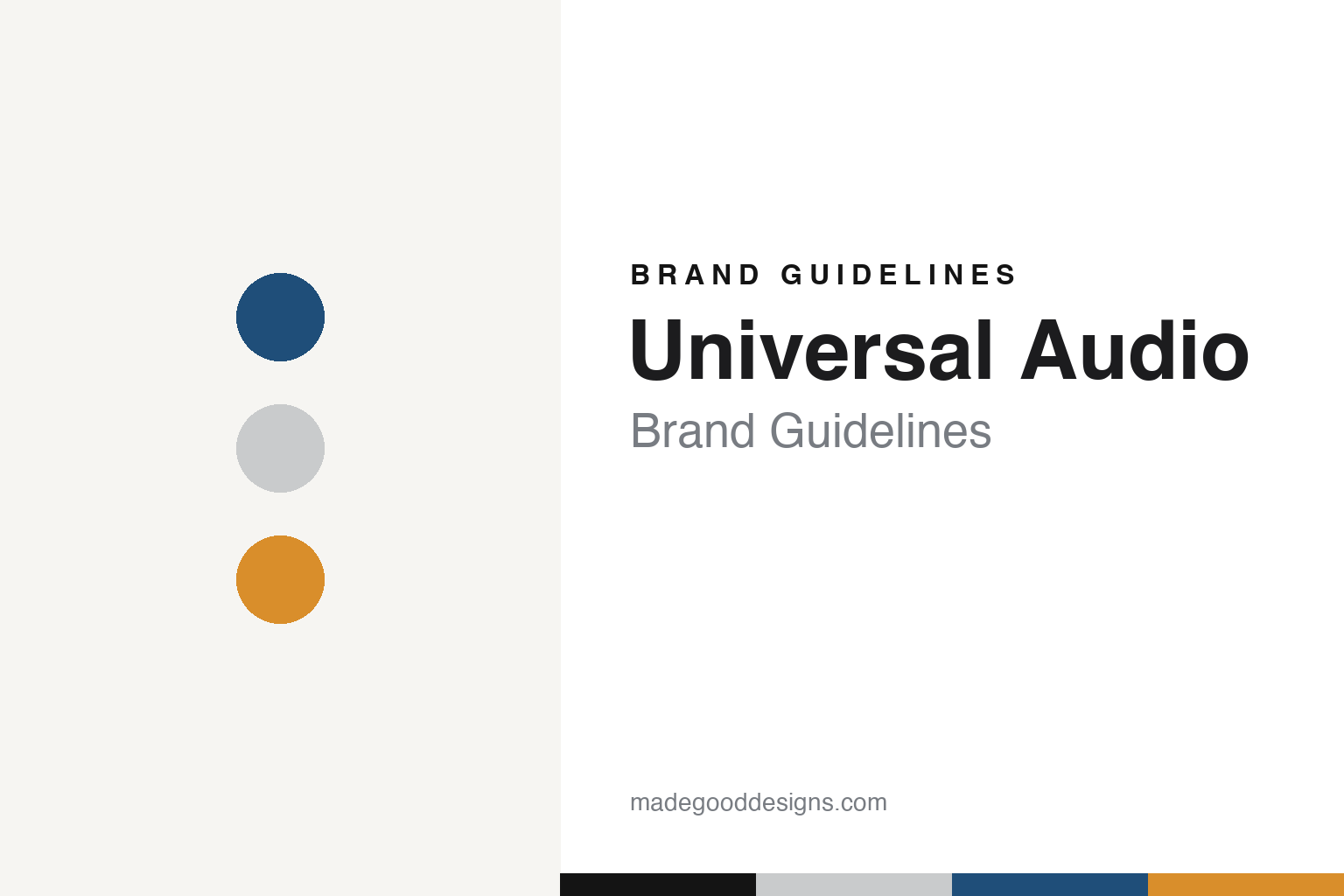
Two constants: a Universal Audio blue, black and silver palette and a Studio sans register. Abstract homage — not a Universal Audio product or mark; no instrument, logo or nameplate is reproduced.
Putnam’s workshop
A studio owner who built his own equipment.
Universal Audio is the second life of a name created by Bill Putnam, the engineer and studio owner whom Bruce Swedien called the father of recording “as we know it today,” as Universal Audio’s own history quotes him. Putnam opened Universal Recording Corp. in Evanston, Illinois, in 1946 and soon moved it to Chicago. There, in 1947, he recorded the Harmonicats’ “Peg o’ My Heart” using a tiled washroom as an echo chamber — “generally accepted to be the first ‘pop’ record to use artificial reverberation,” the company’s 2008 history page said; English Wikipedia calls it the first artistic use of artificial reverb in a pop song.
When the equipment company began is less tidy than the brand suggests. Universal Audio today says it has worked “since 1958,” and English Wikipedia dates its founding to that year in Hollywood, where Putnam had moved in 1957 to build United Recording on Sunset Boulevard; Wikipedia says Universal Audio started there as United’s manufacturing arm, best known for the 610 tube preamplifier. The company’s own older pages told it differently: in 2004 they said UA was “founded in the 1950’s,” and in 2008 they tied it to Putnam’s first studio, in Evanston and then Chicago, saying most of Universal Recording’s equipment, including the console, “was built by Universal Audio.” Wikipedia’s UREI article also places the start in Chicago. We give 1958 as the company’s own date.
The name then passed through a studio group’s reorganisations. United bought Studio Supply Co. in 1961 and renamed it Studio Electronics, which had absorbed Universal Audio by December 1965, though products kept the UA label. In 1967 it bought the broadcast division of Babcock Electronics, including Teletronix and its LA-2A — the optical tube compressor invented by James F. Lawrence II, who had founded Teletronix in Pasadena in 1958 — and became United Recording Electronics Industries, or UREI. The 1176, an early all-solid-state peak limiter built around a field-effect transistor, followed in 1967, Wikipedia says, or 1968, according to its UREI article; the first units were known as “blue stripe” for the blue band around their meters on a silver panel. Putnam later sold UREI to Harman, which made it part of JBL; Wikipedia’s articles give the year as 1983, 1984 and 1985.
Colour
Two reissues and a DSP card.
In 1999 Putnam’s sons, Bill Putnam Jr. and James (Jim) Putnam, relaunched Universal Audio, the company’s 2004 website said, and merged it with Kind of Loud Technologies, a software firm that Wikipedia says Bill Jr. had co-founded with Jonathan Abel, whom he met at Stanford’s Center for Computer Research in Music and Acoustics. The aims were to reproduce the equipment designed by their father and his colleagues, and to design new tools “in the spirit of vintage analog technology.” Recent press releases describe the company as “refounded in 1999 by Bill Putnam Jr.,” naming one son; its earlier website and Wikipedia name both.
The first products were reissues of the 1176LN and the Teletronix LA-2A. In a September 2007 press release Bill Putnam Jr. said the company had grown from his Santa Cruz basement and “the original 2 classic re-issues of the 1176LN and LA-2A that restarted the company in 1999.”
The digital side grew alongside. Sound On Sound reviewed the UAD-1, a computer card that runs UA’s plug-ins on its own processor, in October 2001, and its successor, the UAD-2, in November 2008. In January 2012 UA announced Apollo, an audio interface with UAD-2 processing built in, so that musicians could record through the plug-ins with, the company said, “sub-2ms latency”; Bill Putnam Jr. called it “the culmination of 10 years of analog and digital audio development.” In 2020 UA announced LUNA, its recording software, and in 2021 the cheaper Volt USB interfaces, whose “Vintage” mode is designed to emulate the 610 preamp, Wikipedia says, citing Engadget. In June 2021 it agreed to buy the assets of Townsend Labs, maker of the Sphere L22 modelling microphone.
Recognition has come to both generations. Bill Putnam Sr. received a Technical Grammy in 2000, and the company received its own in 2009: the Recording Academy presented it to Bill Putnam Jr. on 7 February, the eve of the 51st Grammy Awards. The LA-2A and the 1176LN are both in the TECnology Hall of Fame, inducted in 2004 and 2008, Wikipedia says.
Typography
Design and documentation.
The makers in this guide build the equipment that turns sound into numbers and back again — analog-to-digital and digital-to-analog converters, clocks, and the audio interfaces that connect microphones to computers. Their reputations were made in recording and mastering studios, and several now also sell to home musicians.
They are spread across Europe and the United States. Weiss Engineering is in Uster, near Zurich, according to its website. Prism Sound says it has been based since 2008 in the former SADiE building at Stretham, Cambridgeshire, after buying that company. Antelope Audio is the trading name of Elektrosfera Ltd. of Sofia, Bulgaria, according to its privacy policy.
In the United States, Benchmark Media Systems ships its orders from what it calls its factory in Syracuse, New York; Lynx Studio Technology gives its address as Costa Mesa, California; and Universal Audio is based in Scotts Valley, California, according to the companies’ websites.
Ownership varies more than location. Focusrite, of High Wycombe in Buckinghamshire, is the only listed company here: shares in its parent, Focusrite plc, trade on the London Stock Exchange’s AIM market, and the group also owns brands including Novation and ADAM Audio, according to Wikipedia. Universal Audio is privately held, Wikipedia says. Prism Sound’s studio business has operated since 2019 under Audio Squadron, alongside Tracktion and SADiE, while the original 1987 company is controlled by its founders’ firm, Companies House shows. For Weiss, Benchmark, Lynx and Antelope we found no parent company in the sources we checked.
This guide sets out what can be checked about each brand — who founded it, who owns it, and what it says about where its products are made — and marks clearly what rests only on the company’s own word.
Aa
A studio sans — the plain lettering of rack-mounted equipment. (Specimen set in Archivo, a sans STAND-IN; NOT the Universal Audio logo.)
Universal Audio
Santa Cruz County, by its own account.
Universal Audio is based in Scotts Valley, California, in Santa Cruz County. In September 2007 it announced it was moving its headquarters and manufacturing there from Santa Cruz, into a 30,000-square-foot building, with about 65 full-time staff. English Wikipedia describes it as privately held, with Bill Putnam Jr. as chief executive, as its website also shows. We found no sale of the company and no outside parent in the sources we checked.
On manufacturing, UA is specific about its analog classics and silent about its interfaces. Its product pages say staff “hand build and test each unit at the UA Custom Shop in Santa Cruz, California” for the 1176LN, that every LA-2A is “point-to-point handwired” there, and that the UA Bock 251 microphone, made to the specification of the designer David Bock, is handmade in Santa Cruz with a German-made capsule. We give those as the company’s statements, and note that the 2007 release placed manufacturing in Scotts Valley while the current pages name Santa Cruz. The Apollo and Volt pages we read say nothing about where those interfaces are made, so we make no claim.
For a design guide, Universal Audio shows how a company can build a modern brand on its own back catalogue — reissuing the hardware, modelling it in software and keeping the original names. Compare RME, the German audio-interface maker, and Warm Audio, whose affordable tributes to classic studio gear draw on the same history from outside. For this guide we use a blue-stripe blue, rack black and brushed silver with a sans, an unofficial interpretation; no product or logo is reproduced.
Explore & save
Keep Universal Audio’s identity on hand — save it to a board in the Made Good inspiration library.
Universal Audio identity set
Pin the Universal Audio blue, black and silver palette and the Studio sans register to your own board.