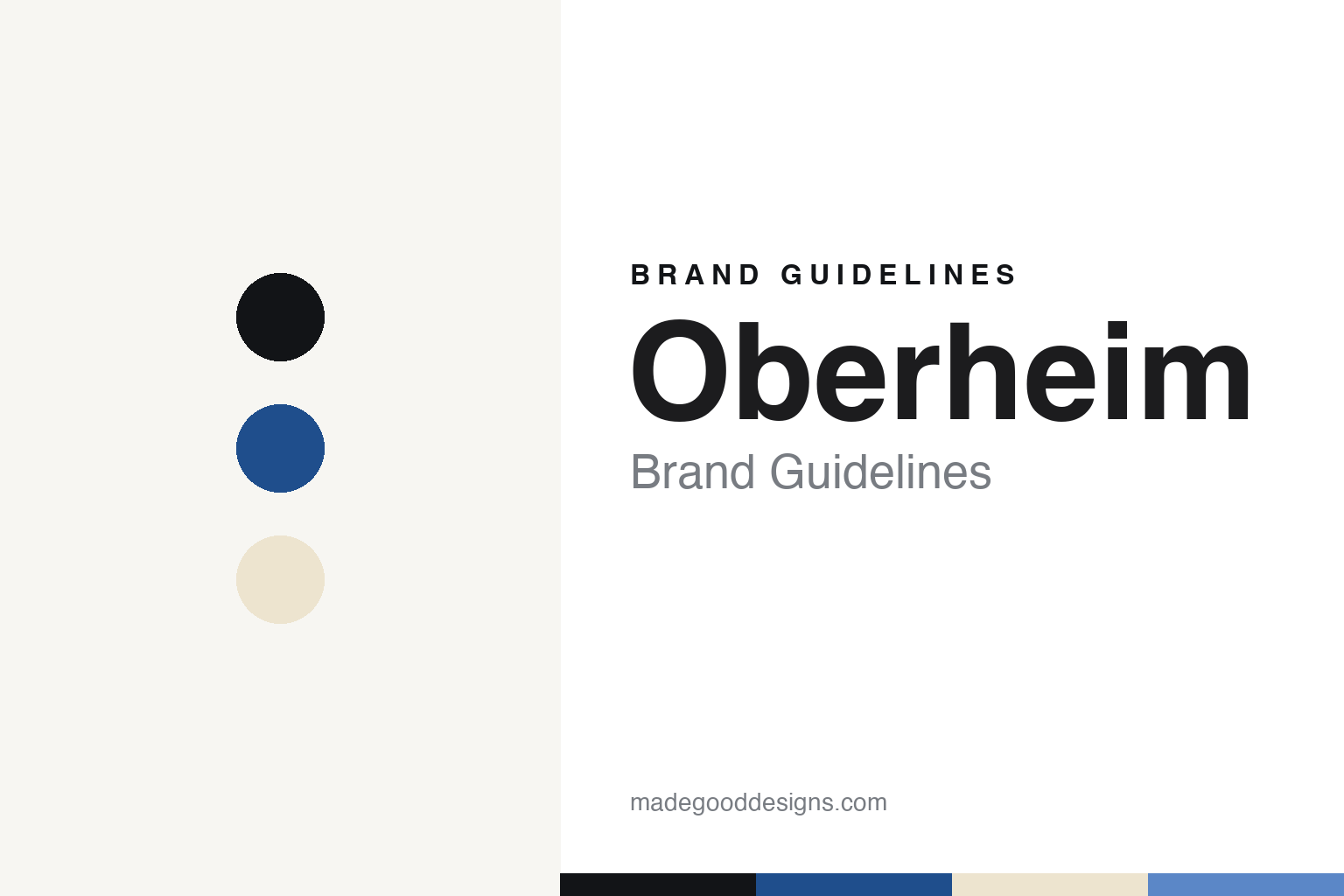
Oberheim Brand Guidelines
The polysynth pioneer whose name outlived its company.
Aa
Two constants: an Oberheim black, pinstripe blue and SEM cream palette and a Wide sans register. Abstract homage — not an Oberheim product or mark; no instrument, logo or nameplate is reproduced.
Oberheim Electronics
A ring modulator, a phase shifter and a Los Angeles start-up.
Oberheim began in Los Angeles in 1969, founded by the engineer Tom Oberheim, who had moved to the city from Manhattan, Kansas, and studied physics at UCLA, English Wikipedia says. According to Wikipedia’s account, the Chicago Musical Instruments company approached him that year about a ring modulator he had built for musicians, and he raised about $6,000 from friends to start Oberheim Electronics as a designer and contract manufacturer. Its first products were sold under CMI’s Maestro name: a ring modulator and the PS-1 phase shifter, which, Wikipedia says, sold nearly 25,000 units in about three years.
The first product under the company’s own name was the DS-2, one of the earliest digital music sequencers. It led to the Synthesizer Expander Module, or SEM, of 1974, a compact analog voice that let a musician play one synthesizer while the sequencer played another. When Norlin, CMI’s successor, cancelled large Maestro orders in 1975, Oberheim combined several SEMs with a digitally scanned keyboard developed by Dave Rossum to make the Two Voice and Four Voice, shown at the June 1975 NAMM Show, and later the Eight Voice. Mark Vail’s histories count them among the first commercially available polyphonic synthesizers; the company today calls its four- and eight-voice models “the world’s first commercially available polyphonic synths.”
Programmability followed. The OB-1 of 1977 was the first programmable monophonic synthesizer, according to Mark Jenkins’s book Analog Synthesizers, and the polyphonic OB-X arrived in 1979, a year after Sequential Circuits’ Prophet-5. Tom Oberheim was also one of the figures, with Roland’s Ikutaro Kakehashi and Sequential’s Dave Smith, who pushed for the MIDI standard in the early 1980s, according to Wikipedia.
Colour
The OB-Xa, the pinstripes and the DMX.
Oberheim’s look is easiest to date from its instruments. The Polyphonic systems of the mid-1970s carried cream-coloured control panels, English Wikipedia notes. The OB-Xa of 1980 was the first Oberheim with blue horizontal pinstripes on a black panel, the scheme that, Wikipedia says, citing Sound On Sound, became the company’s signature look. The OB-Xa used Curtis chips, which simplified manufacture, and a proprietary Oberheim parallel bus that predated MIDI. That bus linked it to the DMX drum machine of 1980 and the DSX sequencer of 1981, a trio the company sold as “The System.” The eight-voice OB-8 followed in 1983, with a hidden “Page 2” of functions that roughly doubled its programming options.
The instruments travelled. Wikipedia links the OB series and the DMX to Van Halen’s “Jump,” Prince’s “Let’s Go Crazy,” Madonna’s “Into the Groove” and Herbie Hancock’s “Rockit,” among other records, and lists Stevie Wonder, Joe Zawinul and Lyle Mays among users of the four-voice systems.
The company itself did not survive the decade intact. Sound On Sound’s Gordon Reid wrote in 2022 that financial difficulties forced Oberheim into liquidation in 1985, and its successor, Oberheim ECC, in 1988; the Matrix-12, Matrix-6, Xpander and Matrix-1000 appeared in between. Guitar.com reported in 2019 that Gibson acquired the business in 1988. Under Gibson, a team led by Keith McMillen produced the OB-Mx analog synthesizer of the mid-1990s, designed with Don Buchla, and the Echoplex Digital Pro looper. From 2000 Gibson licensed the name to the Italian maker Viscount, which sold the OB12 synthesizer, master keyboards and an organ under it.
Typography
Design and documentation.
Beyond the largest names in electronic instruments sits a tier of smaller synthesizer makers, some dating from the 1960s and others barely a decade old. Many have changed hands.
Oberheim, founded by Tom Oberheim in 1969, passed to Gibson after a 1988 bankruptcy; English Wikipedia says Gibson returned the trademark to its founder in 2019. Focusrite plc says it bought the Oberheim brand and trademarks from Tom Oberheim in 2022, and the brand, based in San Francisco, now works alongside Focusrite’s Sequential. Buchla began with Don Buchla in Berkeley in 1963; Australian investors bought it in 2012, and in 2018 its assets passed to Buchla U.S.A., which says many products are hand-built to order.
Waldorf, founded in 1988, went insolvent in 2004; Waldorf Music GmbH, set up in 2006, gives its address as Remagen, Germany. Access, maker of the Virus, calls itself a privately held German manufacturer; its website is published by Kemper GmbH of Recklinghausen, and German Wikipedia says no Virus has been produced since February 2024.
Modal Electronics, a British company incorporated in 2013, entered administration in 2023; after a 2024 restructuring involving Alltronics Holding, Modal calls itself a brand of a Hong Kong–registered company. Polyend, founded by Piotr Raczyński, is based in Olsztyn, Poland. 1010music, which debuted in 2016, gives Los Angeles as its home and lists China as the country of origin for its current hardware.
This guide sets out what can be checked about each brand — who founded it, who owns it, and what it says about where its products are made — and marks clearly what rests only on the company’s own word.
Aa
A wide sans — for a brand whose panels were its most recognisable mark. (Specimen set in Michroma, a sans STAND-IN; NOT the Oberheim logo.)
Oberheim
The founder, the name and a new owner.
Tom Oberheim kept designing without his name. After Marion Systems, founded in 1987, and SeaSound, an audio-interface maker started in 2000, he began building an updated SEM in 2009, made by Marion Systems and branded tomoberheim.com because Gibson still owned the trademark, Wikipedia says. A Two Voice Pro followed, and in January 2016 he and Dave Smith announced the OB-6, co-branded Tom Oberheim and Dave Smith Instruments, pairing his SEM-style voice circuits with Smith’s Prophet-based controls.
In July 2019 Gibson returned the Oberheim trademark and intellectual property to its founder. Its chief executive, JC Curleigh, called the move “a gesture of goodwill to the musical instrument industry,” Guitar.com reported, and Tom Oberheim said he was “thrilled to once again be able to use the Oberheim trademark for my products.” In May 2022 came the OB-X8, an analog polysynth that combines the voice architectures of the OB-X, OB-Xa and OB-8, developed with Sequential; Sound On Sound named it best keyboard or synth in its 2023 awards. The smaller TEO-5 followed in 2024, named, the company says, from the initials of Thomas Elroy Oberheim; Wikipedia describes it as an Oberheim-branded version of Sequential’s Take 5 with Oberheim filters.
Ownership changed again with the OB-X8. Sequential had been bought in April 2021 by Focusrite plc, the British audio group listed on London’s AIM market. Focusrite’s 2022 annual report says that in May 2022 the group “added the Oberheim brand to its portfolio by acquiring all the IP and trademarks owned by Tom Oberheim,” with the Sequential team partnering with him on the relaunch. A later Focusrite statement gives the date as May 2023, which conflicts with that report and with the OB-X8’s launch, so we follow the 2022 report. Focusrite’s 2025 results describe Sequential, based in San Francisco, as designing and manufacturing synthesizers under both the Sequential and Oberheim names. Oberheim’s website places the brand in San Francisco’s North Beach and says it brings products to market “with the help of the Focusrite organization and renowned synth maker, Sequential.” Neither company’s site says where the instruments are assembled, so we do not say either.
For a design guide, Oberheim shows how a signature panel, black with blue pinstripes, can carry a name through decades of changing owners. Compare Sequential, its partner and sister brand, and Moog. For this guide we use black, a pinstripe blue and an SEM cream with a wide sans, an unofficial interpretation; no product or logo is reproduced.
Explore & save
Keep Oberheim’s identity on hand — save it to a board in the Made Good inspiration library.
Oberheim identity set
Pin the Oberheim black, pinstripe blue and SEM cream palette and the Wide sans register to your own board.