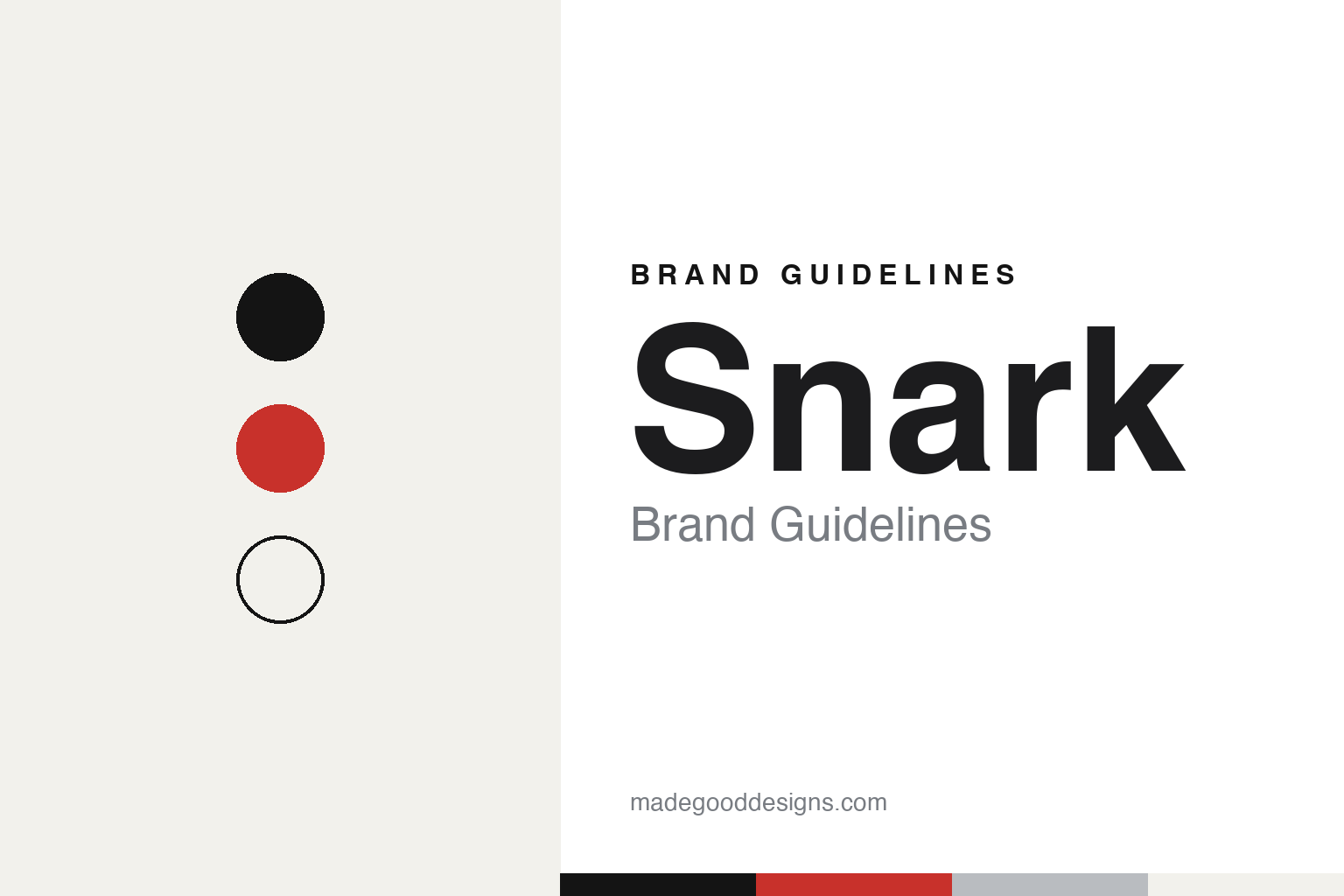
Snark Brand Guidelines
The low-cost clip-on tuner launched in 2010.
Aa
Two constants: a Snark black, red and silver palette and a condensed sans register. Abstract homage — not a Snark product or mark; no tuner, logo or nameplate is reproduced.
Launched in 2010
A clip-on for the headstock.
Snark is a brand of small, inexpensive clip-on tuners. Its website says Snark “launched in 2010 and immediately became the favorite of millions of musicians”; that is the company’s own claim, and it publishes no sales figures. The Internet Archive shows the snarktuners.com address holding a placeholder page in July 2010. By October 2011 the site listed six models: the Snark guitar and bass tuner, the all-instrument tuner, versions of both with a metronome, another guitar and bass tuner, and a ukulele tuner, known by the model numbers SN-1 to SN-6.
A clip-on tuner fixes to an instrument’s headstock and picks up pitch mainly from vibration through the wood, not from the air. That lets it work in a noisy room or on a crowded stage without a cable, which made the clip-on a common tool for guitarists, ukulele players and school bands. Snark’s products follow that pattern: a small clip and a bright screen, sold at low prices.
Snark’s own pages say little about who is behind it. Its about page names no founder, and its contact page gives only a service email. An archived 2013 version of the site was more specific: for repairs or replacements under warranty within the USA, it told customers to send their tuner to the Evets Corporation in Camarillo, California. The same page listed user manuals for more than a dozen models, from the S-1 Mini to the SN-7 pedal tuner, the SN-8 “Super Tight” all-instrument tuner, the SN-10 stage and studio tuner and the SN-14.
Colour
Evets, Danelectro and Qwik Tune.
The Evets name connects Snark to a better-documented brand. English Wikipedia says the Evets Corporation, which it calls an importer, bought the Danelectro name in the late 1990s and began selling recreations of old Silvertone and Danelectro guitars alongside new effects pedals and small amplifiers, citing Vintage Guitar magazine in January 1999. Danelectro was founded in Red Bank, New Jersey, in 1947 and closed its plant in 1969, according to Wikipedia; the revived brand still sells pedals and accessories today. In October 2020 Premier Guitar reported that Danelectro “is now owned by Steve Ridinger,” whom it credited with bringing the Foxx Tone Machine fuzz pedal into existence in 1971.
Snark and Danelectro still operate side by side. The two websites use the same footer wording and the same service desk, and the videos on Snark’s high-precision tuner page are posted by Danelectro’s official YouTube channel. Snark does not publish its ownership, so we describe these links rather than name an owner.
There is also an earlier tuner in the story. NAMM’s oral-history archive, summarising a 2022 interview with the musician and retailer Michael Campion, says that, teaming with Ridinger, he helped produce the “very popular QWIK Tune products, which utilized LCD meters.” English Wikipedia’s article on Campion says the two met in 1992, that Qwik Tune was their first project together, using a liquid-crystal display to imitate the needle meters of older tuners at a price of $19.95, and that Qwik Tune later “rebranded as SNARK Tuners.” Wikipedia supports that last point only with a link to a Snark product page, so we give it as Wikipedia’s account.
Typography
Design and documentation.
The seven makers in this guide each hold one corner of the guitar-accessory trade — straps, capos, tuners or picks — and most are still tied to a founder or a founding family.
Levy’s, which makes straps, was founded in 1973 by Dennis Levy, its 2009 website said, describing factories in Winnipeg and in Antigonish, Nova Scotia. In January 2019 Gator Co., the Tampa case maker, said it had acquired Levy’s the year before, and Levy’s now gives a Tampa address.
Three make capos. Shubb was formed in California in 1974 by Rick Shubb and Dave Coontz; Rick Shubb’s own history says a dedicated shop in Qingdao, China, was making about 80% of its capos by 2016, the year its founding partnership ended. Kyser says the machinist Milton Kyser had incorporated it in Texas by 1980, and that it makes its capos in Kaufman, Texas, under his great-niece Meredith McClung-Attebery. Paige, begun by Bryan Paige and his father Ralph in Michigan, says it now operates only from Erwin, Tennessee.
Two make tuners. Peterson Electro-Musical Products, founded by the inventor Richard H. Peterson, has been based in Alsip, outside Chicago, since 1964, its history says. Snark says it launched in 2010; in 2013 its warranty address was Evets Corporation’s, in Camarillo, California; English Wikipedia names Evets as the owner of Danelectro. Gravity Picks, the youngest, says it began in early 2011 and makes its acrylic picks in California.
This guide sets out what can be checked about each brand — who founded it, who owns it, and what it says about where its products are made — and marks clearly what rests only on the company’s own word.
Aa
A condensed sans of the kind Snark’s own website uses. (Specimen set in Roboto Condensed, a sans STAND-IN; NOT the Snark logo.)
Snark
Originals, Super Tight, Silver and HPT.
The range has grown well beyond the first six models. The website now lists the Originals (including the SN-1X, SN-5X and SN-6X), the Super Tight ST-2 and ST-8, rechargeable models, the Silver Snark line, the Titanium, which the company says uses a “patent pending Titanium Technology” to block much of the surrounding noise, the rechargeable Air, and a 9-volt power supply for pedals. In December 2024 Premier Guitar reported the Crazy Little Thing, Snark’s most compact model, about the size of a pick, rechargeable by USB-C and priced at $21.99. In July 2025 it reported three high-precision models, the ST-1X HPT, ST-2 HPT and ST-8 HPT, with what the company calls a patented “anechoic sound shield” on the back to block room noise, at list prices of $24.99 to $26.99. All three are rechargeable and show a battery gauge on screen, and the ST-2 HPT can switch from vibration sensing to a microphone mode, so it can be clipped to a music stand for brass and woodwind players.
The product pages we checked do not say where the tuners are made, so we make no claim about it. We found no design awards in the sources checked.
The brand’s typography is visible on its website. The current site loads Roboto Condensed from Google Fonts alongside an Adobe Fonts kit, while archived copies of the earlier site show it serving web fonts called Toronto Subway and VT Bulletin. The site sets the name in capitals as SNARK®.
For a design guide, Snark shows how a cheap, everyday tool can carry a loud, memorable name. Compare Peterson, the strobe specialist at the other end of the market, and D’Addario, whose accessories also include clip-on tuners. For this guide we use black, red and silver with a condensed sans, an unofficial interpretation; no product or logo is reproduced.
Explore & save
Keep Snark’s identity on hand — save it to a board in the Made Good inspiration library.
Snark identity set
Pin the Snark black, red and silver palette and the condensed sans register to your own board.