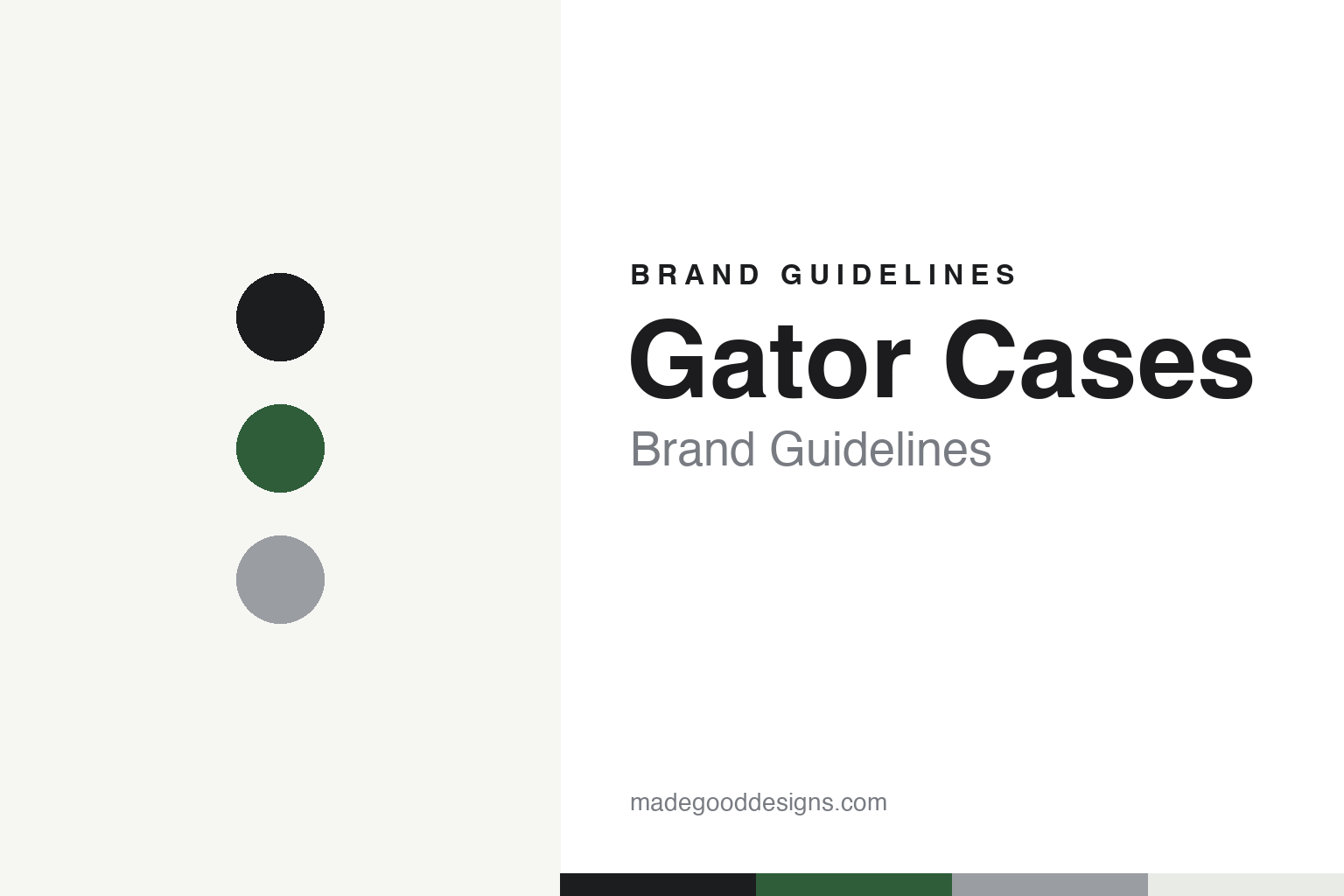
Gator Cases Brand Guidelines
The Tampa father-and-daughter case maker that became a gear catalogue.
Aa
Two constants: a Gator black, green and grey palette and a condensed sans register. Abstract homage — not a Gator product or mark; no case, logo or nameplate is reproduced.
Father and daughter
A Tampa start with a handful of molded guitar cases.
Gator began in 2000 in Tampa, Florida, founded by Jerry Freed and his daughter Crystal Morris. The trade magazine MMR, in an obituary published in November 2014, and the National Association of Music Merchants, in its oral-history archive, both describe it as a father-and-daughter venture. The company says the pair launched it with a small range of molded plastic guitar cases at the Summer NAMM show in Nashville, Tennessee.
Freed was no newcomer. MMR says that after college he sold and represented Roberts Electronics, which co-branded reel-to-reel tape recorders made by Akai, and launched a line of Califone guitar amplifiers; he later co-founded International Music Corporation, which began as a supplier of percussion and went on to help create Akai Professional and to buy Charvel/Jackson guitars. NAMM’s archive, which recorded an interview with him in 2003, says he built Kasuga International with Tommy Moore in the 1960s. In 1989 he left to form Freed International, which marketed and represented other music brands. NAMM credits him with growing the case market “with a series of specialized cases both hard and soft side, rarely available in the industry at the time.” He died in November 2014, MMR reported.
Morris grew up in the trade. NAMM’s note on her interview, recorded in July 2017, says she started as a child working at her father’s booth at the NAMM show, and that Gator was launched when the pair “saw a need for cases utilizing different materials.” She leads the company as chief executive, and with DeDe Heid and Robin Walenta she co-founded Women of NAMM, a network for women in music products, pro audio and entertainment technology. Music Inc, profiling her in January 2022, gave Gator about 135 employees.
Colour
From guitar cases to stands, bags and furniture.
The range soon went well beyond guitar cases. MMR said in 2014 that Gator offered more than 1,000 products in vacuum-formed and rotational-molded plastics, wood, fabric and EVA, for pro audio, IT, audio-visual work, band instruments and percussion, and the company still uses that figure. Its website also describes an OEM division that designs and makes custom cases for other manufacturers, and licensed lines carrying the JBL and Shure names.
Gator grew partly by buying other makers. The company says it bought the factory and product line of Protechtor Cases in Fort Wayne, Indiana, in 2008, adding rotational molding in the United States and a foothold in percussion; moved in 2014 into a manufacturing and distribution building of more than 180,000 square feet in Columbia City, Indiana; bought Viking Cases, a St. Petersburg, Florida, maker of ATA-rated flight cases, in 2015, moving its production to Columbia City; and in 2018 bought Levy’s Leathers, the guitar-strap maker that Levy’s own website says Dennis and Cheryl Levy founded in 1973. Levy’s website now gives the same Tampa headquarters as Gator.
In 2013 Gator added Frameworks, a line of more than 50 stands for microphones, speakers, guitars, keyboards and audio-visual gear launched at the Winter NAMM show; the company says the line won Best in Show honours at Summer NAMM 2013 and Winter NAMM 2015. Frameworks later grew into what Morris described to Music Inc as “musician’s furniture” — studio, podcasting and guitar furniture meant to look at home in a house. In the same interview she said Gator often brings “over a hundred products a year to market,” that it has thrown products off the roof to test latches and plastics, and that its new Icon Series guitar bags had been run over with a Jeep. During the pandemic it also made filter covers for the bells of brass and woodwind instruments.
Typography
Design and documentation.
The seven brands here all protect instruments on the road. Two are best known for moulded plastic. SKB says it was founded in 1977 by Dave Sanderson and Steve Kottman in an Anaheim garage, and that its iSeries cases are made at its factory in Orange, California. Since January 2025 the private-equity firm MPE Partners has held a stake alongside Dave Sanderson and the management team, MPE announced. Gator Cases says it was founded in Tampa, Florida, in 2000 by Jerry Freed and his daughter Crystal Morris, and in 2008 bought the Protechtor Cases factory in Fort Wayne, Indiana.
Two make rigid cases in Britain, by their own account. Hiscox says it has made lightweight hard cases since 1985 and lists “hand-made in the UK” among its selling points; its online shop now gives a contact address in Poland. Hardcase, of Chesterfield, Derbyshire, says it was established in 1992 as a family-run maker of rigid plastic drum and percussion cases and is “proud to remain a British manufacturer.”
Three are known mainly for soft cases and gig bags. Reunion Blues says it began making gig bags in 1976; Ace Products Group of Petaluma, California, lists it among its brands. Gruv Gear says it began in 2007 as a side project of the Los Angeles bassist Jay Baldemor and is now based in Murrieta, California. Protection Racket, in Cornwall, dates itself to 1994, says it began with surfboard bags, and is privately owned through a holding company of its two directors, Companies House records show.
Few of these companies say plainly where every product is made, and where they do, the claim is usually their own.
This guide sets out what can be checked about each brand — who founded it, who owns it, and what it says about where its products are made — and marks clearly what rests only on the company’s own word.
Aa
A condensed sans for a catalogue brand. (Specimen set in Barlow Condensed, a sans STAND-IN; NOT the Gator logo.)
Gator
A Tampa name with an Indiana plant.
Where Gator products are made is only partly spelled out. The company’s own history presents its Columbia City plant in Indiana as its base for American manufacturing, with rotational molding and the flight cases it took over from Viking. Its sustainability page says its primary Tier 1 suppliers are audited under the SEDEX SMETA social-audit standard, and that it is adding recycled nylon and polyester and OEKO-TEX certified fabrics to its bags. A range of bags made with Someone Somewhere, a certified B corporation, is woven and knotted by artisans in Mexico, Gator says. We give these as the company’s statements; we could not confirm, product by product, where its molded cases and gig bags are made.
The name has shifted too. The company now presents itself as Gator Co. on its website, gatorco.com, to which the older gatorcases.com address redirects, and it sells under sub-brands including Frameworks, the Vertex pedalboard line and the Levy’s strap name. Its published mission lists passion, loyalty and trust, and a pledge to leave “the world a better place” through more environmentally friendly products and help for “music makers of the future.” The headquarters remain in Tampa, with Morris as chief executive, the company says.
For a design guide, Gator shows how a case maker can become a catalogue brand, stretching one name across molded shells, padded bags, stands and furniture. Compare SKB Cases, the older California case maker, and Boss, whose compact pedals are the kind of gear Gator’s pedalboards are built to carry. For this guide we use a tread black, a swamp green and a latch grey with a condensed sans, an unofficial interpretation; no product or logo is reproduced.
Explore & save
Keep Gator Cases’s identity on hand — save it to a board in the Made Good inspiration library.
Gator identity set
Pin the Gator black, green and grey palette and the condensed sans register to your own board.


