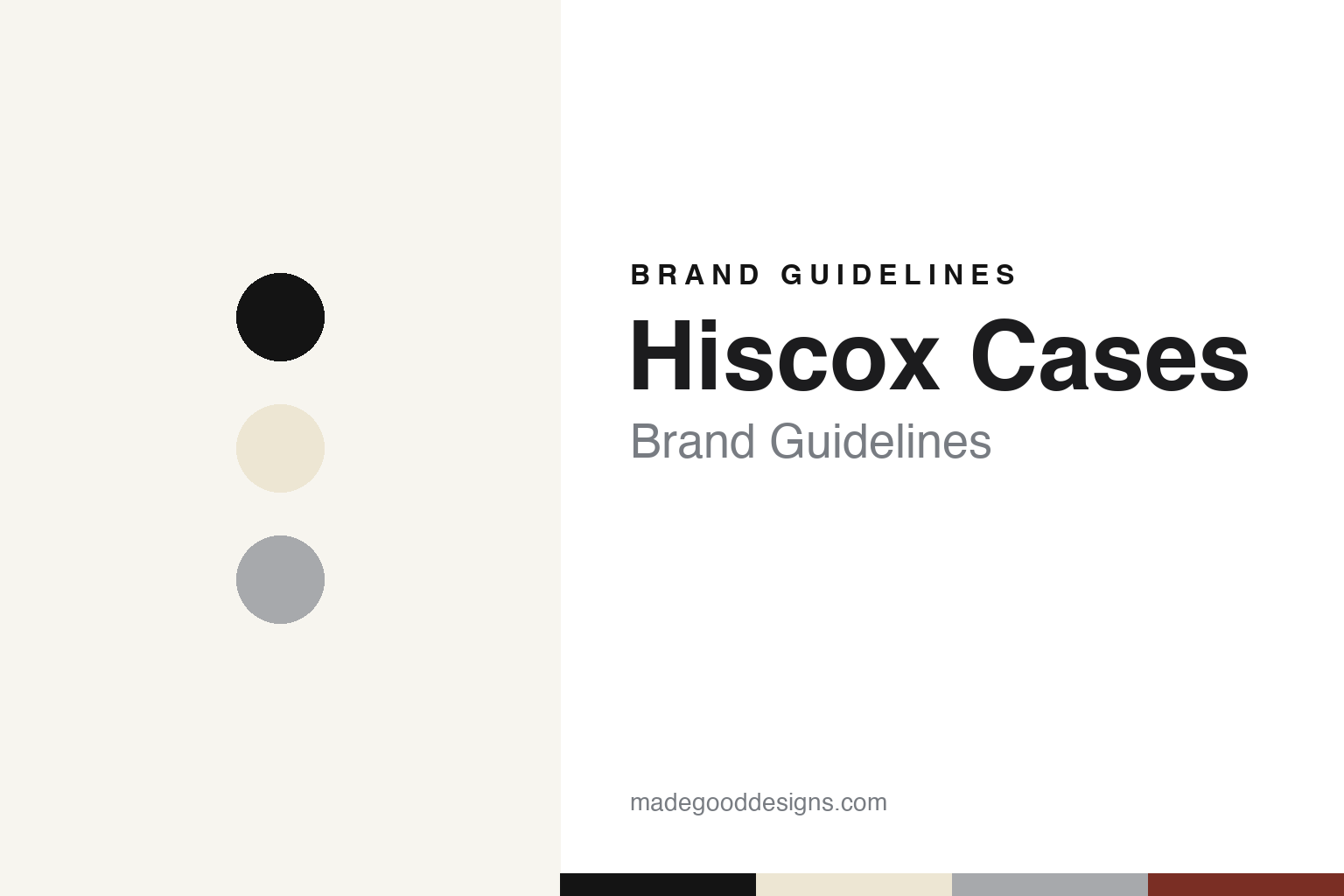
Hiscox Cases Brand Guidelines
The British guitar-case maker built on a bonded shell.
Aa
Two constants: a black, ivory and aluminium palette and a clean workshop sans register. Abstract homage — not a Hiscox Cases product or mark; no case, logo or badge is reproduced.
Brynn Hiscox
A guitar maker who wanted a lighter case.
Hiscox Cases is a British maker of hard cases for musical instruments, and it has nothing to do with Hiscox, the London insurer that shares its surname. The company says it was established in 1985 and is “the brainchild of Brynn Hiscox, a professional guitar maker,” who used an engineering background to design a case that met his own requirements, because his customers wanted more protection with less weight. That account has appeared, almost word for word, on the company’s website since at least 2011, according to captures held by the Internet Archive.
The paper trail begins a decade later. Companies House records show Hiscox Cases Limited was incorporated in October 1995, with Brynn Hiscox a director from the first day; he is still listed as one. The 1985 date is the company’s own. The records do not contradict it — a business often trades for years before it becomes a limited company — but they cannot confirm it either.
For most of its documented life the company gave its address as an industrial estate in Cannock, Staffordshire, in the West Midlands. Its website said in 2011 that Hiscox cases were sold in 20 countries and through more than 900 UK retailers and instrument makers; by 2019 the figure given was more than 700. Today the company says its cases are relied on by over 600,000 musicians worldwide, a figure we give as its own.
Colour
A shell, a foam and a metal rim.
Construction is what Hiscox sells. A 2014 version of its website described an outer shell of ABS plastic, chosen partly because it would chemically bond to the inner moulding during manufacture to make a single composite structure. The inner moulding was a closed-cell, semi-rigid polyurethane foam blend that the company called unique to Hiscox, bonded directly to the fabric lining without a separate adhesive. Around the lips runs an aluminium valance with a double-lipped seal, about three-quarters of it hidden behind the shell, and the hardware is riveted to it. The range has long been sold under the name Liteflite.
The current site packages those ideas as “Triple Shield Technology”: crush strength — the company says its cases withstand 500 kg — shock absorption, and what it calls Thermo-Balance Engineering, insulation meant to slow temperature changes so instruments stay in tune. It says its ivory shells stay about 10°C cooler than black ones under a heat source, and that its crush-velour linings are dye-fast. Cases are graded Standard, Pro II and Artist, and the company says it caters for electric-guitar neck angles from 0 to 4 degrees.
Guitars are the core, from dreadnought and Martin OOO shapes to Strat, Les Paul, SG, 335 and PRS styles, but the catalogue also covers basses, saxophones, violins, violas, cellos, banjos, mandolins, tenor horns and Uilleann pipes. Hiscox says more than 140 guitar makers and luthiers supply its cases with their instruments; its published list includes Lowden and Fylde in the UK, Brian May Guitars, Maton in Australia, Furch in the Czech Republic and the Spanish makers José Ramírez and Paulino Bernabé. The testimonials it prints — from Fylde’s founder Roger Bucknall, from the band New Model Army after a studio fire, and about a guitar that survived a New York studio flooded by Hurricane Sandy — are its own selection.
Typography
Cases as part of the instrument.
The seven brands here all protect instruments on the road. Two are best known for moulded plastic. SKB says it was founded in 1977 by Dave Sanderson and Steve Kottman in an Anaheim garage, and that its iSeries cases are made at its factory in Orange, California. Since January 2025 the private-equity firm MPE Partners has held a stake alongside Dave Sanderson and the management team, MPE announced. Gator Cases says it was founded in Tampa, Florida, in 2000 by Jerry Freed and his daughter Crystal Morris, and in 2008 bought the Protechtor Cases factory in Fort Wayne, Indiana.
Two make rigid cases in Britain, by their own account. Hiscox says it has made lightweight hard cases since 1985 and lists “hand-made in the UK” among its selling points; its online shop now gives a contact address in Poland. Hardcase, of Chesterfield, Derbyshire, says it was established in 1992 as a family-run maker of rigid plastic drum and percussion cases and is “proud to remain a British manufacturer.”
Three are known mainly for soft cases and gig bags. Reunion Blues says it began making gig bags in 1976; Ace Products Group of Petaluma, California, lists it among its brands. Gruv Gear says it began in 2007 as a side project of the Los Angeles bassist Jay Baldemor and is now based in Murrieta, California. Protection Racket, in Cornwall, dates itself to 1994, says it began with surfboard bags, and is privately owned through a holding company of its two directors, Companies House records show.
Few of these companies say plainly where every product is made, and where they do, the claim is usually their own.
This guide sets out what can be checked about each brand — who founded it, who owns it, and what it says about where its products are made — and marks clearly what rests only on the company’s own word.
Aa
A clean, rounded workshop sans. (Specimen set in Figtree, a sans STAND-IN that the company’s own web shop also uses for text; NOT the Hiscox Cases logo.)
Hiscox Cases
A badge that moved to the handle.
The brand mark itself has moved. Hiscox cases long carried an external metal badge — the company noted that some cases made in the mid-1990s were sold with internal badges instead — and its website said in 2019 that from 2015 it “moved the logo to the handle of the case and stopped using the metal badges.” No official colours or typeface are published. The cases supply the palette: a black or ivory shell, a silver aluminium rim and a velour interior.
The company says its cases are “hand-made in the UK,” and its 2014 site said they were “wholly manufactured in the U.K.” Recent records leave the picture less clear. In 2025 the website carried a notice that only limited stock was available; in 2026 it announced that “cases are back in stock” and ran a stock sale. Its contact page now gives a contact address for “Hiscox Cases Poland,” near Warsaw, and sends orders from the UK to an exclusive UK distributor, Hiscox Music Co. The company does not say whether any production has moved, so where its cases are made today rests on its own “hand-made in the UK” wording. Companies House shows the registered office moving from the Cannock address to Derby in September 2025, and a related company, Hiscox Distribution Ltd, was incorporated at the same office that summer. We could not confirm where Hiscox cases are made today, and give the UK claim as the company’s own.
Ownership remains private: no acquisition by a larger group appears in the records we checked, and the founder’s name is still the brand.
For a design guide, Hiscox Cases shows how a maker can let engineering speak for the brand, with a mark small enough to sit on a handle. Compare Martin, whose guitar shapes give Hiscox several of its case names, and Fender, whose Strat and Tele bodies set another. For this guide we use black, ivory, aluminium silver and a deep brick with a sans, an unofficial interpretation; no product or logo is reproduced.
Explore & save
Keep Hiscox Cases’s identity on hand — save it to a board in the Made Good inspiration library.
Hiscox Cases identity set
Pin the Hiscox Cases black, ivory and aluminium palette and the clean workshop sans register to your own board.