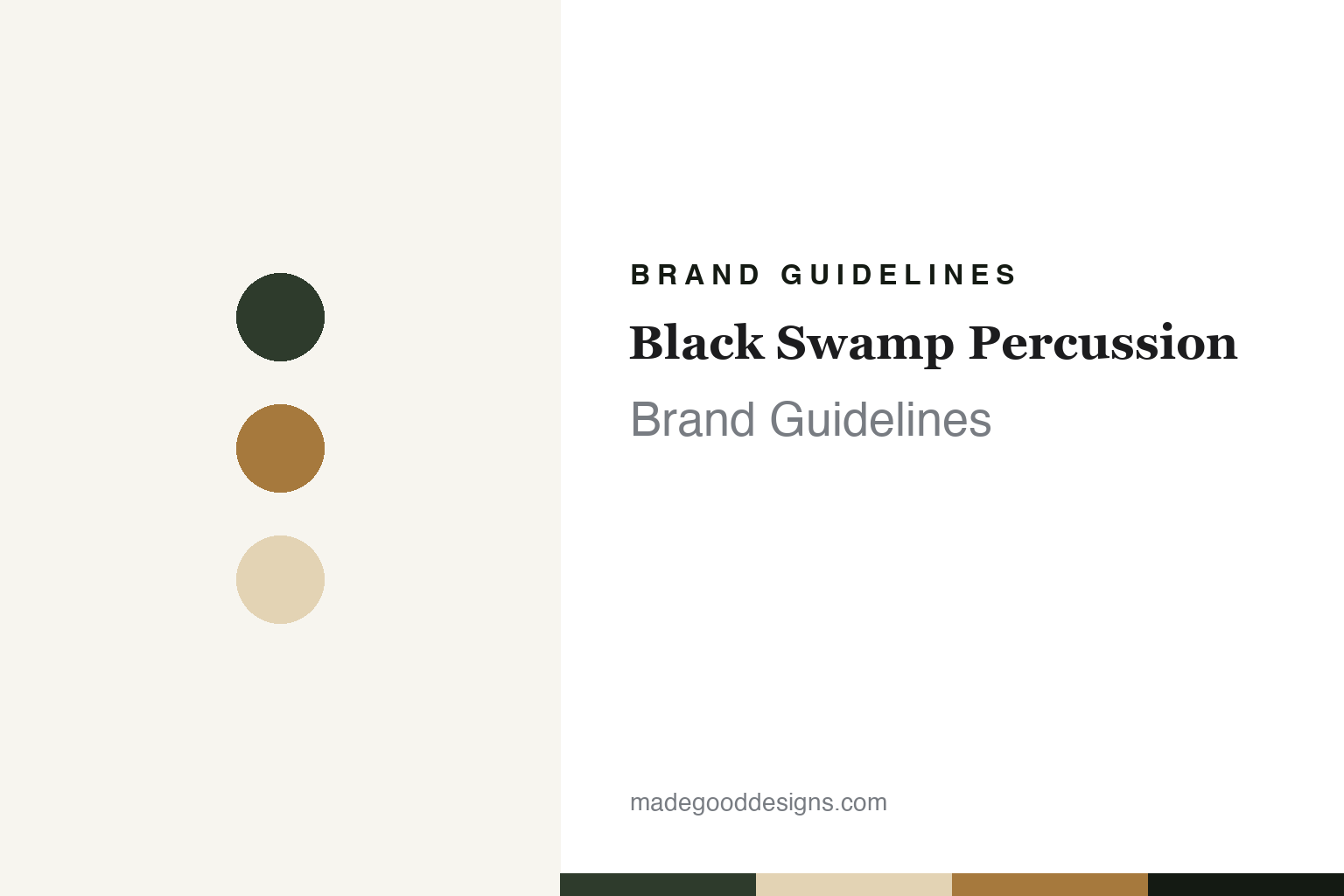
Black Swamp Percussion Brand Guidelines
The Michigan maker of steam-bent tambourines and the Multisonic snare.
Aa
Two constants: a swamp green, peat and ash palette and a concert-hall serif register. Abstract homage — not a Black Swamp Percussion product or mark; no instrument, logo or nameplate is reproduced.
The Great Black Swamp
A percussionist’s workshop in Bowling Green, Ohio.
Black Swamp Percussion began in Bowling Green, Ohio, in the mid-1990s. Its founder and president is the percussionist Eric Sooy. The company’s website today dates it to 1995, and it marked its 20th anniversary in 2015, its 25th in 2020 and its 30th in 2025; an earlier version of the site, archived in February 2001, said it began “in the basement of a rented house in Bowling Green, Ohio in 1994.” Modern Drummer, reviewing its drums in 2017, gave 1995.
The name is a piece of local geography. Bowling Green lies in what was once the Great Black Swamp, the glacial wetland that covered much of north-west Ohio until it was drained for farmland between 1859 and 1885, English Wikipedia says. The company says the name began “as a fun nod to our roots” and as a way to avoid the frequent mispronunciation of Sooy’s surname.
Sooy came to instrument making as a player and a scholar. The 2001 site said he held a bachelor’s degree in percussion performance and a master’s in ethnomusicology from Bowling Green State University, where he had taught percussion; that his field studies of instrument building had taken him to Bali, Java and Ghana; and that his master’s thesis, on gamelan instruments in Bali and the people who make them, was published by the American Gamelan Institute. It also described him as a percussionist with the Grand Rapids Symphony.
By 2001 the workshop had moved to Holland, Michigan, a few miles from Lake Michigan, and by 2009 its contact page gave an address in nearby Zeeland, where Black Swamp Percussion LLC is based today. Its website lists a small team, with Sooy as founder and president and Tim Church as vice-president for sales and marketing; no outside owner is named in the sources we checked.
Colour
Tambourines first, then the snare drum.
Its first two products, the 2001 site said, were bamboo timpani sticks and SoundArt tambourines — “handmade tambourines and bamboo-shaft timpani mallets,” in Modern Drummer’s 2017 account. The tambourines set the pattern: a solid, steam-bent ash shell rather than plywood, with the jingles held on captive pins. The company says it led the way in bringing back the solid-shell concert tambourine as the standard, and that talks with players including Chris Lamb of the New York Philharmonic produced its Chromium 25 jingle, for a dry, articulate sound. Its tambourine pages now sort models by jingle alloy — German silver, Chromium 25, phosphor bronze, beryllium copper and mixtures — on a chart running from bright to dark and from wet to dry.
Drums followed. The Multisonic concert snare drum, which the company says was introduced in 2002 and designed by Sooy, carries five separate snare units, in cable and wire, that can be tensioned and engaged in any combination; the company calls it the most advanced and versatile system of its kind. The SoundArt strainer, it says, was the first to build a trio of snare units into the throw-off. Its Unibody drums use single-ply shells that it steam-bends, machines and finishes itself, in woods from maple to cocobolo and bocote, and its Dynamicx line applies the same work to drum-set snares, which Modern Drummer reviewed in 2017 and described as made in the U.S.
The range now runs to triangles in bronze and steel, castanets machined from grenadillo and purpleheart, maple woodblocks, bentwood temple blocks, log drums and mounting hardware, plus an entry-level line called Overture. The company describes its instruments as “USA made”; its tambourine page carries the banner “Made in Michigan,” and it says its wooden instruments are “sourced, machined, processed and assembled in our Zeeland Michigan facility.” Its website does not say where the Overture line is made.
Typography
Hand percussion and the drum trade.
The seven brands in this group make the instruments that sit around the drum kit: hand drums, cajóns, frame drums, tambourines, concert percussion and drumheads.
Two are hand-drum makers. LP, or Latin Percussion, was founded in New York in 1964 by Martin Cohen; Drum Workshop bought it from Fender’s Kaman Music business in 2014–15, and Roland bought Drum Workshop in 2022. Tycoon Percussion says it was founded in Bangkok in 1983 by Stephen Yu, a musician from Hong Kong, and that it is family-owned and makes its instruments in its own Thai factory.
Two work mainly in wood. Schlagwerk says it began in 1982, when two carpentry apprentices, Gerhard Priel and Bengt Schumacher, copied a Brazilian slit drum, and that it makes its cajóns at Gingen an der Fils, Germany, though its cajón cymbals are hammered in Turkey. Cooperman says Patrick Cooperman began making drumsticks and fifes in Mount Vernon, New York, in the 1950s, and that it has worked from a former sawmill in Bellows Falls, Vermont, since 2006.
Three make tambourines, concert percussion and drumheads. Rhythm Tech grew from the crescent tambourine of the session drummer Richard Taninbaum, which it says it introduced in 1980; its website calls it a division of JAM USA. Black Swamp Percussion was founded by Eric Sooy in Bowling Green, Ohio, dates itself to 1995 and now works from Zeeland, Michigan, calling its instruments “USA made.” Aquarian, founded in 1980 by Roy Burns and Ron Marquez, has made drumheads since 1987 and is based in Anaheim, California.
This guide sets out what can be checked about each brand — who founded it, who owns it, and what it says about where its products are made — and marks clearly what rests only on the company’s own word.
Aa
A concert-hall serif for an orchestral maker. (Specimen set in Libre Baskerville, a serif STAND-IN; NOT the Black Swamp Percussion logo.)
Black Swamp
A design studio in the family.
Black Swamp’s look has a documented source. Its 2001 website credited its “print and digital design work” to Brian Sooy & Co., which it described as an internationally recognised, award-winning design firm owned by Eric Sooy’s brother; the logo itself, and any colours or typefaces behind it, are not set out in any public guide we found. Its anniversary editions show the house style: for 2015, a snare drum with a bocote Unibody shell, a Multisonic strainer and an engraved plate — 20 drums at a list price of $1,732, Modern Drummer reported — and, for the 25th anniversary, a brass snare drum hand-engraved by Sooy and limited to 25.
The company also builds its name through teaching. In March 2014 the University of Michigan Percussion Ensemble gave its first “In the Shop” concert in the Black Swamp factory, streamed online, Modern Drummer reported. The company runs an online Solo & Ensemble Showcase, which it says was founded by its artist Dan Smithiger in 2009, a Percussion 101 lesson series and an educator network, and the endorsing artists on its website include Evelyn Glennie.
For a design guide, Black Swamp Percussion shows how a small maker can build a name on one instrument done carefully — the orchestral tambourine — and carry it across a whole family of instruments. Compare Remo, whose Renaissance heads Black Swamp fits to its drums, and Ludwig, a far older American drum name. For this guide we use swamp green, peat black and steam-bent ash with a serif, an unofficial interpretation; no product or logo is reproduced.
Explore & save
Keep Black Swamp Percussion’s identity on hand — save it to a board in the Made Good inspiration library.
Black Swamp Percussion identity set
Pin the Black Swamp swamp green, peat and ash palette and the concert-hall serif register to your own board.