Floyd Rose Brand Guidelines
The double-locking tremolo that kept rock guitar in tune.
Aa
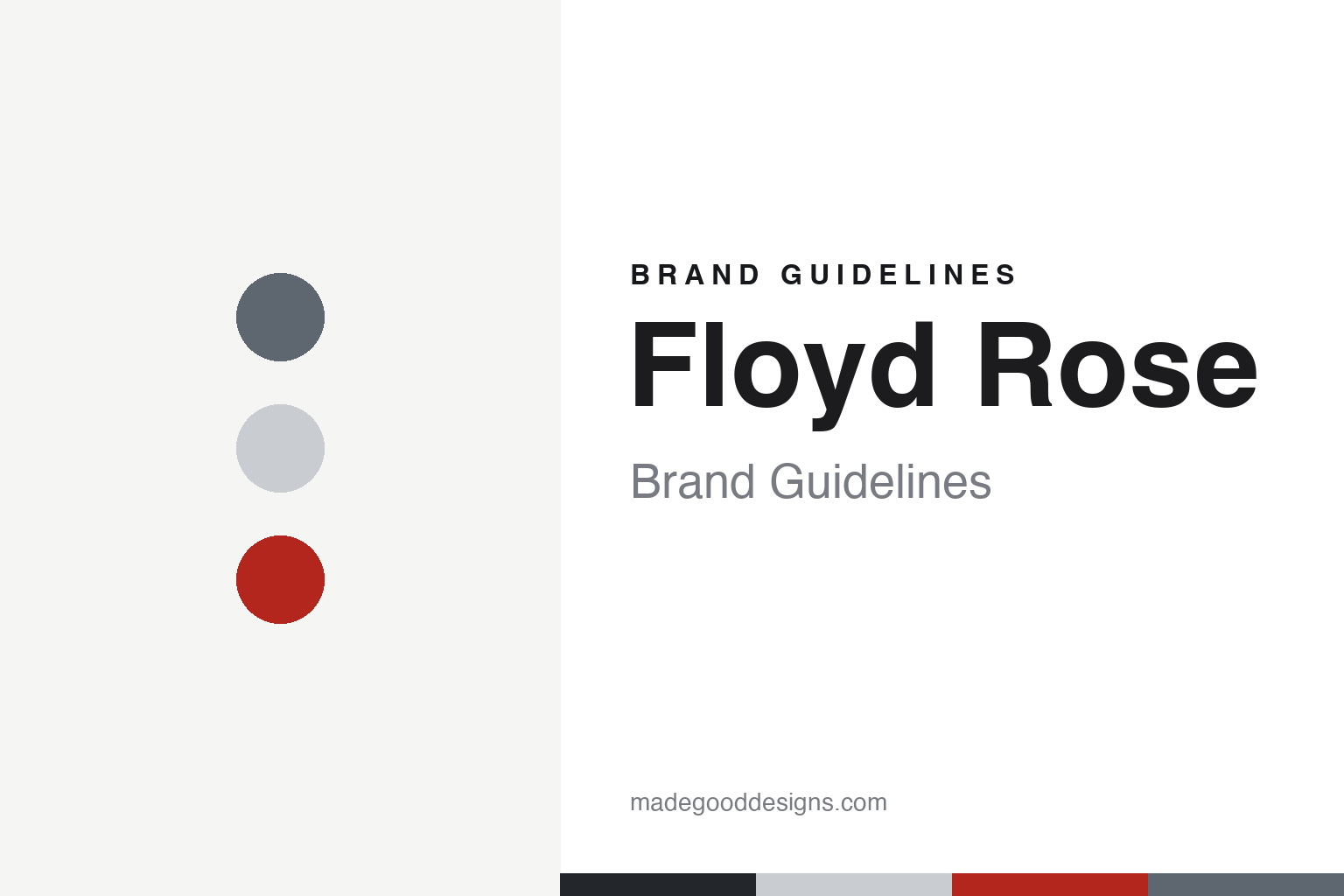
Two constants: a Floyd Rose steel, chrome and red palette and a condensed sans register. Abstract homage — not a Floyd Rose product or mark; no tremolo, logo or plate marking is reproduced.
A brass nut and a jeweller’s rig
One guitarist’s fight with tuning.
The Floyd Rose locking tremolo began with one guitarist’s frustration. Floyd D. Rose, who the company says moved with his family from Durango, Colorado, to Reno, Nevada, as a teenager, was playing in a rock band in the mid-1970s and leaned hard on the vibrato arm. “I’m real finicky about being in tune when I play,” he told Guitarist magazine in a 2010 interview that MusicRadar republished in 2024. Lubricating the nut and using fewer winds round the posts did not solve it.
One night, he said, he noticed the windings of the low E string sliding across the nut as he pushed the arm down. He tried Krazy Glue first. Then, in 1976 by the company’s dating, he used the lapidary rig from his jewellery work to make a brass nut with three U-shaped clamps that locked the strings, and fitted it to his ’57 Strat neck — “which is of course sacrilege,” he said. A stronger version, made at a machine shop, cost $600 borrowed from his parents. Brass dented under the clamps, so he moved to hardened steel and added a bridge that clamped the strings too: the principle of double locking, at the nut and at the saddles, that still defines the design.
Rose was a working musician as well as an inventor. The company says that in Seattle in the early 1980s he played in a band called C.O.R.E. and then co-founded Q5, whose debut album, Steel the Light (1984), found success in Europe; When the Mirror Cracks followed in 1985.
Early buyers included the Hendrix interpreter Randy Hansen. Through Linn Ellsworth of Boogie Bodies guitars, Rose showed the system to Eddie Van Halen, and he won over Journey’s Neal Schon by going backstage to show it to guitar techs first, he recalled. When mass production made hand-fitted clamps impractical, he added fine tuners to the bridge so a guitar could be tuned after the nut was locked. The company says U.S. Patent 4,171,661, for a “guitar tremolo method and apparatus,” was granted on 23 October 1979.
Colour
Kramer, Van Halen and the licences.
Rose licensed the design to Kramer. Guitar World wrote that the tremolo “didn’t become widely available until 1982, when Kramer started mass producing the units and offering them on its guitars,” and placed it among its “10 Most Earth Shaking Guitar Innovations.” Van Halen’s endorsement mattered. “Many people ask if this would have happened without Eddie and I think it would have, but certainly not as quickly,” Rose said. Van Halen wanted his own name on the unit, Rose recalled; he refused at first, but later allowed an EVH version “as a ‘thank you’ to him for his part.”
Success brought copies. Rose said that he and Kramer’s chief executive decided they “couldn’t just constantly sue everybody,” and instead let other companies license the design; licensed units were stamped with wording such as “Licensed Under Floyd Rose Patents.” English Wikipedia lists licensees in Japan including Gotoh, which also developed the Edge tremolo with Ibanez. Rose was candid about the cost: when the deal was made, he said, “we just didn’t think that approving the quality mattered at the time.”
Distribution changed hands more than once. English Wikipedia says Fender became the exclusive distributor of Floyd Rose products in January 1991 and worked with Rose on a Fender Deluxe Locking Tremolo; the company says distribution of the Floyd Rose Original reverted to Floyd Rose in 2005, while the patented designs were still licensed to other makers. Not every idea stayed in the catalogue: the SpeedLoader, a bridge for pre-cut strings with bullet ends that Rose began developing in 1991 and showed at the January 2003 NAMM show, is no longer in production, the company says.
Typography
Design and documentation.
The seven brands here make the hardware that keeps a guitar in tune: tuning machines, bridges and nuts. Three are tuner names with long histories. Grover’s machine heads come from a Cleveland company that took the name in 1952, when the Grossman family’s firm bought A. D. Grover & Son; English Wikipedia says it designs and imports its tuners. Kluson, founded as John Kluson’s Chicago machine shop in 1925, folded in 1981; WD Music Products of Florida revived the brand in 1994, and English Wikipedia says its tuners are now made in Korea. Schaller, founded by Helmut Schaller in 1945 and based at Postbauer-Heng near Nuremberg, has been owned by Lars Bünning since 2009 and says its hardware is “Made in Germany.”
Two American makers stress their factories. Sperzel says it has made tuning keys since 1977, from parts made in its own Cleveland factory. Hipshot says Dave Borisoff founded it in California in 1982 with a B-string bender worked from the hip; now based in Interlaken, New York, it makes tuners, bridges and detuners.
Floyd Rose is a bridge and a company. Floyd D. Rose began work on his locking tremolo in 1976 and patented it in 1979; English Wikipedia says Schaller made the Original in Germany from 1983 to 2024. The company says it is a division of AP International Music Supply and that its 1000 Series is made in Korea.
Graph Tech began with the nut. Founded in Vancouver in 1983 by Dave Dunwoodie around a self-lubricating nut, it makes TUSQ nuts and saddles and, since 2013, Ratio tuners, and says it ships from its own factory in Vancouver.
This guide sets out what can be checked about each brand — who founded it, who owns it, and what it says about where its products are made — and marks clearly what rests only on the company’s own word.
Aa
A condensed sans — the register of a stamped base plate. (Specimen set in Barlow Condensed, a sans STAND-IN; NOT the Floyd Rose logo.)
Floyd Rose
From a German partner to a US factory.
Today Floyd Rose is a division of AP International Music Supply, the company’s website says, under Andrew Papiccio, a former vice president of Kramer. Its press releases are datelined Fort Myers, Florida, and AP’s other lines include Pure Tone jacks, ProRockGear cases, KTS Titanium parts and AxLabs hardware. Since January 2023 W-Music Distribution, of Markneukirchen in Germany, has been its sole European distributor, the company announced.
The biggest recent change is where the flagship is made. For decades the Floyd Rose Original came from Germany; English Wikipedia names the maker as Schaller. In early 2025 the company said that “USA production” was now “at the heart of our operations,” with saddles CNC-machined in its “NC factory” and locking nuts 3D-printed in steel instead of cast by the lost-wax method. In August 2025 it wrote that it had stepped away from its “longtime German manufacturing partner after nearly 40 years” to avoid “further delays and unapproved design changes.” The lower-priced 1000 Series, the company says, is made in Korea.
The range now runs from the Original and the Special to the Rail Tail, the low-profile Pro, a model without fine tuners, and the FRX, a surface-mounted unit for Les Paul-style guitars that needs no routing, with a locking nut that doubles as the truss-rod cover.
For a design guide, Floyd Rose shows how an inventor’s own name can become the name of the hardware itself. Compare Gotoh, an early licensee, and Ibanez, whose Edge tremolo grew from the same idea. For this guide we use black nickel, hardened steel, chrome and a red with a condensed sans, an unofficial interpretation; no product or logo is reproduced.
Explore & save
Keep Floyd Rose’s identity on hand — save it to a board in the Made Good inspiration library.
Floyd Rose identity set
Pin the Floyd Rose steel, chrome and red palette and the condensed sans register to your own board.