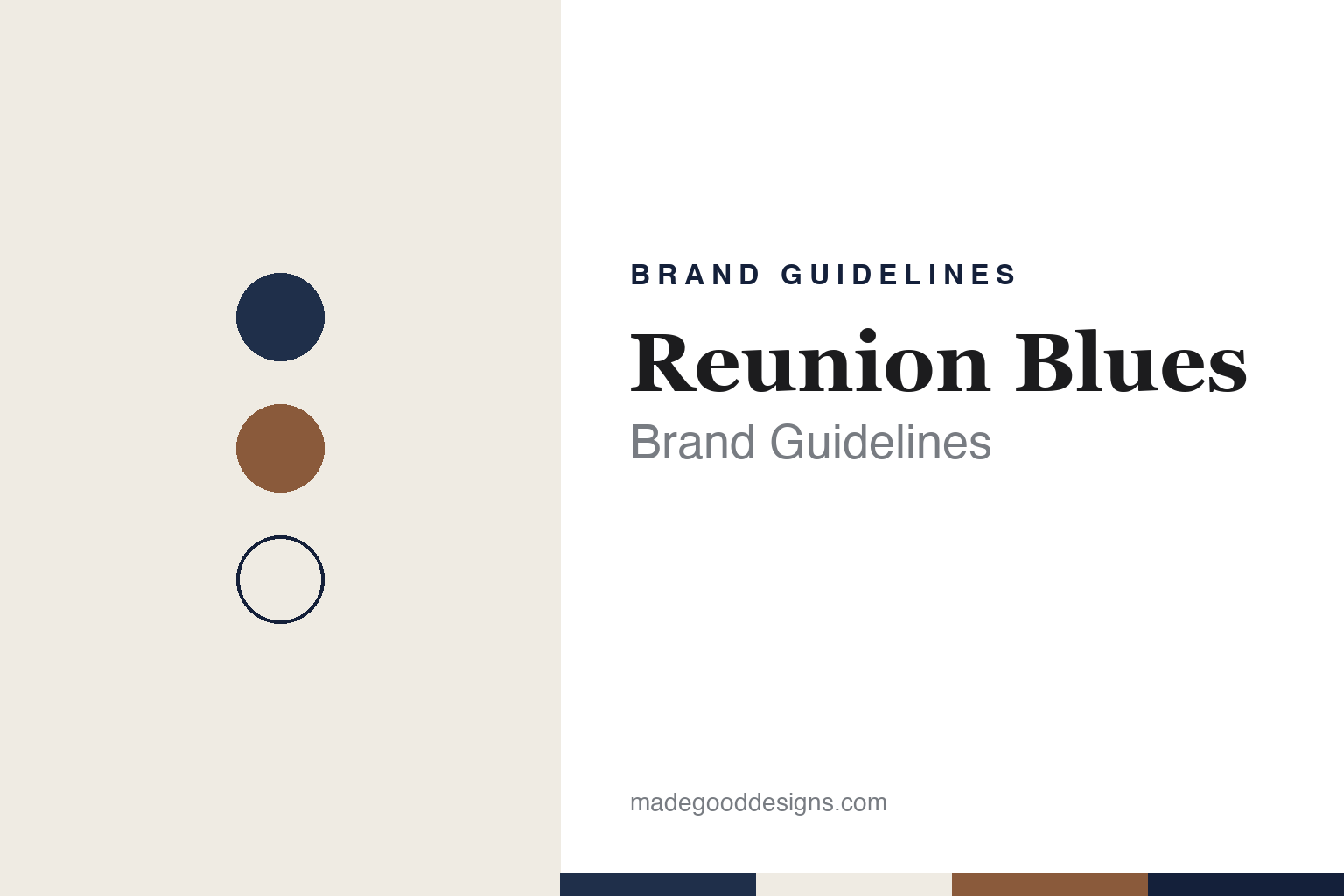
Reunion Blues Brand Guidelines
The 1976 gig-bag maker that made soft cases for serious instruments.
Aa
Two constants: a Reunion Blues midnight blue, leather and canvas palette and a heritage serif register. Abstract homage — not a Reunion Blues product or mark; no bag, case, logo or label is reproduced.
Since 1976
A soft case for serious instruments.
Reunion Blues dates itself to 1976. “Since we first started making gig bags back in 1976,” its website says today, and the date stays the same in every version of the site we checked, from a 2002 page in the Internet Archive to the 2026 store. None of those pages names a founder. The 2002 version says only that the company “was founded in 1976 by people who believe music is essential to the human spirit,” and a 2007 version adds that it was “a privately held company.”
Its claim to a place in history is the soft case. On its 2007 site the company said it “was the first company to create a soft, lightweight instrument bag with padding substantial enough to protect the finest instruments”; today it calls itself “the creators of the first professionally accepted gig bags ever made.” Both are the company’s own words, and we have not found an independent history that tests them. What the archived pages do show is the early product: leather and fabric gig bags identified by style numbers, with brushed steel hardware, leather string guards and padded interiors, sold through music dealers and instrument makers rather than direct to players.
The name is a small puzzle. The 1972 Oscar Peterson album Reunion Blues, with Milt Jackson, Ray Brown and Louis Hayes, shares it exactly, and in January 2009 the company’s own blog noted that “lots of people think” this was where the brand name came from, then asked readers, “What do YOU think?” It did not give an answer, so neither do we: the link is plausible but unconfirmed.
The early company was rooted in San Francisco. A warranty form revised in March 2004 gives a San Francisco address, and the 2002 site names the city’s Community Music Center and the San Francisco Grammys among the causes it supported, alongside VH1 Save the Music and MusiCares. Around the turn of the century its home page carried a single line: “just the World’s Best Gig Bags… that’s all.”
Colour
Leather, then the Flexoskeleton.
For decades Reunion Blues was known for leather. By around 2011 its range had settled into three families: bags in “Performance fabric,” bags in “Classic full-grain leather,” and a newer line, the RB Continental. The company said it then offered more than 70 models, and over 90 by 2012, for guitars and other fretted instruments, brass, woodwind, strings and percussion, including double guitar and triple trumpet bags. It also quoted the nicknames musicians had given its bags: “Road Warrior,” “Old Friend,” “Better With Age,” “Bullet-Proof.” At a NAMM show in Anaheim, it said, veteran players told stories of using the same bag for “one, two, even three decades.”
The RB Continental moved the brand from soft luxury towards protection. The company dates its launch to 2008 and tells it as a stunt: a case with a guitar inside thrown from the top of a three-storey building, the guitar landing “without a scratch.” Its structure is a padded shell the company calls the Flexoskeleton, a shock-absorbing frame with reinforced impact panels; the cases also carry a palm-contoured Zero-G handle, an exterior it calls Ballistic Quadraweave and, on some models, a quilted velvet lining it once described as its “signature double-helix” pattern.
Later lines kept the same vocabulary. In May 2019 the company announced the RB Continental Voyager series, with a lighter Flexoskeleton and a “Black Heather” exterior, and RBX Oxford gig bags, a line it calls affordable, in dark grey with chevron quilting under the slogan “The Gig Bag, Reinvented.” In August 2024 came the RB Expedition cases, with what it calls a 2025D Ballistic AEGIS exterior and a “SideKick” D-ring system for clip-on add-on bags. The 2026 range covers guitar, bass, banjo, ukulele, brass, woodwind, cymbal and pedalboard bags, guitar stands and straps, and headless-guitar versions of the RBX and Expedition cases, all under a limited lifetime warranty.
The artists on its website run from blues to rock: the guitarist Christone “Kingfish” Ingram, Jesske Hume of TV on the Radio and Mark Damon of The Pretty Reckless are quoted on its home page, and it has artist pages for Rhiannon Giddens and the bassist Stuart Hamm.
Typography
Cases, bags and carts.
The seven brands here all protect instruments on the road. Two are best known for moulded plastic. SKB says it was founded in 1977 by Dave Sanderson and Steve Kottman in an Anaheim garage, and that its iSeries cases are made at its factory in Orange, California. Since January 2025 the private-equity firm MPE Partners has held a stake alongside Dave Sanderson and the management team, MPE announced. Gator Cases says it was founded in Tampa, Florida, in 2000 by Jerry Freed and his daughter Crystal Morris, and in 2008 bought the Protechtor Cases factory in Fort Wayne, Indiana.
Two make rigid cases in Britain, by their own account. Hiscox says it has made lightweight hard cases since 1985 and lists “hand-made in the UK” among its selling points; its online shop now gives a contact address in Poland. Hardcase, of Chesterfield, Derbyshire, says it was established in 1992 as a family-run maker of rigid plastic drum and percussion cases and is “proud to remain a British manufacturer.”
Three are known mainly for soft cases and gig bags. Reunion Blues says it began making gig bags in 1976; Ace Products Group of Petaluma, California, lists it among its brands. Gruv Gear says it began in 2007 as a side project of the Los Angeles bassist Jay Baldemor and is now based in Murrieta, California. Protection Racket, in Cornwall, dates itself to 1994, says it began with surfboard bags, and is privately owned through a holding company of its two directors, Companies House records show.
Few of these companies say plainly where every product is made, and where they do, the claim is usually their own.
This guide sets out what can be checked about each brand — who founded it, who owns it, and what it says about where its products are made — and marks clearly what rests only on the company’s own word.
Aa
A heritage serif — for a brand that began in leather. (Specimen set in DM Serif Display, a serif STAND-IN; NOT the Reunion Blues logo.)
Ace Products
A brand inside a Petaluma accessories group.
Today Reunion Blues is one of four brands of Ace Products Group of Petaluma, California, in Sonoma County north of San Francisco. Ace’s website lists “Pig Hog Cables, Reunion Blues, Kaces & Strukture” as its brand family and describes the company as “the leading global manufacturer of musical instrument accessories,” from cables and stands to gig bags and hybrid cases; Reunion Blues gives the same Petaluma address and telephone numbers. Sources differ on Ace’s age. Its own site says it was founded in 1983; the NAMM Oral History programme, which interviewed its founder Alan Poster in 2001, says he formed Ace Products in 1979 “to offer a wide range of gig bags and cases.”
We could not establish when Ace took over Reunion Blues. By about 2011 the two were already intertwined: an archived Reunion Blues staff page from then lists Alan Poster as chief executive, and NAMM’s 2010 interview with John Maher, who wrote the Reunion Blues blog, gives his job as marketing director of Ace Products. The same staff page called the product developer Dave Andrus “the longest standing member of the Reunion Blues team.”
Neither company says, product by product, where the bags are made. Reunion Blues’ product pages describe “industrial-grade high-tensile thread” and reinforced stress points, but not a country of origin. Ace says its manufacturing operation “includes facilities across Asia, anchored by our 400,000 square meter factory in Vietnam,” in a page offering that capacity to other brands; we give that as its claim and do not assume every Reunion Blues product comes from it.
For a design guide, Reunion Blues shows how a case maker can turn construction into identity — named frames, named handles, named fabrics — while keeping one date, 1976, at the centre. Compare Gruv Gear, a younger Californian maker of bags and carts, and Levy’s, the strap maker founded in Nova Scotia three years earlier. For this guide we use a midnight blue, saddle tan and canvas with a serif, an unofficial interpretation; no product or logo is reproduced.
Explore & save
Keep Reunion Blues’s identity on hand — save it to a board in the Made Good inspiration library.
Reunion Blues identity set
Pin the Reunion Blues midnight blue, leather and canvas palette and the heritage serif register to your own board.