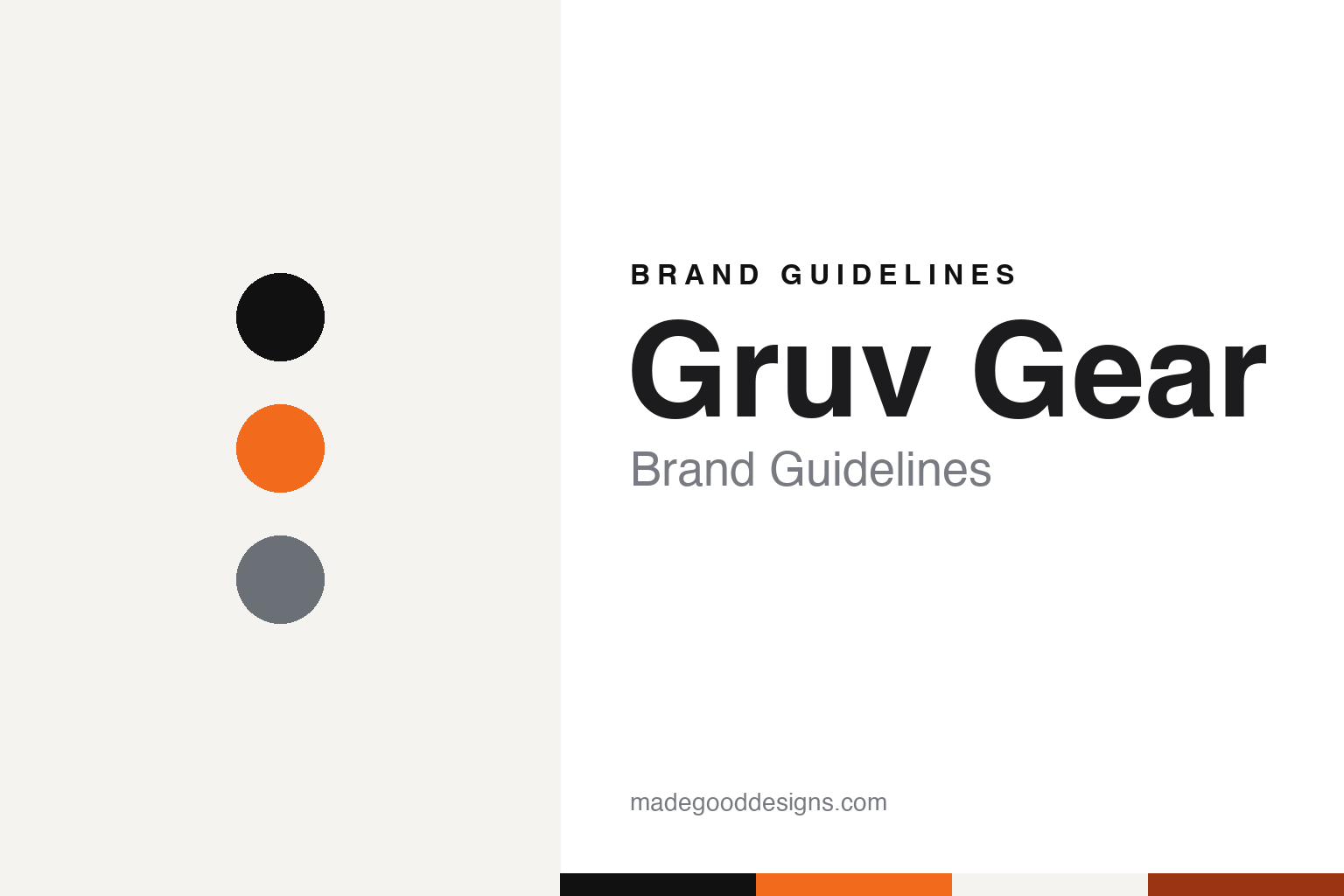
Gruv Gear Brand Guidelines
The gigging bassist’s cart that grew into a gear brand.
Aa
Two constants: a Gruv Gear black, steel and orange palette and an industrial sans register. Abstract homage — not a Gruv Gear product or mark; no bag, cart, logo or label is reproduced.
A cart for a bass rig
A gigging bassist’s after-hours project.
Gruv Gear began with a heavy amplifier. Its founder, Jay Baldemor, was running a web design and development company by day in the mid-2000s and playing bass in clubs and bars around Los Angeles at night, the company’s history says. Looking for a cart for his bass rig, he found only light office trolleys and industrial hand trucks too bulky for a car already full of amplifiers and speakers. In early 2007, it says, he decided to design his own, “and the Gruv Gear name was born.”
He worked on it after hours with Peter Espartero, an industrial designer he knew from church, and an engineer friend. A first product was on sale that year: an archived copy of gruvgear.com from March 2007 presents “the über cool V-CART” as the company’s flagship, with a “buy online” link and a line that sums up the brand — “a company that believes in innovation, smart design, and products that really make sense.” A 2010 version of the site calls that first cart a “pilot launch” and says feedback from players led straight into a redesign; the company’s current history compresses the story into “about two years of R&D.”
The redesign, the V-Cart Solo, made Gruv Gear’s name. A folding cart that converts from a two-wheel dolly to a four-wheel platform or tilted cart, it weighed “just a bit over 20 lbs.” and was rated for 500 lb, according to the company’s 2011 FAQ. Gruv Gear took it to the NAMM Show in January 2010 with “a handful of USA-made prototypes” and, it says, came away with distribution offers from around the world. In April 2010 Bass Musician Magazine ran a review by the bassist Damian Erskine, who soon appeared among Gruv Gear’s endorsers; he called it “bar-none the coolest, best designed, well thought-out and most functional cart on the market,” and quoted Baldemor, as founder and chief executive: “We aim to bring products and accessories to the market that address certain ‘gaps’ and not just be a ‘me too’ type of company.”
The 2010 site also explains the look. Baldemor was then chief executive of Louder Design, a web company in Orange County, California, whose team, the site said, was responsible for Gruv Gear’s “branding, marketing and tradeshow design, and ecommerce.” The early sites carried the credit “Created by Louder Design” and the mantra “Make Life Gruv.”
Colour
Carts, then a string muter, then bags.
Distribution followed quickly. In 2011 the German distributor Adam Hall agreed to carry Gruv Gear across 30 European countries, introducing it at Musikmesse and Prolight + Sound in Frankfurt that April, and Heartbeat Distributors took it on in Canada, according to the company’s press releases. Its range by then included the V-Cart Solo, Solo XL and Solo Lite carts, the six-wheel Muver 6, “Venue Series” cargo bags, a double guitar strap called the V-Strap — and FretWraps.
FretWraps became the product most players know. A padded band with an adjustable strap that slides onto a guitar or bass neck to damp the strings, it was pitched in 2011 at studio players and two-hand tappers under the line “Creative muting. Without the scrunchie.” It was then sold in three-packs in three sizes; the 2026 range adds Pro, Stealth, Metallics and Dekade editions, a FretWedge headstock damper and a bridge-side damper called the Fump. In 2015 Gruv Gear licensed a co-branded version to the American builder Strictly 7 Guitars, launched in the United States and in Japan through Shimamura Music. The company calls FretWraps “category-defining” and “industry-leading”; those are its words.
Bags came next. Gruv Gear’s gig-bag line now includes the GigBlade, a slim bag for electric guitar or bass designed to be carried at the side, now in its third version; the Kapsule guitar cases; the VELOC drum and hardware bags; and tech backpacks. The guitarist Lee Ritenour is quoted on its home page calling his Kapsule Duo case “AMAZING,” and the drummer Dennis Chambers praising the VELOC bags. Its SoloStrap Neo and DuoStrap straps spread an instrument’s weight; the company says the DuoStrap’s weight distribution is patent-pending.
The carts went their own way. The company says the original V-Cart Solo “earned a utility patent” and that the cart line has since been rebranded Krane AMG — “Advanced Moving Gear” — and is used in several industries beyond music; the website now signs itself “Gruv Gear | Krane.”
Typography
Cases, bags and carts.
The seven brands here all protect instruments on the road. Two are best known for moulded plastic. SKB says it was founded in 1977 by Dave Sanderson and Steve Kottman in an Anaheim garage, and that its iSeries cases are made at its factory in Orange, California. Since January 2025 the private-equity firm MPE Partners has held a stake alongside Dave Sanderson and the management team, MPE announced. Gator Cases says it was founded in Tampa, Florida, in 2000 by Jerry Freed and his daughter Crystal Morris, and in 2008 bought the Protechtor Cases factory in Fort Wayne, Indiana.
Two make rigid cases in Britain, by their own account. Hiscox says it has made lightweight hard cases since 1985 and lists “hand-made in the UK” among its selling points; its online shop now gives a contact address in Poland. Hardcase, of Chesterfield, Derbyshire, says it was established in 1992 as a family-run maker of rigid plastic drum and percussion cases and is “proud to remain a British manufacturer.”
Three are known mainly for soft cases and gig bags. Reunion Blues says it began making gig bags in 1976; Ace Products Group of Petaluma, California, lists it among its brands. Gruv Gear says it began in 2007 as a side project of the Los Angeles bassist Jay Baldemor and is now based in Murrieta, California. Protection Racket, in Cornwall, dates itself to 1994, says it began with surfboard bags, and is privately owned through a holding company of its two directors, Companies House records show.
Few of these companies say plainly where every product is made, and where they do, the claim is usually their own.
This guide sets out what can be checked about each brand — who founded it, who owns it, and what it says about where its products are made — and marks clearly what rests only on the company’s own word.
Aa
An industrial sans — for a brand that started with a hand truck. (Specimen set in Archivo, a sans STAND-IN; NOT the Gruv Gear logo.)
Murrieta
A Californian brand with warehouses on three continents.
Gruv Gear’s base has moved within Southern California. Its 2011 and 2015 press releases were datelined Orange County; its contact page now gives a headquarters in Murrieta, in Riverside County, with warehouses in Ibbenbüren in Germany and in Shanghai’s Jiading district. Its history page adds a warehouse in Canada and says the products are distributed in more than 55 countries and endorsed by more than 250 performers, producers, photographers and frequent travellers. The company describes itself as “a premium lifestyle accessories brand originally rooted in the creative community,” with a mission “to revolutionize the musician and jetsetter’s lifestyle.”
The website does not say who owns the business today, and we found no report of a sale in the sources we checked; the company’s 2015 release still described Baldemor as president and founder. Nor does it say where its current products are made. Apart from the 2010 prototypes, which the company calls “USA-made,” we found no statement of manufacturing origin on its product pages, and we do not infer one from the location of its warehouses.
What the brand does show consistently is its voice. Its product names favour altered spellings — Kapsule, Quivr, Veloc, Muver, Fump — and its tone, from the 2007 site’s “über cool V-CART” to “Make Life Gruv,” has always been looser than the cases-and-hardware trade around it.
For a design guide, Gruv Gear shows how a brand born from one practical problem — getting an amplifier from car to stage — can keep a playful, consistent voice as it moves into bags, straps and accessories. Compare Reunion Blues, a gig-bag maker three decades older, and Pedaltrain, the Nashville pedalboard maker. For this guide we use black, steel grey and a flare orange with a sans, an unofficial interpretation; no product or logo is reproduced.
Explore & save
Keep Gruv Gear’s identity on hand — save it to a board in the Made Good inspiration library.
Gruv Gear identity set
Pin the Gruv Gear black, steel and orange palette and the industrial sans register to your own board.