CodaBow Brand Guidelines
Winona’s carbon-fibre bows, born of a dropped test ring.
Aa
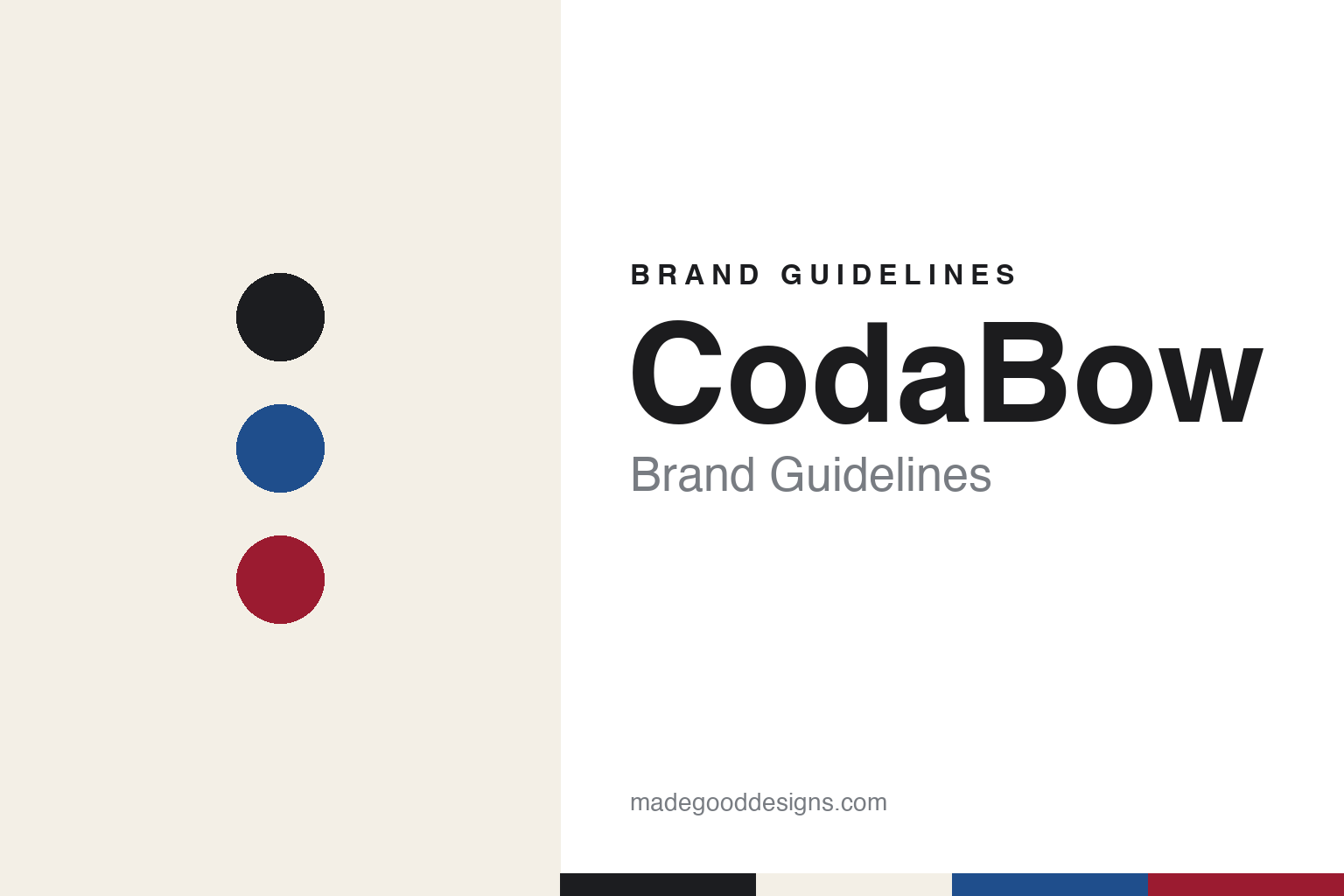
Two constants: a CodaBow graphite, sapphire and ruby palette and an Engineered sans register. Abstract homage — not a CodaBow product or mark; no bow, logo or nameplate is reproduced.
Coda Composites
A composites scientist and an aerospace engineer.
CodaBow began in Winona, Minnesota, in 1993. An archived 1997 version of the company’s website says that in that year Coda Composites Company “was formed as a partnership between Stan Prosen and Jeff Van Fossen,” with the aim of producing an affordable violin bow from graphite composite that would rival the finest wood bows for performance and sound. By 2004 the website named the business CodaBow International, Ltd.; today it trades as CodaBow International, LLC, still in Winona.
The two founders came from materials science rather than the bow-maker’s bench. The 1997 site describes Prosen as a composites researcher since the early 1950s, when he was in the US Navy, who later led the advanced composites group of the Fiberite Corporation, owned a series of composites companies and set up an undergraduate programme in composites technology at Winona State University. It credits him with 40 publications, eight patents and four ASTM standards, and says he was elected a Fellow of SAMPE, the materials-engineering society, in 1987. Van Fossen, the same page says, studied mechanical and aerospace engineering at Princeton and worked for Instron in Boston before meeting Prosen at a symposium and moving to Winona.
The company’s founding story reaches further back. CodaBow says Prosen worked with samples of the carbon fibre invented by Roger Bacon — Wikipedia dates Bacon’s graphite fibres to 1958, at the Parma Technical Center outside Cleveland — and made them into a test ring at the Naval Ordnance Lab. When he dropped the ring, the company says, it bounced almost to its original height and gave “a tone remarkably clear and sustained”; that sound, it says, planted the idea of a carbon-fibre bow. Van Fossen told Strings magazine in 2016 that the hoop is still kept in the company’s office.
Colour
From an attic laboratory to three tiers of bows.
The first prototypes, CodaBow says, were made in “the attic laboratory of a dormant liniment factory in Winona.” Its 2004 website said that the CodaBow Classic for violin, the first model, had made its professional debut “more than a decade ago,” and that bows for viola, cello and bass had followed, in full and fractional sizes. Strings magazine described CodaBow in 2015 as “one of the first producers of carbon fiber bows”; the company itself speaks of having pioneered “the original carbon fiber bow,” which we give as its claim.
The range is now arranged in tiers on its website. The Master models include the Marquise series — GS, Heritage, Aero, Escher and Tuxedo — and the Escent; the Performance models include the Diamond GX, SX and NX, the Joule and the Luma; and the Prodigy is the student bow. For double bass it currently lists a Marquise GS, after the Revelation and Infinity of its 2016–2019 catalogues. Strings reported in 2019 that the Marquise uses only unidirectional carbon fibre, and in 2022 that the all-black Escent, from $995, has a plant-fibre-blend core and contains no endangered, monitored or regulated species.
Materials carry much of the brand’s argument. CodaBow’s frogs are made of Xebony, which it describes as a proprietary blend of natural fibres and resin and “an elegant solution” to the shrinking supply of instrument-grade ebony; tip plates, tip wedges and button bearings are composite. In 2021 Strings reported on its new Chroma custom programme, which let players choose stick colours such as ruby amethyst and sapphire, with coloured windings. The company also sells its own Aurum rosin.
Typography
The orchestral accessory trade.
The seven brands here make the small things string players handle daily, in four trades. Two make shoulder rests. Kun was started in Ottawa by Joseph Kun, who, the company says, left Czechoslovakia for Canada in 1968 and had the design patent for its first rest published in 1972; it says its products are made in Canada. Bon Musica is the trade name of Bonmusica OHG of Vettweiß, in western Germany, whose own product notes describe the bendable, plastic-coated aluminium rest it manufactures.
Two work on the bow. CodaBow began in Winona, Minnesota, in 1993 as a partnership between the materials scientist Stan Prosen and the engineer Jeff Van Fossen, its early website said, and describes its carbon-fibre bows as made in the USA. Hidersine, the British rosin maker, says on its website that it was founded in London in 1890, though the same site has also given 1876; it says the music company Barnes & Mullins bought it in 1987 and moved production to Oswestry, in Shropshire.
Two make strings. Jargar was founded in Denmark by Jarl Hansen, a cellist in the Royal Danish Orchestra, after experimenting from 1950; its website now calls it part of the Thomastik-Infeld family. Warchal, a Slovak company, was established in 2003 by the violinist Bohdan Warchal Jr., concertmaster of the Slovak Chamber Orchestra, which his father founded in 1960.
The seventh, Wittner, makes metronomes and fittings. It says Gustav Wittner founded it in 1895; it is based in Isny im Allgäu, labels almost all its products Made in Germany, and since 2024 has belonged to GEWA music of Adorf, in Saxony.
This guide sets out what can be checked about each brand — who founded it, who owns it, and what it says about where its products are made — and marks clearly what rests only on the company’s own word.
Aa
An engineered sans for a maker that talks like an aerospace firm. (Specimen set in Archivo, a sans STAND-IN; NOT the CodaBow logo.)
CodaBow
Handcrafted in the USA, the company says.
CodaBow’s website names three people as its “pioneers”: Prosen, Van Fossen and Roger Zabinski, a maker of pernambuco bows in the French tradition whose bows, it says, are held in the Smithsonian Institution’s musical-instrument collection; a 2016 version of the page added a gold medal from the Violin Society of America. We have not checked those claims against the collections. Van Fossen is the company’s bow designer, and Strings described him in 2015 as an engineer and violinist who “designs and makes carbon-fiber bows under the CodaBow brand in Winona.”
On where the bows are made, the company has been consistent. Its 2016 website carried the line “Handcrafted in the USA,” and today it says it produces “the finest American-made carbon fiber orchestra bows” in its Winona workshop. In 2019 it described “our small team of 18 workers,” and its careers page now lists engineering, manufacturing, customer service and quality assurance among its work. It sells through dealers and also runs an in-home trial service, letting players try bows before buying.
No colour or typeface standard is published. The look of the brand leans on the material itself: black carbon, metal windings and, since Chroma, jewel-coloured sticks.
For a design guide, CodaBow shows how a brand can be built on a material story — a dropped test ring, an attic laboratory, an engineer’s vocabulary — while keeping the form of a two-hundred-year-old craft. Compare D’Addario, another American maker of string-player accessories, and Pirastro, the German string house. For this guide we use graphite black, sapphire and ruby with a sans, an unofficial interpretation; no product or logo is reproduced.
Explore & save
Keep CodaBow’s identity on hand — save it to a board in the Made Good inspiration library.
CodaBow identity set
Pin the CodaBow graphite, sapphire and ruby palette and the Engineered sans register to your own board.