Bad Cat Brand Guidelines
The Southern California amp maker built on Mark Sampson’s designs.
Aa
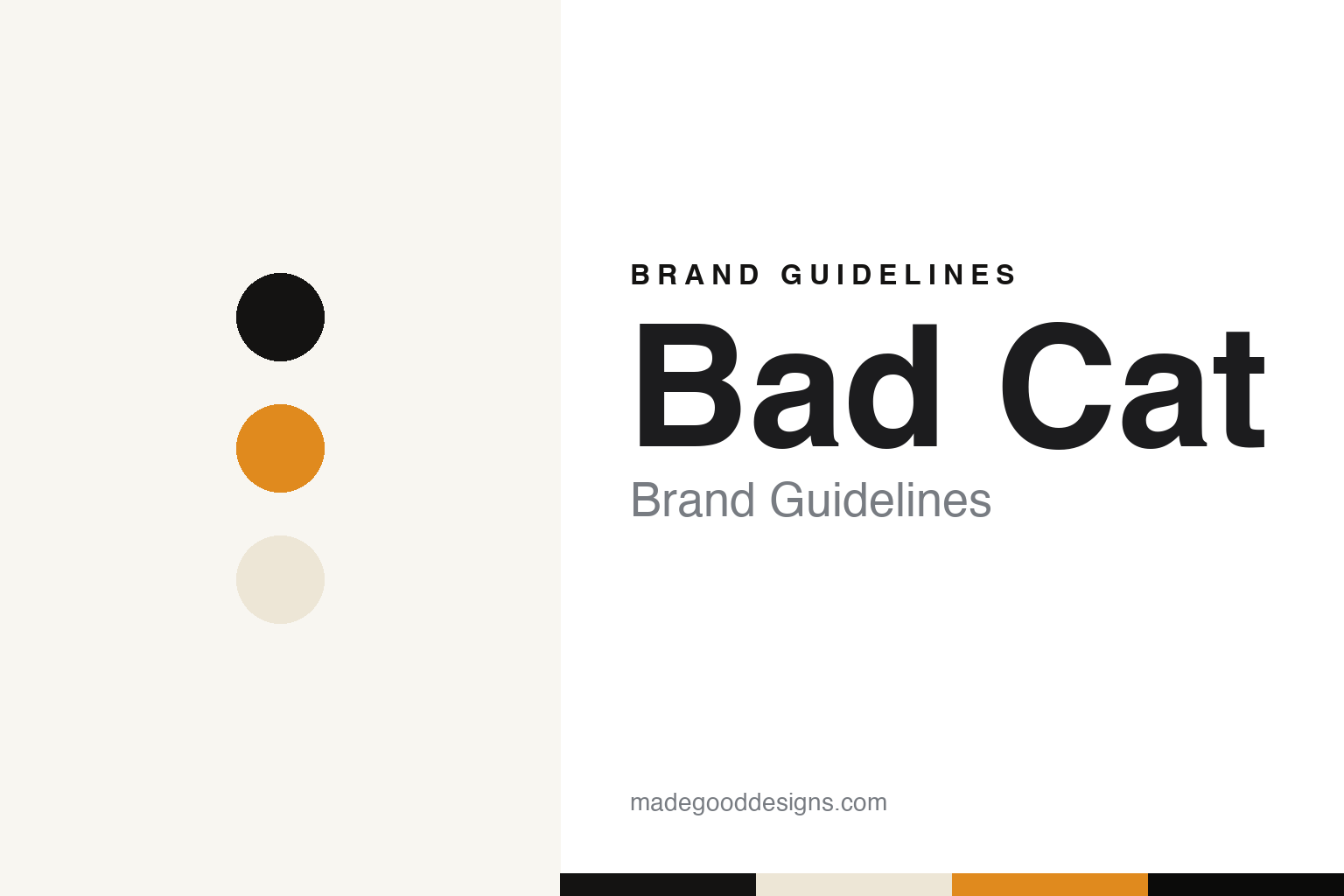
Two constants: a tolex black, cream and amber glow palette and a heavy sans register. Abstract homage — not a Bad Cat product or mark; no amplifier, logo or nameplate is reproduced.
The Main Cat
A custom builder, his wife and the designer of Matchless.
Bad Cat Amplifiers began in Southern California at the turn of the millennium. The company dates itself to 1999 — its website says it has designed and built amplifiers “since 1999,” and Guitar World gave the same year in January 2025 — although the “word from the Main Cat” on its own website, archived between 2009 and 2019, said the company “was founded in 2000.” The earliest archived version of its website, captured in 2001, describes “the Bad Cat Amplifiers Company, of Corona, California.”
That 2001 page is clear about who founded it. James Heidrich, who had built custom guitars and custom amplifiers, “and his wife Debbie founded the Bad Cat Amplifiers Company,” it says; James was the “Main Cat,” buying hard-to-find valve parts and managing production. Heidrich had gone looking for a designer by contacting engineers in the amp industry and interviewing artists, and “all roads seemed to lead to Mark,” the page says.
Mark was Mark Sampson, who with Rick Perrotta had founded Matchless in 1989, Guitar World reported, and whose AC30-inspired amps had helped start the boutique boom. Matchless was then in financial trouble and closed in 1999, English Wikipedia says. The 2001 Bad Cat page named Sampson as its designer, Perrotta — who knew amp construction and was “the guy who gets it done” — as part of the team, and Joe Allrich, a former Fender executive by the company’s account, as head of sales. Sampson later recalled making “the first Bad Cat amp for James Heidrich,” in an interview published by Guitar World in April 2025.
Colour
Class A, a cat theme and a change of owner.
The early amps were sold as Class A valve amplifiers, and the names followed the cat theme: the Hot Cat, the Black Cat, the Cub, the Trem Cat, the Wild Cat and the Lynx all appear in the company’s archived model lists. In 2005 its home page showed Brad Whitford of Aerosmith playing a Hot Cat. By its own count the company had won seven Guitar Player Editors’ Pick awards by about 2010, a figure we give as its claim.
Sampson did not stay long. Guitar World reported that he worked with Bad Cat “from its pre-launch days, before leaving in 2003.”
The company changed hands in 2011. “I walked in the door at Bad Cat in 2011 and bought the company from James Heidrich,” John Thompson told Guitar World. The company’s website announced the change in early 2012 as a merger with Inductors Incorporated, which it described as a designer and manufacturer of magnetic components, in a note signed by Thompson as president of Bad Cat Holdings, LLC; Heidrich, it said, would continue to lead research and development. The business later moved from Corona to Santa Ana and then to Costa Mesa, in Orange County, where its website places it today; the archived pages do not date the moves. By 2013 its website was advertising the amps as “American Made,” with a lifetime warranty.
Under Thompson the range split by price. Guitar World described a lower-priced Player Series II of “hand-crafted (but not hand-wired)” amps alongside a premium Hand Wired series. The company has since added a Lunchbox range — the 20-watt Ocelot of 2025, its first amp with built-in cabinet emulation, developed with Two Notes, Premier Guitar reported — and a Mod Shop series of small production runs. A new 50-watt Hot Cat followed in January 2026.
Typography
Design and documentation.
The boutique amplifier began as a reaction to mass production: small shops building tube amps largely by hand, often by one designer. Two of the makers in this guide date from the late 1980s. Dr. Z was founded in 1988 by Mike Zaite, who built his first amps in Cleveland, Ohio, while working as a medical electronics technician, English Wikipedia says. Fryette began in January 1989 as VHT Amplification, started by Steven Fryette in Studio City, Los Angeles; the company took the Fryette name in 2009, and the VHT name now belongs to a different company.
Two more followed a decade later. Bad Cat was founded in Corona, California, by James and Debbie Heidrich, with Mark Sampson as designer, its 2001 website said; John Thompson told Guitar World he bought it from James Heidrich in 2011, and it now says its amps are designed and built in Costa Mesa. Carr made its first sales in 1998 and has built its amps in Pittsboro, North Carolina, for most of its history, Premier Guitar reported in 2024.
Two are British. Hiwatt goes back to Dave Reeves, who registered his Hylight company in 1966 and later built amps under the Hiwatt name; its UK website is now published by Britampco, a Doncaster company, which says its Original range is still hand-wired to Reeves’s specifications. Victory launched in 2013 with Martin Kidd as chief designer and says its amps are designed and built in England; Guitar.com reported in 2023 that the retailer Lee Anderton is one of nine business partners behind it.
The youngest is Canadian. Revv says it was founded in Winnipeg, Manitoba, in 2014 by two friends, led by its president and designer Dan Trudeau, and that it builds its gear in Canada.
This guide sets out what can be checked about each brand — who founded it, who owns it, and what it says about where its products are made — and marks clearly what rests only on the company’s own word.
Aa
A heavy sans for a backlit cat. (Specimen set in Archivo, a sans STAND-IN; NOT the Bad Cat logo.)
Bad Cat
A lit faceplate whose eyes come on.
For its 25th anniversary Bad Cat went back to its first designer. Thompson told Guitar World that a friend put him in touch with Sampson in 2024, and that he asked him what the Matchless DC-30 would look like with twenty more years of experience behind it. The result, the Era 30, was announced in January 2025 at a starting price of $3,899: a two-channel amplifier with an EF86 valve in one channel, three 12AX7s in the other and four EL84 output valves, hand-wired in Costa Mesa, Guitar World reported. Sampson died soon afterwards; Bad Cat announced his death on its social media channels, Guitar World reported on 3 March 2025. Before his death he had also reworked the Black Cat into a 30-watt Mod Shop edition, the magazine said.
Today the company calls itself “fiercely independent” and “a small company,” and says that “every Bad Cat amplifier is built by hand in Southern California,” from point-to-point wiring to testing; we give that as its claim. Guitar World’s reviewers have described its look: a leather-effect vinyl covering, and an illuminated faceplate logo on which “the eyes of the Bad Cat flash to life” when the standby switch is flicked. On the Ocelot, Premier Guitar noted, orange stripes across the front panel glow when the amp is on. No official typeface or colour code is published.
For a design guide, Bad Cat shows how a playful name and a single lit-up logo can carry a premium product. Compare Matchless, where Mark Sampson’s amps began, and Vox, whose AC30 inspired them. For this guide we use tolex black, panel cream and a glowing amber with a sans, an unofficial interpretation; no product or logo is reproduced.
Explore & save
Keep Bad Cat’s identity on hand — save it to a board in the Made Good inspiration library.
Bad Cat identity set
Pin the Bad Cat tolex black, cream and amber palette and the heavy sans register to your own board.